

By Tony O’Reilly-
Former French President Nicolas Sarkozy has been subjected to death threats less than a day after beginning his five-year prison sentence, immediately placing his security detail under intense scrutiny. Sarkozy, who governed France from 2007 to 2012, was incarcerated on Tuesday following his conviction for criminal conspiracy related to illegal campaign funding from Libya.
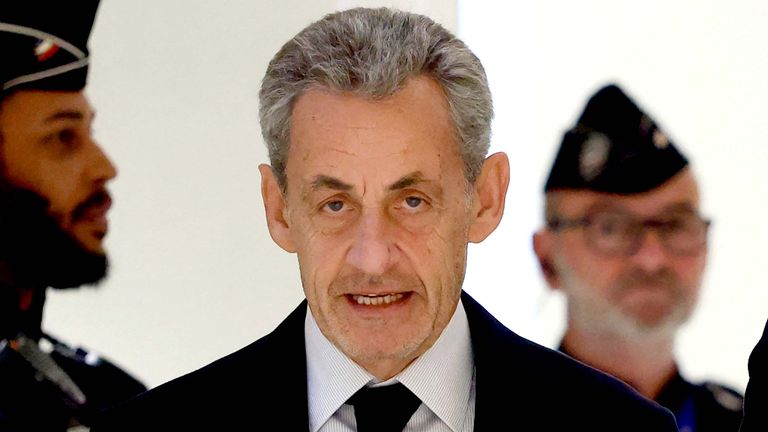
Sarkozy at his trial. Pic Reuters
The seriousness of the situation became public when a video, circulated online and apparently filmed by a fellow inmate, showed verbal threats being directed at the former head of state upon his arrival at Paris’s infamous La Santé prison. This alarming incident dramatically underscores the critical importance of specialized Sarkozy Prison Security arrangements.

AD: Capeesh Restaurant
The Paris prosecutor’s office was alerted to the threatening video yesterday, and an immediate investigation was launched to identify and question those involved. As part of this urgent probe, authorities questioned three inmates and seized two mobile phones during a sweeping search of the facility. The swift judicial response highlights the volatile nature of holding such a high-profile, politically contentious figure within a standard prison environment. News of these direct threats quickly followed reports detailing the extraordinary security measures being taken to protect the former president, confirming the extreme, pre-existing threat assessment.
The gravity of the threat confirms the necessity of the unprecedented security measures put in place for the former president. Reports indicated Sarkozy would be assigned two permanent police officers as bodyguards throughout his time in prison. These officers are stationed in adjacent cells, ensuring continuous, close-proximity protection to guarantee he comes to no physical harm during his detention.
French Interior Minister Laurent Nunez publicly defended the measure, telling Europe 1 radio that Sarkozy is undeniably entitled to this level of protection “because of his status.” He explicitly confirmed the immediate threat, adding, “There is obviously a threat against him, and this protection is being maintained while he is in detention.”

AD: Oysterian Sea Food Restaurant And Bar
These security arrangements, however, have not been without internal controversy. Prison union representatives voiced complaints, arguing they were not adequately informed about Sarkozy’s specialized security detail. Hugo Vitry, a guard at La Santé and head of the local branch of the Force Ouvriere union, stated they had contacted the prison administration and the Ministry of Justice to demand immediate explanations. The need for specialized police bodyguards rather than relying on standard prison guards emphasizes the unique risks associated with the high-profile conviction and the critical nature of maintaining Sarkozy Prison Security.
Sarkozy’s imprisonment for conspiring to raise illegal campaign funds from Libya represents a landmark moment in French judicial history, as he becomes one of only two former presidents of France to be convicted in the modern era. Despite the current circumstances, the former president has consistently denied any wrongdoing, maintaining that the entire case is politically motivated. This denial is being vigorously pursued by his legal team.
His lawyers immediately filed a formal request for early release, pending the outcome of his formal appeals trial. The legal team indicated they expect this request to be reviewed in approximately one month. They expressed hope they could secure his early release, potentially by Christmas, allowing him to serve his sentence outside the general prison population while his case is reviewed. The outcome of this request will determine the future of the unique Sarkozy Prison Security arrangements. If he is released, the threat level changes, potentially removing the need for the costly and controversial in-prison bodyguards. While awaiting the appeal, Sarkozy reportedly took several books with him, including The Count of Monte Cristo, the classic tale of a man wrongfully imprisoned who later takes revenge, suggesting a mindset focused on ultimate vindication.

AD: Heritage And Restaurant Lounge Bar


