
By Ben Kerrigan-
Russia’s latest wave of missile and drone strikes across Ukraine has killed dozens and injured more than a hundred people, but Kyiv is insisting that Moscow is still failing to achieve strategic gains on the battlefield, even as it intensifies its offensive operations.
Ukrainian officials say the scale of Russia’s recent assault underscores desperation rather than dominance, arguing that mounting losses and limited territorial progress point to a shifting balance in the war.

AD: Capeesh Restaurant
The renewed fighting comes amid one of the most intense periods of the conflict in months, with both sides escalating long-range strikes and battlefield operations. While Moscow has continued to frame its campaign as a gradual push forward, Ukrainian commanders and analysts say Russia’s ability to convert firepower into meaningful territorial gains is weakening.
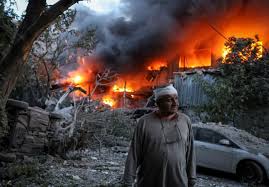
Early Tuesday, Russian forces carried out a sweeping missile and drone barrage across multiple Ukrainian cities, including Kyiv, Dnipro, Kharkiv and other regions. Ukrainian officials reported widespread damage to residential buildings, infrastructure and critical services, with at least 21 people killed and more than 100 injured in the initial assessments. Rescue operations continued throughout the day as emergency crews searched through rubble in heavily affected districts.
The strikes involved dozens of missiles and hundreds of drones, according to Ukrainian authorities, and were described as one of the most extensive coordinated aerial assaults in recent months. Air raid sirens sounded across the country for hours, forcing civilians into shelters as explosions lit up city skylines.

AD: Oysterian Sea Food Restaurant And Bar
Ukrainian President Volodymyr Zelenskyy urged Western partners to accelerate deliveries of air defence systems, warning that existing stockpiles are under severe strain.
Despite the scale of the assault, Ukrainian officials stressed that most incoming threats were intercepted or disrupted by air defence systems, though several projectiles still penetrated defences. Kyiv has repeatedly argued that Russia’s increasing reliance on long-range strikes reflects its difficulties on the front lines, where advances have slowed significantly in recent months.
International observers have also noted the intensity of Russia’s air campaign. According to reporting on the latest wave of strikes, the attack involved coordinated missile and drone salvos that stretched Ukraine’s defensive systems across multiple regions simultaneously, further highlighting the pressure on Kyiv’s air defence network .
Kyiv insists Moscow is “losing on the battlefield” despite pressure
Ukrainian officials have framed Russia’s intensified attacks as evidence of mounting strain rather than battlefield strength. Monitoring data reported by Ukrainian analysis group DeepState and covered from reports indicates that despite a sharp rise in the number of Russian assault operations, Moscow’s territorial gains have slowed significantly, with some reporting even showing periods of net loss in occupied ground.
Analysts cited in the same reporting note that Russian forces have struggled to convert repeated high-intensity offensives into sustained advances, with monthly gains falling to some of their lowest levels since 2024 despite continued pressure along multiple front-line sectors.
This pattern, Ukrainian military observers argue, reflects diminishing returns on Russia’s offensive strategy, as increased troop activity has not translated into proportionate changes in territorial control.
Recent battlefield assessments suggest Russian forces have increased the number of attacks while gaining only minimal ground, with some monitoring groups reporting that Moscow even experienced net territorial losses in certain recent months despite stepping up operations.Ukrainian officials say this indicates that Russia is expending significant manpower and equipment without achieving strategic breakthroughs.
Kyiv also claims that Ukrainian counterstrikes against Russian logistics, ammunition depots and command infrastructure are disrupting Moscow’s ability to sustain its offensive tempo. These operations, combined with defensive resilience along key front-line sectors, are being cited by Ukrainian commanders as factors slowing Russian advances.
At the political level, Ukrainian leaders are using the latest escalation to press their argument that continued Western military assistance is critical to shifting the war’s trajectory. Zelenskyy has repeatedly warned that delays in air defence deliveries could leave Ukrainian cities increasingly vulnerable to massed aerial attacks, even as front-line positions remain comparatively stable.
Meanwhile, Russia has continued to assert that its campaign is progressing according to plan, despite heavy losses and slow territorial gains. Independent defence analysts have long noted that the war has evolved into a prolonged attritional conflict, with both sides suffering significant casualties and neither achieving rapid breakthroughs.
Still, Ukrainian officials insist that the current phase reflects a broader trend: Russia can still launch large-scale strikes, but struggles to translate them into decisive battlefield success.
With one senior Ukrainian military figure recently suggested in broader strategic assessments, the coming months may prove critical in determining whether Ukraine can consolidate defensive gains into a longer-term shift in momentum.
However, the war remains locked in a brutal cycle of escalation, with civilians continuing to bear the brunt of Russia’s expanding aerial campaign even as the front lines move only incrementally. Across Ukraine, air raid alerts have become a near-daily feature of life, forcing families into shelters at night and disrupting essential services during the day.
Cities far from the front lines, once considered relatively safe, have increasingly come under long-range missile and drone attacks, underscoring how the conflict has broadened into a nationwide security crisis rather than one confined to eastern and southern battle zones.
Residential districts, energy infrastructure, and transport hubs have all been repeatedly targeted, with Ukrainian authorities reporting significant damage to power grids and heating systems at various points during the war. These strikes are not only destructive in immediate human terms but also strategically aimed at weakening civilian morale and straining the country’s economic resilience.
Officials in Kyiv have described the pattern as an attempt to exhaust civilian endurance through sustained pressure, particularly during colder months when energy disruptions carry higher risks.
Despite these challenges, Ukraine’s air defence network continues to intercept a large proportion of incoming missiles and drones, limiting the scale of destruction compared with the volume of attacks launched.
However, even partial penetrations of air defences have been enough to cause casualties and widespread damage, particularly when strikes are concentrated on densely populated urban areas. Emergency services remain stretched, responding to overlapping incidents across multiple regions during large-scale barrages.
Conditions along the front lines have changed only gradually. Military analysts describe the conflict as increasingly attritional, where incremental territorial shifts are achieved at high cost and often without decisive breakthroughs.
Neither side has been able to secure rapid operational momentum, leading to prolonged fighting over small areas of land that change hands repeatedly or remain contested for extended periods.
This combination of static front lines and escalating long-range strikes has created a dual-layered war: one fought in trenches and artillery zones in the east, and another waged in the skies over every major Ukrainian city. The result is a persistent sense of instability, where even periods of relative calm can be abruptly broken by overnight attacks.
International observers continue to warn that without a shift in the strategic balance either through enhanced air defence support for Ukraine or changes in Russia’s capacity to sustain its missile and drone production the current pattern is likely to continue.
In the absence of such a change, the war risks settling further into a prolonged stalemate defined less by movement on the map and more by the steady accumulation of destruction behind the front lines.

AD: Heritage And Restaurant Lounge Bar