
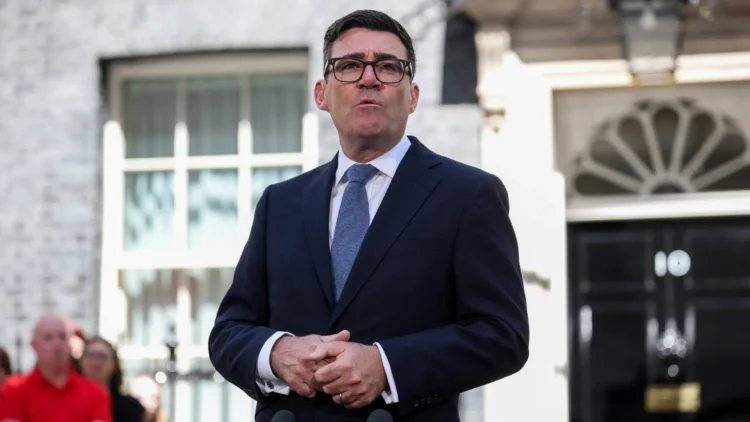
By Ben Kerrigan-
Andy Burnham has wasted little time reshaping the British government, unveiling a dramatically reconfigured Cabinet that places experienced Labour figures in some of the country’s most influential positions.
Among the most notable appointments is Ed Miliband as foreign secretary, while former defence secretary John Healey assumes the role of chancellor in one of the biggest surprises of the new administration. The appointments come only hours after Burnham formally became the United Kingdom’s prime minister following Keir Starmer’s resignation, signaling an immediate shift in both personnel and political priorities.

AD: Capeesh Restaurant
Burnham’s first Cabinet appointments signalled a decisive break with the previous administration, with several senior ministers from Keir Starmer’s government leaving office as the new prime minister assembled his own top team. Speaking outside 10 Downing Street after taking office, Burnham described his leadership as a “circuit breaker” for Britain and pledged to deliver the “biggest changes in 40 years.”
He said his government would pursue a 10-year programme focused on rebuilding industry, tackling the cost-of-living crisis and restoring public confidence, while appointing ministers he believes can help deliver that agenda from the outset. Political observers had widely expected several different outcomes before the official announcements. Speculation had centred on Shabana Mahmood or Ed Miliband becoming chancellor, while questions remained over the future of several senior ministers who had served under Starmer.
Instead, Burnham opted for Healey, whose experience in defence and previous Treasury responsibilities appears to have convinced the new prime minister that he possesses the economic credibility needed during a period of fiscal uncertainty.

AD: Oysterian Sea Food Restaurant And Bar
Healey’s appointment is particularly significant given his recent departure from the Defence Ministry following disagreements over defence spending. He now inherits responsibility for steering Britain’s economy through persistent inflationary pressures, sluggish growth and increasing demands for greater public investment.
His immediate challenge will be balancing Burnham’s promises to invest in housing, transport and regional development while maintaining confidence in the government’s fiscal framework. Meanwhile, Miliband’s move to the Foreign Office marks another high-profile chapter in a political career that has seen him lead the Labour Party, serve as energy secretary and remain one of the party’s most recognisable figures.
His appointment signals that Burnham intends to rely on experienced voices to navigate an increasingly unstable international landscape shaped by the wars in Ukraine and the Middle East, growing tensions with China and the continuing evolution of Britain’s post-Brexit foreign policy.
Burnham also opted for continuity in several areas of government. Shabana Mahmood remains home secretary, allowing ongoing work on immigration and policing reforms to continue without disruption. Louise Haigh was promoted to the influential roles of first secretary of state, minister for the Cabinet Office and chancellor of the Duchy of Lancaster, giving one of Burnham’s closest political allies responsibility for coordinating government across departments.
A Government Built Around Economic Renewal
The composition of Andy Burnham’s first Cabinet reflects the priorities he has outlined for his government, with a focus on economic renewal, strengthening public services and giving greater power to communities outside Westminster. Burnham has repeatedly argued that Britain needs a new approach centred on regional investment, devolution and rebuilding industrial capacity.
His government’s agenda places long-term economic growth and reducing regional inequalities at the heart of its plans, with a commitment to spreading opportunity more evenly across the country. Central to Burnham’s agenda is a commitment to what he describes as the “reindustrialisation” of Britain. His vision includes greater investment in manufacturing, green industries, transport infrastructure and affordable housing.
He has repeatedly argued that economic growth should not be concentrated in London but shared across cities and towns throughout England, Scotland, Wales and Northern Ireland.
Healey will play a pivotal role in translating those ambitions into practical economic policy. His Treasury faces immediate questions over how the government intends to finance increased public investment without undermining financial stability. Analysts expect close scrutiny of future budgets, particularly regarding taxation, borrowing and defence expenditure.
One of Healey’s earliest priorities will likely involve reviewing spending plans inherited from the previous administration while considering Burnham’s commitment to raising defence spending to three per cent of GDP by 2030. Funding that pledge without significantly increasing borrowing presents one of the government’s first major economic tests.
Burnham has indicated that his government will remain committed to responsible fiscal management while making greater use of flexibility within existing borrowing rules to finance long-term investment. That approach reflects an effort to reassure financial markets while distinguishing his administration from both Conservative governments and some of Labour’s previous economic strategies.
The cabinet reshuffle also resulted in the departure of several prominent ministers associated with the Starmer administration. Former Chancellor Rachel Reeves, former Foreign Secretary David Lammy and several other senior figures have left government as Burnham assembles a team more closely aligned with his political priorities.
The scale of the changes underscores the extent to which the new prime minister intends to place his own stamp on government from the outset. Ed Miliband’s appointment as foreign secretary introduces one of the most experienced politicians in modern Labour politics to Britain’s diplomatic leadership at a particularly complex moment for international affairs.
Although Ed Miliband is best known for his previous roles as Labour leader and energy secretary, he now takes charge of Britain’s foreign policy at a time of heightened international uncertainty. As foreign secretary, he will oversee the UK’s diplomatic relationships with key allies and help shape the government’s response to global security challenges.
His appointment comes as Prime Minister Andy Burnham reaffirmed Britain’s commitment to supporting Ukraine and pledged to strengthen the country’s international partnerships as part of his new administration’s foreign policy agenda. Burnham moved quickly to reassure international partners following his appointment as prime minister. Among his earliest conversations was a call with Ukrainian President Volodymyr Zelensky, during which he reaffirmed Britain’s continuing commitment to Ukraine’s defence against Russian aggression.
European leaders have also signalled interest in working closely with the new administration as Britain seeks to deepen cooperation with European partners while maintaining strong transatlantic relationships.
Domestically, Burnham hopes the new Cabinet will project both competence and stability after weeks of political uncertainty surrounding Labour’s leadership transition. His selection of ministers with substantial experience in government indicates his plans to reassure both financial markets and the public that his administration is prepared to govern immediately despite the rapid change in leadership. improvements on living standards, economic growth and public services over the coming months.With Miliband, Healey and the rest of Burnham’s newly assembled team, the honeymoon period is likely to be brief.
The UK government faces mounting pressures ranging from public finances and housing shortages to NHS waiting lists, energy costs and geopolitical instability, besides a judicial system in disarray.

AD: Heritage And Restaurant Lounge Bar