
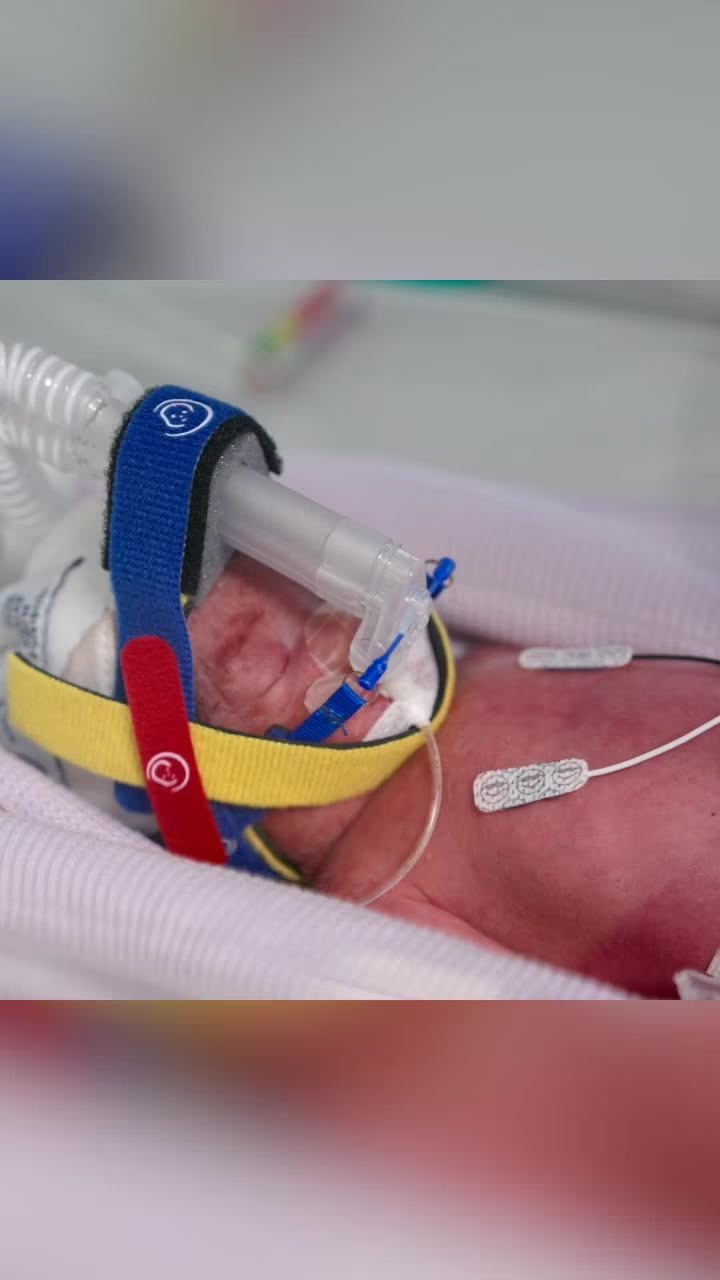
A rare twist of nature has delivered what doctors believe may be one of the most extraordinary births ever recorded in Australia — four genetically identical baby girls, conceived naturally from a single fertilised egg and all sharing the same placenta, a phenomenon so uncommon experts say it may have happened only a handful of times worldwide.
The quadruplets — Emily, Harriet, Alexa and Catherine Na’amoana — were born by caesarean section at 28 weeks and four days at Brisbane’s Royal Brisbane and Women’s Hospital, where an operating theatre filled with around 20 medical specialists assembled for what was expected to be one of the most challenging deliveries of their careers.
For parents Jenitar and Jortham Na’amoana, the arrival of four daughters at once was beyond anything they had imagined. Already raising four children aged between one and 10, the couple had not been planning to expand their family when a routine pregnancy turned into a medical rarity that would capture the attention of obstetricians around the world.

AD: Capeesh Restaurant
While quadruplet pregnancies themselves are exceptionally uncommon, specialists say this case belongs in an altogether different category. Maternal foetal medicine expert Dr Alexa Bendall explained that all four babies developed after a single fertilised egg divided into four embryos — making them monozygotic, or identical, quadruplets. Such pregnancies are estimated to occur in only one in every 15 million pregnancies.
Even more remarkable was the fact that every baby shared the same placenta.

AD: Oysterian Sea Food Restaurant And Bar
“To share the same placenta — this is unheard of,” Dr Bendall said. “We don’t think it’s ever happened in Australia. There may have been a couple of cases elsewhere in the world — and when I say a couple, literally two.”
The shared placenta made the pregnancy extraordinarily dangerous. Blood vessels linking the babies can create life-threatening imbalances in blood flow, while the risks of restricted growth, premature delivery and death rise dramatically for both mother and babies.
“Whenever you have a multiple pregnancy where the babies are sharing a placenta, there’s a very high risk of complications,” Dr Bendall said. “The fact that we’ve got four beautiful healthy babies born at 28 weeks and four days is incredible.”
Doctors monitored Ms Na’amoana from just 10 weeks into the pregnancy, carrying out ultrasound scans every fortnight before admitting her to hospital at 25 weeks after her cervix shortened, significantly increasing the risk of premature labour. Despite the mounting dangers, clinicians said she approached the pregnancy with remarkable composure.
“I was amazed that the conception happened and then we were convinced there would be some complication,” Dr Bendall said. “The fact that they got to 28 weeks well, and well grown, is incredible.”
When delivery day arrived, the hospital mobilised four dedicated neonatal teams, each waiting to care for one newborn as they entered the world. Emily weighed 1,025 grams, Harriet 1,121 grams, Alexa 1,120 grams and Catherine, the largest of the sisters, 1,151 grams.
All four girls are now being cared for in the hospital’s neonatal intensive care unit, where doctors say they are progressing “extremely well”. Although they face several weeks of specialist care before going home, clinicians are optimistic.
“I think long-term their outlook will be really good,” Dr Bendall said.
The family’s extraordinary journey has already left a lasting personal mark on the medical team. In a tribute to the obstetrician who guided the pregnancy, the parents named one of their daughters Alexa.
Dr Bendall, one of fewer than 100 maternal foetal medicine specialists in Australia and only 17 in Queensland, described the gesture as deeply moving and hopes the case will shine a spotlight on a speciality facing significant workforce shortages as senior specialists prepare to retire over the coming years.
Independent obstetrician Dr Gino Pecoraro, who was not involved in the case, said the birth represented an astonishing medical success. While quadruplet pregnancies occur in roughly one in 700,000 pregnancies, naturally conceived identical quadruplets are vastly rarer.
“The fact that they’ve done well and they’re all alive is the big thing,” he said. “Isn’t that fantastic.”
Away from the medical milestones lies the reality of raising eight children.
“Our precious miracles have arrived safely, and while our hearts are overflowing with gratitude, the reality of caring for four newborns at once has brought challenges we never could have imagined,” Ms Na’amoana wrote on the family’s fundraising page.
The couple are seeking help to buy a larger vehicle capable of carrying their expanded family, along with specialist baby equipment and assistance with mounting medical and living costs.
Doctors remain both shocked and enthused that in an age of modern medicine, nature can still produce events so rare that they challenge the boundaries of medical experience. Against daunting odds, four tiny sisters have survived one of the world’s rarest pregnancies — and in doing so have written a new chapter in Australian obstetric history.

AD: Heritage And Restaurant Lounge Bar
-
Share On
- Categories
- Date