
By Isabelle Wilson-
Partisan Stalemate Over Healthcare Leads to Shutdown
The began when the funding authority for many federal agencies expired at 12:01 a.m. on Wednesday, October 1. The resulted from the failure of the Senate to pass a continuing resolution—a stopgap measure intended to keep agencies open—which required 60 votes to overcome a filibuster.

AD: Capeesh Restaurant
Senate Democrats collectively refused to support the measure, demanding that any funding bill address crucial healthcare issues, specifically seeking an extension of Affordable Care Act subsidies and a reversal of deep Medicaid cuts.
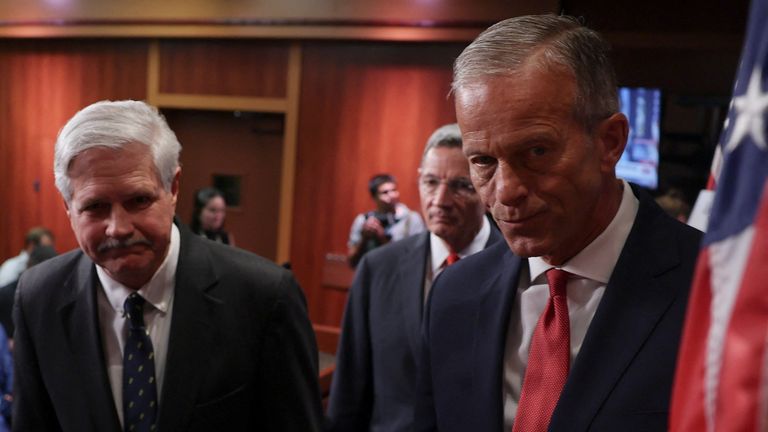
Republican senators blamed the Democrats for not keeping the government open. Pic: Reuters
This represents a high-stakes legislative battle where the minority party utilised its leverage to force negotiations on policy matters.
Republicans, who control both the House and the Senate, staunchly insisted that healthcare policy debates should be entirely separate from keeping the government fiscally operational.

AD: Oysterian Sea Food Restaurant And Bar
The core of the dispute involves millions of Americans who purchase health insurance through the Affordable Care Act marketplaces and face dramatically higher premium costs as expanded subsidies are set to expire.
Democrats have clearly stated their refusal to endorse a partisan spending bill that they believe compromises the healthcare security of ordinary Americans.
Senate Majority Leader John Thune immediately blamed “far-left” Democrats for the closure, while Senate Minority Leader Chuck Schumer charged Republicans with plunging the nation into a shutdown and risking Americans’ healthcare.
The bitter stalemate comes despite weeks of back-and-forth negotiations, including a final meeting between the President and congressional leaders that unfortunately failed to yield an agreement.
Background of Shutdowns and the Trump Layoff Threat
A federal government shutdown occurs when the Congress fails to approve a funding bill for the new fiscal year by the constitutional deadline of October 1. Without a spending bill, federal agencies can no longer spend money on non-essential work and must halt most operations until a new law is enacted.
The history of government shutdowns dates back to the 1970s, with a significant change in impact following legal opinions in the early 1980s that enforced the actual cessation of government work.
The last major shutdown, which was also the longest in US history, occurred during President Donald Trump’s first term, lasting a total of 35 days from December 2018 into January 2019. That prolonged closure was triggered by President Trump’s firm demand for billions of dollars to fund his proposed wall along the US-Mexico border.
In a significant escalation of political tactics this time, the White House’s Office of Management and Budget (OMB) has instructed agencies to prepare for mass layoffs, or a “reduction in force,” for programs deemed inconsistent with the President’s priorities. This controversial threat is a departure from historical precedent, where workers were typically furloughed but guaranteed back pay once the shutdown concluded.
Federal workers’ unions have already filed a lawsuit challenging the legality of this layoff threat, which introduces an element of long-term job insecurity and permanent upheaval into the federal workforce.
Immediate Impact and the Uncertain Path Forward
The most immediate consequence of the is the furloughing of an estimated 750,000 non-essential federal employees, leaving them without pay for the duration.
Essential personnel, including military service members, air traffic controllers, and agents in law enforcement like the FBI and border patrol, must continue working without immediate compensation.
Crucial services that operate through mandatory funding, such as Social Security and Medicare payments, will generally continue uninterrupted.
However, services like national parks, Smithsonian museums, and certain processing functions within agencies will either close entirely or see severe delays.
The duration of the remains unpredictable, as both sides appear entrenched in their positions.
Republicans in the Senate have vowed to continue forcing votes on their short-term funding measure, hoping to fracture the Democratic resistance.
Conversely, Democrats are holding firm on their healthcare policy demands, viewing the funding bill as their best and perhaps only chance for a legislative victory on the issue.
Experts warn that a prolonged closure will inevitably slow economic growth, erode market confidence, and diminish public trust in the government’s ability to function.
Ultimately, the resolution will require one party, or a small bipartisan group, to concede, a political outcome that currently seems far from reach.

AD: Heritage And Restaurant Lounge Bar


