

By Isabelle Wilson-
The United States Senate delivered a glimmer of hope to a nation paralyzed by political gridlock, reaching a crucial agreement late Sunday night aimed at finalizing the Record-Long US Shutdown Deal.
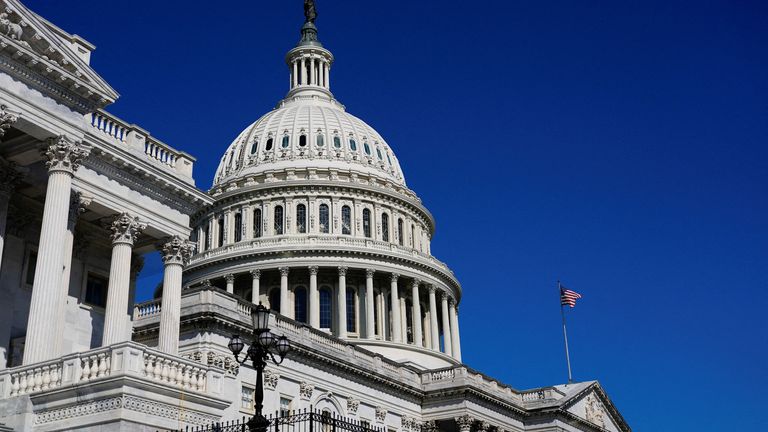
US Capitol. Pic: Reuters
This breakthrough came in the form of a procedural vote that saw senators advance a House-approved bill. That legislation will now undergo vital amendments designed to fund the federal government through January 30th of the following year. This development is widely viewed as the first genuine, tangible sign of progress towards resolving the crisis, which has disrupted the lives of millions of American citizens since it commenced on October 1st.

AD: Capeesh Restaurant
The crucial procedural vote passed by a 60-40 margin, representing the minimum number required to successfully overcome a Senate filibuster. The filibuster, a powerful procedural tool, empowers the minority party to delay or even completely block a piece of legislation they oppose. Achieving this difficult supermajority demonstrated an unusual degree of bipartisan cooperation, necessary to circumvent the highly divisive political atmosphere.
Prior to the vote, US President Donald Trump confidently told reporters at the White House: “It looks like we’re getting very close to the shutdown ending.” Securing this initial victory requires sustained effort; consequently, policymakers immediately began turning their attention to the remaining legislative obstacles.
A small group of Democrats, who openly rebuffed their own party’s leadership, played a pivotal role, teaming up with Republicans to construct the fragile, preliminary agreement. This necessary compromise established a pathway to negotiate further critical funding details immediately. Achieving this Record-Long US Shutdown Deal depends entirely upon maintaining this delicate political balance throughout the final stages.

AD: Oysterian Sea Food Restaurant And Bar
The longest government shutdown in American history was initially triggered by politicians failing to pass essential funding bills due to a fierce political stand-off concerning healthcare spending. Democrats and Republicans remained bitterly divided over the continuation and extension of subsidies provided under the Affordable Care Act (ACA). The compromise that ultimately facilitated the Record-Long US Shutdown Deal included a key provision addressing this deep-seated ideological disagreement. This pivotal agreement established plans for a vote to be held in December on extending the popular subsidies under the ACA, essentially punting the contentious issue down the road but allowing government funding to resume immediately.
Furthermore, the emerging legislation includes a significant win for federal worker unions and their strong allies in Congress. The bill contains specific language that would prohibit federal agencies from firing any employees until the new funding deadline of January 30th. This protective measure takes on added significance considering President Trump’s recent, extensive efforts to downsize the federal workforce.
Officials previously estimated that at least 300,000 employees were expected to leave government service by the end of this current year alone due to Mr. Trump’s aggressive reform initiatives. Therefore, ensuring job security, even temporarily, provided essential leverage for the Democrats who crossed the aisle to support the compromise. The bipartisan agreement demonstrated that common ground could be found when facing catastrophic financial deadlines, even amidst deeply entrenched differences over national policies. Successful implementation of the Record-Long US Shutdown Deal rests upon all parties adhering to these complex, negotiated terms.
The shutdown, the first experienced in almost seven years, has caused unprecedented levels of disruption across the American economy and society. When the federal government runs out of money, all non-essential functions are immediately frozen, impacting various crucial aspects of daily life. This freezing of operations affects everything from the processing of certain aspects of social security claims to severely disrupting air travel regulations and completely closing access to national parks. Millions of individuals rely upon continuous government functions for their well-being, meaning the impact quickly spirals beyond mere inconvenience. Consequently, the lack of federal funding forced hundreds of thousands of federal workers to go without pay, creating significant financial hardship for their families across the nation.
Federal agencies must rely entirely on funding being approved by Congress, which allows the President to sign the necessary budget legislation for the fiscal year ahead. When politicians cannot approve this essential funding, typically because of political differences that are particularly sharp in America’s bitterly divided system, those agencies are instantly forced to shut down operations.
Essential personnel, such as air traffic controllers and border patrol agents, are required to continue working without receiving pay, while hundreds of thousands of others face mandatory unpaid leave. This severe disruption does not just impact the workers themselves; consequently, entire local economies surrounding federal installations suffer greatly. Economists have noted that the cumulative loss in productivity and wages from this Record-Long US Shutdown Deal fallout places significant drag on the nation’s overall economic health. Restoring the continuity of federal services remains critical to stabilizing the financial concerns faced by countless Americans.
Despite the significant momentum gained in the Senate, the Record-Long US Shutdown Deal must still clear several formidable legislative hurdles before it becomes law. The successful procedural vote in the Senate only advances the bill; the full chamber must still pass the amended measure, which is widely expected to occur quickly. However, the legislation must then return to the House of Representatives, where approval is far less certain given the complex, shifting partisan dynamics within that chamber. Historically, the House has proven to be a less predictable environment for compromise legislation, often dominated by the more ideologically rigid wings of both parties.
If the bill successfully navigates the House of Representatives, it must then be formally sent to US President Donald Trump for his final signature. Although President Trump expressed optimism about the shutdown ending before the Senate vote, his willingness to sign the specific, amended funding bill remains the ultimate test. His sign-off is non-negotiable for the funding to take effect and for the government to fully reopen its doors.
The current deal only funds the government until January 30th, meaning Congress and the White House will face a compressed timetable to negotiate a comprehensive, long-term fiscal plan immediately after the government reopens. Failure to pass a longer-term budget solution by that mid-winter deadline could potentially trigger another debilitating funding crisis. You can review the official process for federal appropriations and government funding on the Government Accountability Office website. Securing this temporary Record-Long US Shutdown Deal is a victory, yet the real work of legislative compromise still lies ahead.

AD: Heritage And Restaurant Lounge Bar


