
By Tim Parsons-
The governing body for football in the Republic of Ireland, the Football Association of Ireland (FAI), has taken a decisive political stance, voting overwhelmingly to formally petition UEFA for the suspension of Israel from European competitions.
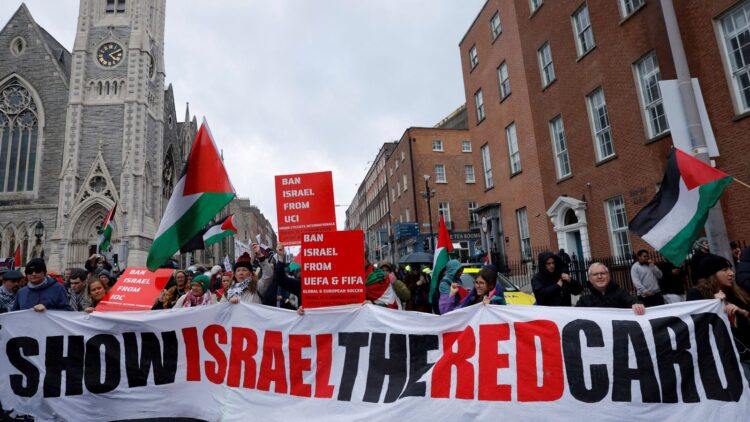
Protesters march in Dublin in support of Palestinians in October. Pic: Reuters
Members of the FAI cast their ballots on Saturday, carrying the resolution by a significant margin of 74 votes to seven, with two abstentions recorded. This official mandate now compels the FAI to submit a formal resolution to European football’s governing body, UEFA, demanding the ban based on serious allegations of rule violations. This powerful institutional vote dramatically intensifies the international movement aiming for the FAI UEFA Israel Ban, placing the decision squarely in UEFA’s jurisdiction.

AD: Capeesh Restaurant
The motion was initially proposed by Bohemian FC, one of Ireland’s leading clubs, reflecting a groundswell of support within the Irish football community. In a subsequent statement, the FAI clearly articulated the specific grounds for its unprecedented action against the Israeli Football Association (IFA).
The FAI asserts the IFA has allegedly failed in its obligation to implement and enforce an effective anti-racism policy across its domestic competitions. Furthermore, the resolution focuses heavily on the controversy surrounding Israeli clubs playing matches within illegal settlements located in the occupied West Bank. Such activities are deemed a direct violation of international law and, crucially, conducted without the necessary consent of the Palestinian Football Association (PFA).
This direct challenge to the IFA’s practices forces UEFA to address long-standing issues that many argue violate its own statutes against political discrimination and territorial disputes. The potential imposition of an FAI UEFA Israel Ban marks a critical junction for European sports governance and geopolitical involvement.

AD: Oysterian Sea Food Restaurant And Bar
The FAI’s action aligns closely with similar, recent calls for Israel’s suspension from international football, notably echoing motions proposed in September by the football bosses of both Turkey and Norway. These calls gained significant momentum following the release of a commission report established by a United Nations investigation.
The commission’s findings accused Israel of committing the international crime of genocide during the intense war in Gaza, demanding both UEFA and FIFA, the sport’s global governing body, suspend Israel from all international competitions. Israel vehemently rejected these accusations, with the country’s foreign ministry calling the UN report “distorted and false,” adding that it “categorically rejects” the findings. The diplomatic tension surrounding the proposed FAI UEFA Israel Ban reflects the deep divisions created by the ongoing military conflict, which was triggered by the Hamas attack on Israel on 7 October 2023.
Earlier discussions regarding a potential UEFA ban had been underway, but those talks were temporarily paused after a US-brokered ceasefire took effect on 10 October 2025. Introducing a ban now would undoubtedly place UEFA on a collision course with the powerful US government, which stands as Israel’s most significant global supporter and is also a co-host of next year’s FIFA World Cup alongside Canada and Mexico.
Senior US Republican politician Lindsey Graham sharply criticized the FAI for holding the vote, delivering a thinly veiled economic threat. Graham stated on Friday that he would use every tool at his disposal to “make those who participate in this effort to marginalise Israel in sports, and elsewhere, pay a heavy price when it comes to access to the American economy.” The threat of economic damage underscores the seriousness of the FAI’s political challenge.
The outcome of the FAI’s resolution presents a significant regulatory dilemma for UEFA, forcing a confrontation between political neutrality and moral obligation. If UEFA does implement a suspension, it would immediately prevent Israel from participating in all UEFA-organized events, including the Champions League, Europa League, and European Championship qualifiers.
However, such a ban might not automatically affect Israel’s participation in World Cup qualifiers, which fall under the direct authority of FIFA, the global football governing body. This distinction highlights the fragmented nature of international sports governance in the face of geopolitical conflict. UEFA maintains strict rules against political interference but also has mandates regarding human rights and anti-discrimination, making the balance precarious.
The Irish government has already established itself as one of the European Union’s most outspoken critics of Israel’s sustained offensive in Gaza. The political pressure from US Congress members regarding Ireland’s plans to restrict trade with Israeli settlements in occupied Palestinian territories already existed before this footballing resolution.
The FAI’s vote provides a highly visible, non-governmental platform for this criticism, adding another layer of complexity to the already strained diplomatic relationship between Dublin and Washington. Meanwhile, the Gaza health ministry, which is run by Hamas and does not distinguish between combatants and civilians in its count, reports that Israel’s retaliatory offensive has killed more than 69,000 Palestinians. The initial Hamas attack resulted in the deaths of approximately 1,200 people and the taking of 251 hostages.
The resolution for the FAI UEFA Israel Ban transforms an economic and political conflict into a sporting one, ensuring that the war’s human cost continues to challenge global institutions. Interested parties can review UEFA’s official statutes regarding member associations and their compliance with ethical standards on the UEFA Governance and Regulations website.

AD: Heritage And Restaurant Lounge Bar
