
By Ben Kerrigan-
A 10-day ceasefire between Israel and Lebanon has officially come into effect, marking a significant if tentative pause in weeks of escalating violence that has left thousands dead and displaced across southern Lebanon.
The truce, brokered through intensive U.S.-led diplomacy, began on Thursday and is being viewed as a critical test of whether a broader de-escalation in the Middle East, including tensions involving Iran, can be achieved.

AD: Capeesh Restaurant
The agreement, announced by U.S. President Donald Trump following direct conversations with Israeli Prime Minister Benjamin Netanyahu and Lebanese President Joseph Aoun, halts Israeli offensive operations in Lebanon while placing responsibility on Lebanese authorities to prevent further attacks from armed groups such as Hezbollah.
The ceasefire formally came into force at 5 p.m. Eastern Time, with both sides agreeing to engage in further negotiations aimed at establishing a longer-term peace framework.
Initial scenes from Beirut reflected a mix of relief and uncertainty, with celebratory gunfire reported in parts of the city as residents reacted to the sudden halt in hostilities after weeks of near-daily airstrikes and rocket fire.

AD: Oysterian Sea Food Restaurant And Bar
Beneath the cautious optimism lies deep scepticism among analysts and residents alike, given the fragile nature of previous ceasefires in the region and the unresolved tensions that continue to underpin the conflict.
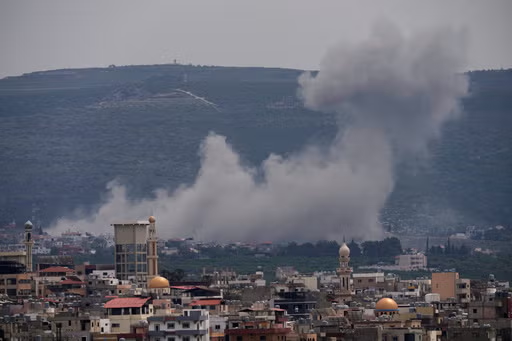
The truce follows a particularly intense phase of fighting that saw Israeli airstrikes target infrastructure across Lebanon, including residential areas and key facilities, in response to Hezbollah rocket attacks. According to reports, more than 2,000 people have been killed in Lebanon since the conflict escalated in early March, with over a million displaced from their homes.
The scale of destruction has prompted urgent calls for humanitarian assistance and heightened international pressure for a cessation of hostilities. The ceasefire represents the most significant diplomatic breakthrough between Israel and Lebanon in decades, with negotiations facilitated by the United States and involving a rare level of direct engagement between the two sides.
Officials have described the agreement as a stepping stone toward a more comprehensive peace deal, though its success will depend heavily on compliance during the 10-day window.
Under the terms outlined by U.S. officials, Israel has agreed to halt offensive military operations in Lebanon while retaining the right to act in self-defence if attacked, a provision explicitly detailed in the published text of the agreement, which also emphasises that both sides must avoid further escalation.
Lebanon, for its part, has committed to asserting state authority over its territory and preventing non-state actors, including Hezbollah, from launching attacks across the border, placing responsibility on the Lebanese government to maintain stability during the truce.
The agreement further establishes a framework for continued diplomacy, stating that both countries will engage in “good-faith direct negotiations” aimed at resolving longstanding disputes, including border demarcation and broader long-term security arrangements, as part of efforts to move toward a more durable peace.
However, key challenges remain unresolved. Hezbollah, the Iranian-backed militant group at the center of the conflict, was not directly involved in the negotiations and has issued cautious statements suggesting that its compliance depends on Israel fully halting its operations and withdrawing forces from Lebanese territory. This ambiguity has raised concerns among observers that the ceasefire could unravel quickly if either side perceives a violation.
Despite these uncertainties, international leaders have welcomed the agreement as a necessary pause in a rapidly escalating regional crisis. European Commission President Ursula von der Leyen described the ceasefire as an important step toward reducing civilian suffering and creating space for diplomacy, while emphasizsng the need for both sides to adhere strictly to its terms.
The ceasefire is also closely tied to broader geopolitical dynamics, particularly the ongoing tensions between the United States and Iran. Analysts note that the Israel-Lebanon conflict has effectively functioned as a secondary front in a wider regional confrontation, with Hezbollah acting as a key proxy for Iranian interests.
While progress in maintaining the ceasefire, could influence parallel diplomatic efforts aimed at stabilising relations between Washington and Tehran.
A fragile pause amid deep-rooted conflict
While the ceasefire offers a temporary reprieve from violence, it does little to resolve the underlying issues that have driven the conflict. The Israel-Hezbollah confrontation is rooted in decades of hostility, territorial disputes, and competing regional alliances, making any lasting resolution inherently complex.
In the final hours before the ceasefire took effect, violence continued, with reports of intensified rocket fire from Lebanon and a surge in Israeli airstrikes targeting Hezbollah positions, as attacks persisted up to the deadline and Israeli forces struck launch sites in response.
Such last-minute escalations are not uncommon in ceasefire scenarios, as both sides seek to secure strategic advantages or respond to final provocations before hostilities pause, a pattern seen repeatedly throughout the conflict in the days leading up to the agreement.
However, the continuation of strikes and rocket launches even as the truce approached underscores the volatility of the situation and highlights how quickly tensions can reignite, raising concerns among analysts that the ceasefire could remain fragile despite the temporary halt in fighting.
With civilians on both sides of the border, the ceasefire provides a crucial opportunity to assess damage, access humanitarian aid, and begin the process of recovery. In Lebanon, entire neighbourhoods have been reduced to rubble, while in northern Israel, communities have faced repeated rocket attacks and mass evacuations.
Aid organisations have warned that the humanitarian situation remains dire, particularly for displaced populations lacking access to basic services.
The next few days will be critical in determining whether the ceasefire can hold and potentially be extended. U.S. officials have indicated that the agreement could be prolonged by mutual consent, depending on progress in negotiations and adherence to its terms. Yet the history of similar agreements in the region suggests that maintaining momentum will be challenging.
Political pressures within both Israel and Lebanon may also complicate efforts to sustain the truce. In Israel, leaders face domestic expectations to ensure security and neutralise threats from Hezbollah, while in Lebanon, the government must navigate internal divisions and limited control over armed groups operating within its borders.
As diplomatic efforts continue out of public view, attention now turns to whether this 10-day pause can lead to something more lasting, or whether it will ultimately become another short-lived arrangement in a region where many similar efforts have struggled to hold.

AD: Heritage And Restaurant Lounge Bar