
By Gabriel Princewill-
A political and legal battle over proposed reforms to jury trials has intensified as the government continues to defend its Courts and Tribunals Bill against a series of amendments aimed at weakening or delaying its key provisions.
The legislation, designed as part of wider efforts to reduce the backlog in the Crown Court system, has become one of the most closely scrutinised justice reforms in recent years. At its core are proposals that would restrict the right of defendants to opt for jury trials in certain cases and limit objections to venue decisions—changes ministers argue are necessary to improve efficiency in a court system under sustained pressure.

AD: Capeesh Restaurant
Opposition MPs and legal campaigners have warned that the reforms mark a significant shift in longstanding principles of jury trial rights in England and Wales. Critics argue that the changes risk eroding a fundamental safeguard in the criminal justice system, while supporters say they are a pragmatic response to growing delays that have left thousands of cases waiting years for trial.
The Public Bill Committee examining the legislation met twice this week to go through the proposals line by line, with MPs debating a series of amendments tabled by opponents of the reforms.
So far, the UK government has succeeded in retaining the central provisions of the bill. Clauses removing the right to elect a jury trial and the right to object to Crown Court venue arrangements were upheld after nine committee members voted in favour of keeping them in their current form, with six voting against.

AD: Oysterian Sea Food Restaurant And Bar
The vote represents an early procedural win for ministers, but the broader legislative path remains uncertain as further contentious amendments are still to be considered.
Legal Objections And Political Resistance
Among the most significant outstanding amendments is a proposal that would prevent the reforms from applying to cases already awaiting trial. The amendment has been tabled amid concerns that applying the new rules to existing cases could amount to a retrospective change in procedure for defendants already in the system.
Courts minister Sarah Sackman urged MPs to reject the amendment when it comes to a vote, arguing that the bill’s approach is consistent with established legal practice. She said that cases would not be returned from the Crown Court to magistrates’ courts where defendants had already elected trial in the higher court system.
Sackman said the application of procedural changes to ongoing cases is not unusual in the justice system and pointed to precedent, including judge-only trials introduced under the Criminal Justice Act 2003 in cases involving jury tampering.
Her comments reflect the government’s broader position that the reforms are procedural rather than substantive, and therefore appropriate for application to existing case loads. That argument is expected to remain a central point of contention as the bill progresses.
Opponents, however, argue that even procedural changes can have significant effects on defendants’ rights, particularly when they alter access to jury trials, which are widely regarded as a cornerstone of the criminal justice system in England and Wales.
One of the vocal critics of vocal critics of the proposed reforms is experienced barrister, Joseph Monson, who has actively criticised Justice Minister, David Lammy and even Sir Brian Leveson for adding the weight of his name to the reforms.
Monson told The Eye Of Media.Com: ‘As an experienced judge, Brian Leveson should have known better. His report contains some measures that are innovative, some that are clearly overdue, and some that are simply not necessary. However, these measures will be forgotten in time, unlike the assault on jury trials, which if happens, will represent a crime with which history will associate his name more than any of the cases he oversaw as a judge’ .
Several legal experts have decried the plans being orchestrated by a government based on the failings of its successive predecessors in adequately funding the criminal justice system.
The debate has taken on added significance given the scale o.f the Crown Court backlog, which has reached record levels in recent years following pandemic-related disruption and ongoing capacity pressures. While successive governments have pledged to address delays, the question of how far reform should go has become increasingly politically charged.
Attention is now also turning to a separate but highly significant amendment relating to the creation of specialist courts for sexual offences and domestic abuse cases. The proposal, tabled by Labour MPs Charlotte Nichols and Stella Creasy, would establish dedicated court structures aimed at improving the handling of sensitive and complex cases.
The amendment reflects a manifesto commitment made by Labour, and its inclusion in the bill has created internal pressure within the party. Some MPs backing the proposal argue that specialist courts, combined with broader efficiency measures in the Crown Court system, could reduce the need for restrictions on jury trials in the first place.
Whilst advocates of specialist courts argue that the move could improve consistency in handling trauma-related evidence, reduce delays in scheduling, and provide better-informed judicial management of complex cases, critics outrightly dismiss the plans as a detraction from the proper working of coherent judicial system.
Similar models have been explored in other jurisdictions, although their structure and effectiveness vary widely. The government has yet to formally debate or vote on the amendment, but it is expected to b
The bill passed its second reading in the House of Commons by 304 votes to 203, but the absence of about 93 Labour MPs from the recorded vote has left questions about the level of internal party cohesion on aspects of the legislation.
While the government retains a working majority, the scale of abstentions has added uncertainty to the committee stage, particularly if MPs who did not vote at second reading choose to oppose the bill later in its passage through Parliament.
Only two further days of detailed line-by-line scrutiny remain in the Commons—next Tuesday and Thursday—before the bill returns to the chamber for its third reading. That stage will determine whether the legislation proceeds to the House of Lords with its core provisions intact or whether it is weakened by successful amendments.
Parliamentary arithmetic will become increasingly important as the bill advances. Even small shifts in voting patterns could influence whether contentious clauses remain unchanged or are modified in response to backbench pressure.
Lords Scrutiny And Constitutional Questions
If the bill clears the Commons, it will face further scrutiny in the House of Lords, where opposition to the jury trial reforms is expected to be more pronounced. Peers have historically taken a more cautious approach to changes affecting criminal procedure and defendants’ rights, particularly where reforms are framed as administrative rather than substantive.
While the Parliament Acts allow legislation to be passed without Lords consent under certain conditions, constitutional convention generally limits their use to measures that are clearly part of a government’s manifesto commitments. The government is likely to argue that the Courts and Tribunals Bill falls within that scope, but critics may challenge that interpretation depending on how the bill evolves through amendment.
That constitutional backdrop adds another layer of complexity to an already contentious piece of legislation, with questions not only about policy but also about the balance of power between the elected Commons and the revising chamber.
At the heart of the dispute is a longstanding tension in the justice system between efficiency and principle. Ministers argue that without reform, delays in the Crown Court will continue to grow, undermining public confidence and leaving victims and defendants waiting years for resolution.
Opponents counter that reducing access to jury trials risks weakening a fundamental safeguard and shifting too much authority into administrative or judicial discretion. They argue that backlog pressures should be addressed through investment and system capacity rather than structural changes to trial rights.
The government’s position rests on the argument that procedural reform is necessary to restore functionality to a system under strain. Critics maintain that efficiency gains achieved through limiting jury trials may come at too high a constitutional cost.
That divide is unlikely to narrow as the bill progresses. Instead, it is expected to sharpen as MPs and peers confront the practical implications of the reforms alongside their broader legal and constitutional consequences.
Bill May Define Direction Of Justice Reform
With only limited time remaining in committee stage, the next week of parliamentary scrutiny is likely to prove decisive in shaping the final form of the legislation. The outcome will determine not only the fate of specific amendments but also the direction of travel for criminal justice reform more broadly.
Legal professionals and campaigners are intently observing whether the government will succeed in preserving its core proposals, or will be forced into concessions under parliamentary pressure, will be closely watched by legal professionals, campaigners and policymakers alike.
The debate over jury trial reform has moved beyond technical adjustment. It has become a wider question about how far the justice system should be reshaped in response to pressure, and where the boundaries of reform should ultimately lie.
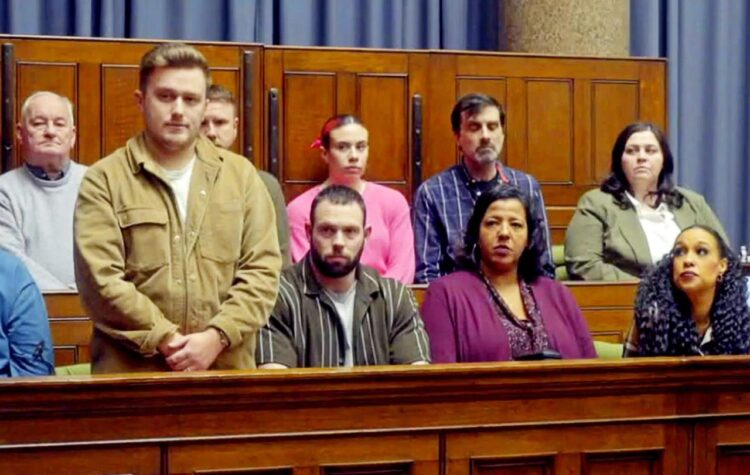
Image: Channel 4

AD: Heritage And Restaurant Lounge Bar