

By Sammy Jones-
The controversy surrounding the decision to ban Maccabi Tel Aviv supporters from attending their Europa League match against Aston Villa has escalated to the highest levels of the UK government. Cabinet ministers are now urgently working to secure additional police and security resources, hoping to overturn the blanket prohibition and ensure fans of both teams can attend the European clash next month. This intervention follows immediate political backlash against the ban, which critics denounced as a shameful capitulation to threats.
The current Energy Secretary, Ed Miliband, confirmed the government is actively “working with the relevant authorities” to mobilise the necessary resources. He stressed the importance of ensuring the Aston area of Birmingham could not become a “no-go area” for Jewish people, directly confronting the narrative that led to the original security ruling.
The ban was issued by Birmingham’s Safety Advisory Group (SAG), a multi-agency body, after West Midlands Police classified the fixture as “high risk,” citing violence at a previous Maccabi match in Amsterdam and current intelligence. The police are now expected to set out early next week exactly what additional support they would require to police the game safely with both sets of fans present. This high-level political involvement underscores the gravity of the Maccabi Tel Aviv fan security issue, which has now become a deeply sensitive matter of public policy and anti-discrimination.

AD: Capeesh Restaurant
The pressure on Maccabi Tel Aviv fan security concerns intensified following a dramatic and violent incident domestically. The fiercely contested Tel Aviv football derby between rivals Hapoel and Maccabi was abruptly cancelled after severe “violent riots,” according to Israeli police reports. The game, for which Hapoel was the home team at the shared Bloomfield Stadium, saw nine people arrested late Sunday night.
Police issued a statement confirming the game was called off “following disturbances and violent riots” where pyrotechnic devices injured thirteen civilians and three officers. Authorities emphasised that these were “very serious incidents that posed a real danger to the lives of police officers and civilians.”
A profoundly different account of the violence came directly from Hapoel Tel Aviv Football Club. The club released a powerful statement claiming that the majority of injuries were caused by “brutal police violence” at the end of the game, arguing this was a direct result of the “scandalous decision to cancel the event.” The Hapoel spokesperson asserted, “Everyone saw the disturbing videos of children being trampled by horses and police officers indiscriminately beating fans.”

AD: Oysterian Sea Food Restaurant And Bar
They further alleged that police had prepared for “war rather than a sporting event.” This stark contradiction between the official police report and the club’s statement highlights the acute political and security tensions surrounding major football fixtures in Israel, which directly influences international perception and subsequent security decisions regarding Maccabi Tel Aviv fan security abroad.
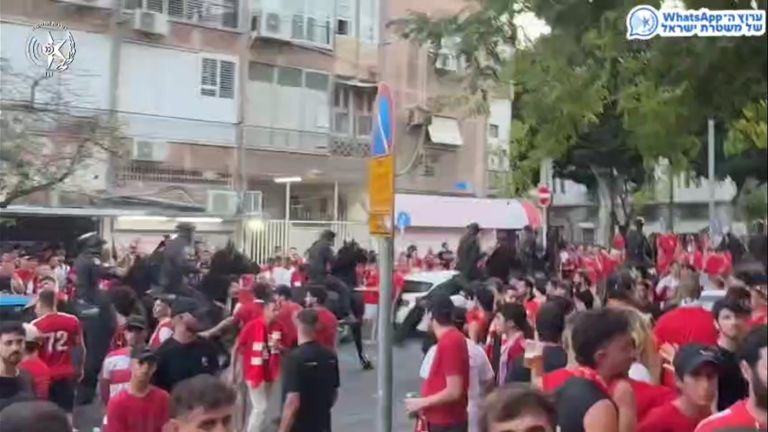
Outside the stadium, mounted police attempt to control crowds. Pic: Israeli police
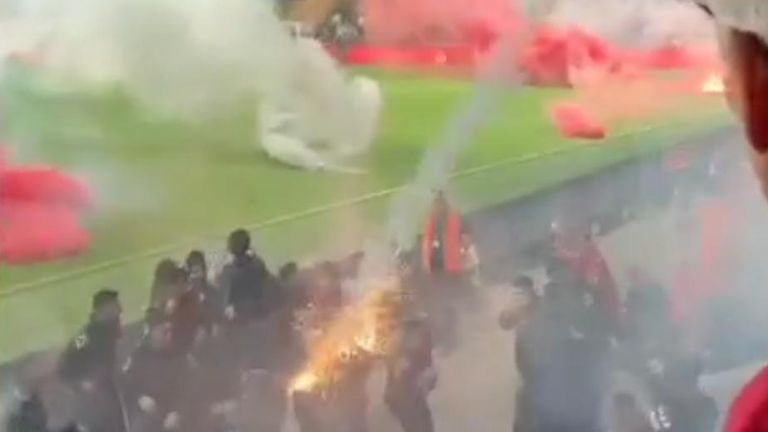
Footage released by Israeli police shows a flare or firework landing near officers. Pic: Israeli police

What looked like smoke canisters were seized by officers. Pic: Israeli police
The UK’s political debate intensified with reactions to a petition calling for the ban, launched by Ayoub Khan, the independent MP for Birmingham Perry Barr. Mr Miliband stated he “profoundly” disagreed with the “approach” taken by the local MP, dismissing the idea that a predominantly Muslim area could not safely host Maccabi Tel Aviv fans. His Tory counterpart, Claire Coutinho, was even more critical, suggesting politicians must have the courage to name the problem, specifically referencing “political Islam.”
Mr Khan defended his petition, saying he “utterly rejects the false and inflammatory characterisations” regarding his motives. He insisted the petition reflected genuine and widespread concern from his constituents solely about public safety and community cohesion, not religion or ethnicity. This heated public exchange has made the Aston Villa fixture a lightning rod for wider debates on antisemitism, Islamophobia, and political expression.
The volatile nature of the Tel Aviv derby, which necessitated the latest police deployment, offers critical context. The rivalry between Hapoel (historically aligned with the political left and the Histadrut Labour Federation) and Maccabi (historically associated with the establishment and middle-class) has always been more than just sport.
This political and social rift often spills into violence, creating a legacy of disorder that police internationally consider when hosting the clubs. The Amsterdam incident last year, where Maccabi fans were caught in attacks, was a crucial piece of intelligence that informed the SAG’s initial decision to restrict Maccabi Tel Aviv fan security in Birmingham.
The UK government’s commitment to finding resources now signals an institutional refusal to accept that religious or political tensions should necessitate exclusion from public life. The outcome of the government’s intervention will set a major precedent for managing similar high-risk events in the future.

AD: Heritage And Restaurant Lounge Bar


