

By Lawal AbdulMalik-
Maccabi Tel Aviv Football Club officially confirmed it will not sell tickets to its supporters for next month’s Europa League fixture against Aston Villa in Birmingham, essentially cementing a self-imposed Maccabi Tel Aviv Fans Ban.

Maccabi Tel Aviv fans inside a stadium in March 2024. Pic: Reuters
The Israeli club made this difficult decision proactively, entirely declining any ticket allocation offered for away fans, irrespective of whether the existing supporter ban imposed by Birmingham’s Safety Advisory Group (SAG) is overturned. This preemptive move, designed to prioritize fan wellbeing, directly cuts across the UK government’s high-profile efforts to reverse the security-related exclusion and allow supporters to attend the high-risk match.

AD: Capeesh Restaurant
Following Maccabi’s statement, a spokesperson for the UK government expressed profound disappointment, confirming they were “deeply saddened” by the Israeli club’s position. The government had previously intervened dramatically, declaring the original ban “unacceptable” and promising to explore “additional resources and support” necessary to guarantee that “all fans” could enjoy the game. This extraordinary intervention by high-ranking politicians like Prime Minister Sir Keir Starmer, who called the original ruling “the wrong decision,” and Tory leader Kemi Badenoch, who labeled it a “national disgrace,” highlighted the geopolitical tension surrounding the fixture.
Ultimately, the club’s commitment to safety superseded the political maneuvering, rendering the official ban decision moot. The government, nevertheless, vowed to continue working closely with police to ensure the game proceeds safely, emphasizing their unwavering commitment to providing the Jewish community with the safety and security it rightfully deserves.
The crisis surrounding the fixture first erupted last week when the Birmingham Safety Advisory Group (SAG), a body comprising local stakeholders including the council, police, and event organizers, informed Maccabi Tel Aviv they would prohibit their fans from attending the November match.

AD: Oysterian Sea Food Restaurant And Bar
The SAG based its initial decision on a high risk of violence, drawing upon “current intelligence and previous incidents.” This judgment received firm support from West Midlands Police, who formally classified the Aston Villa versus Maccabi Tel Aviv fixture as high-risk. Specifically, the advisory group cited violent clashes that occurred in 2024 during a UEFA Europa League match between Ajax and Maccabi Tel Aviv in Amsterdam as significant evidence justifying the stringent security measures.
Conversely, Maccabi Tel Aviv immediately challenged the justification behind the initial decision. The club fiercely argued its supporters routinely travel all over Europe “without incident,” strongly suggesting the official rationale attempted to “distort reality.” They claimed the reference to supporter behaviour was simply an excuse for “the real underlying reasons for the decision to ban our fans.” The club’s position points toward a complex interplay of security challenges and political sensitivities rather than simple hooliganism.
Consequently, the government’s swift intervention to investigate a reversal reflected the political heat generated by the proposed exclusion, demonstrating its seriousness. The public outcry and strong condemnation from political leaders underscored the deep divisions over how to manage major sporting events amidst heightened security concerns.
The club’s final statement confirmed its decision was rooted in grim pragmatism and a commitment to supporter safety. “The wellbeing and safety of our fans is paramount,” the statement affirmed. Maccabi Tel Aviv declared they had learned “hard lessons” regarding security, explaining the decision to decline any allocation “should be understood in that context.” This acknowledgment of previous security failings provides crucial insight into the club’s reluctance to rely on third-party security assurances, particularly in a potentially volatile environment. This serious concern for the traveling faithful led directly to the club’s unprecedented move, solidifying the Maccabi Tel Aviv Fans Ban before it could even be lifted by political decree.
Maccabi Tel Aviv acknowledged the club has struggled with extreme elements within its own fanbase. They stated they have worked “tirelessly to stamp out racism” but added that those specific issues are not unique to Israeli football. They stressed these problems plague the sport worldwide, including within the UK itself. These issues certainly came into sharp focus on Sunday night, when a domestic match against local rivals Hapoel Tel Aviv was abruptly cancelled following “violent riots” at the shared Bloomfield Stadium.
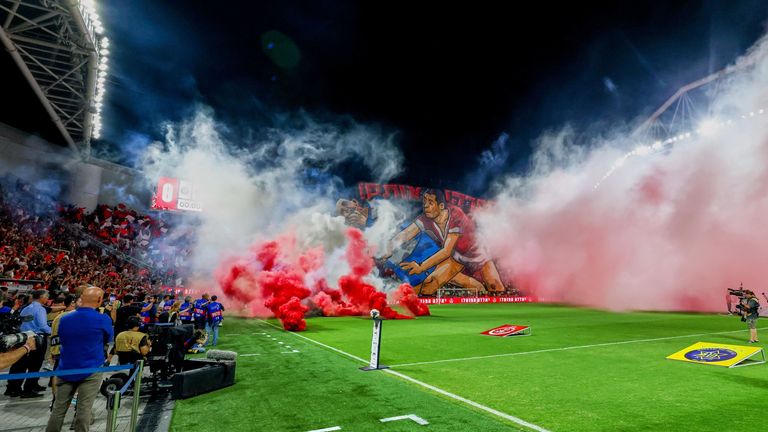
This game against local rivals Hapoel Tel Aviv had to be called off. Pic: AP
Although nine people were arrested at the venue, Maccabi denied their fans were responsible, claiming the police cancelled the derby. This complex situation shows that entrenched groups are eager to “malign the Maccabi Tel Aviv fan base” and “exploit isolated incidents for their own social and political ends.” This internal conflict and external scrutiny informed the club’s decision to avoid placing its supporters in a potentially dangerous situation overseas, reinforcing the necessity of the Maccabi Tel Aviv Fans Ban from their perspective.
The UK government’s response, expressing sadness yet reaffirming its security commitment, underscored the diplomatic complexity of the situation. A spokesman stressed that it is “completely unacceptable that this game has been weaponized to stoke violence and fear by those who seek to divide us.” This strong language highlights the belief that external factors, including anti-Israel sentiment and antisemitism, fueled the security concerns far more than ordinary football hooliganism. The government’s pledge to “never tolerate antisemitism or extremism on our streets” confirms the matter extends far beyond simple sporting logistics; it has become a profound political and community safety issue. The club’s refusal effectively shuts down the political debate over fan presence but leaves the underlying security concerns unresolved.
Consequently, this situation establishes a worrying precedent for future European competitions involving Israeli clubs. If a club must voluntarily forfeit its ticket allocation due to fears for supporter safety despite government assurances, it indicates a significant failure in the current security framework for international fixtures. The ability of football fans to travel across Europe without intimidation is a basic principle that the UK government aimed to defend, but the club itself deemed the risk too high.
This specific incident should prompt a thorough review of the security protocols laid out in documents like the [UEFA Club Licensing and Financial Sustainability Regulations] (Outbound Link), ensuring adequate provisions exist for high-risk fixtures. Furthermore, examining past incidents, like those detailed in reports on [The History of UK Football Hooliganism] (Internal Link), could provide context on managing domestic crowd security in volatile situations.
This unprecedented action by Maccabi Tel Aviv, voluntarily preventing its fans from attending a major European fixture, concludes a chaotic week of political intervention and security warnings. The club chose to take the most decisive action possible to protect its supporters from perceived threats, whether internal or external, ensuring safety over sporting opportunity. The focus now shifts to how Aston Villa, West Midlands Police, and the government will manage the fixture without the presence of away fans.

AD: Heritage And Restaurant Lounge Bar


