
By Isabelle Wilson-
The cries of women and children pierce the thick, humid air as the heavy battering ram shatters the front door. Machine guns and pistols are brandished by officers in tactical gear, who immediately flood the small dwelling.
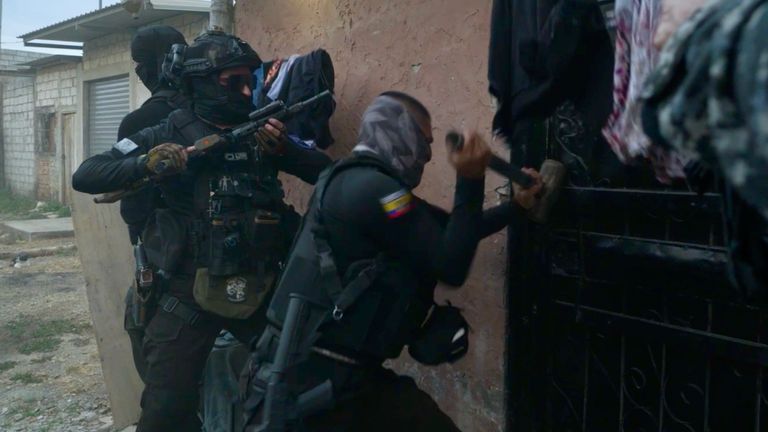
Officers force their way into home on a raid. Image: Sky News
This intense chaos has become routine in Guayaquil, Ecuador’s sprawling port city, which now represents the aggressive new frontline in a global drug conflict.

AD: Capeesh Restaurant
This escalation is not a simple, isolated national response; rather, this intensifying Cartel Crackdown Ecuador is directly fuelled by a seismic shift in American foreign policy.
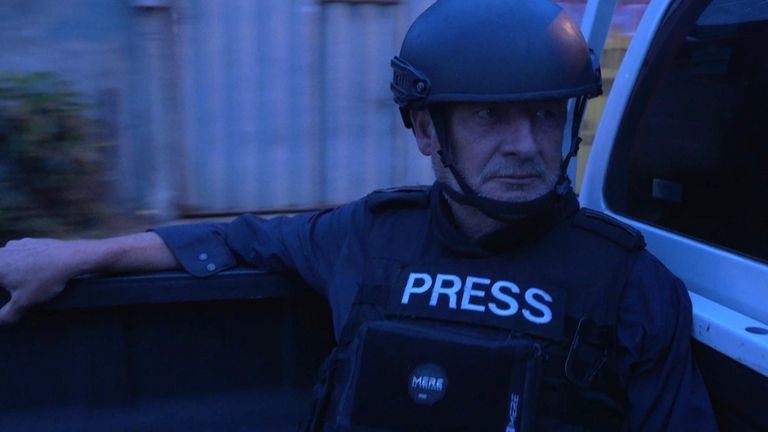
Stuart Ramsay in Guayaquil, Ecuador. Image: Sky News
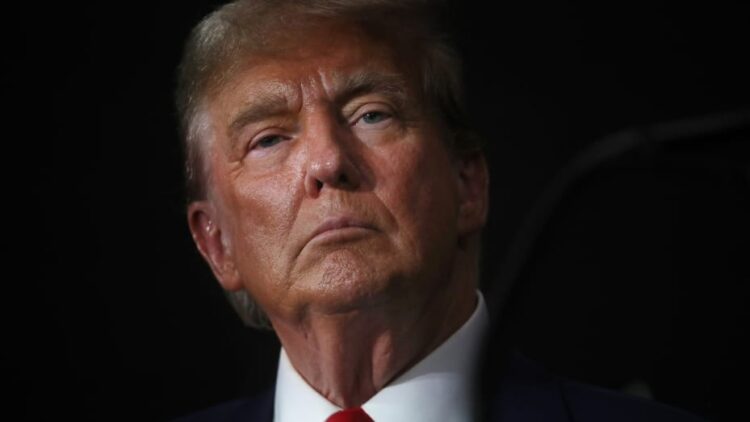
US President Donald Trump declared a “war on drug cartels,” demanding strict adherence from nations caught in the drug trade’s network, often threatening punishing sanctions or worse for non-compliance.
Ecuador, a crucial transit country for cocaine flowing from producers to consumers globally, suddenly found itself on Washington’s list.

AD: Oysterian Sea Food Restaurant And Bar
Now, Ecuador’s security forces are raising their game dramatically, eager to prove their allegiance and secure desperately needed resources for the burgeoning Cartel Crackdown Ecuador.
Ecuador occupies a uniquely precarious position in the transnational drug trade.
Although the country produces virtually no cocaine itself, its extensive Pacific coastline and bustling ports serve as a vital maritime gateway for drug shipments heading north toward the lucrative markets of the United States, as well as west across the Pacific to Asia.
The sheer volume of illicit narcotics passing through its sovereign territory made the nation an inevitable target for American pressure.
Consequently, the United States is now providing significant resources, including funding, weaponry, and advanced surveillance technology, to support the local security apparatus.
This military and financial muscle signifies the core of the US strategy.
In a further move signalling deep commitment, the US is reportedly planning to open a new military base within the country. This profound partnership ensures the Cartel Crackdown Ecuador continues with unwavering resolve.
Officers on the ground, many of them former special forces, welcome the new commitment. One such operative, known by his call sign “Lynx,” serves as a dynamic poster boy for the invigorated Ecuadorian police efforts.
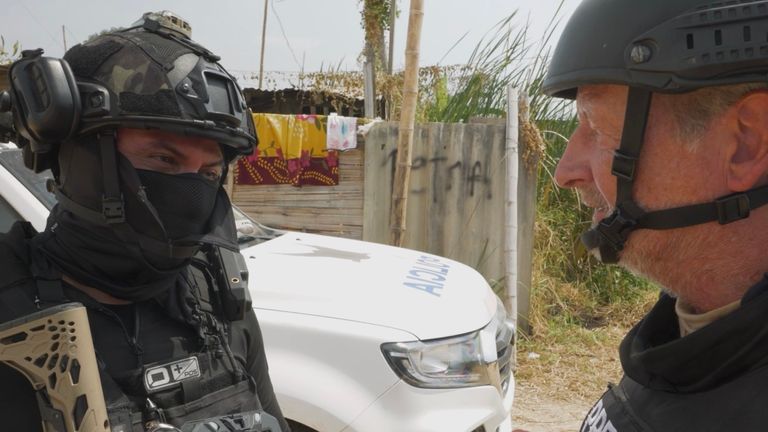
Stuart Ramsay meets with former special forces officer ‘Lynx’. Image: Sky News
He enthusiastically confirmed the profound impact of this new U.S support: “The United States [is] giving us money, guns, technology, and we are so happy about that,” he said, emphasizing its importance “for the war.”
His team uses advanced equipment, including sophisticated drones, to conduct real-time street surveillance, pinpointing drug transactions a kilometre away.
This capability allows the police to rapidly transition from observation to action, a necessary shift for effective engagement against highly mobile criminal networks.
The daily, highly-publicized raids are part of a targeted, intelligence-led initiative aiming to disrupt the entire supply chain.
The dramatic increase in police activity in Guayaquil, a direct consequence of President Trump’s foreign policy demands, relies on a strategic principle: disrupt the chain at its weakest links.
Authorities are not immediately chasing kingpins; instead, they focus on capturing the “small guys,” low-level dealers who possess invaluable, exploitable intelligence.
Lynx described the operational strategy clearly: “We always grab the small guys, and they talk… give me that guy, he’s a bigger guy, and then we go, go, go.” This slow, painstaking process aims to accumulate information which is then shared with US intelligence agencies, assisting in the apprehension of much higher-value targets further up the cartel hierarchy.
The joint effort maximizes the impact of the newly dedicated resources and elevates the tactical efficiency of the Cartel Crackdown Ecuador.
The immediate impact of this joint operation is undeniable and highly visible on the ground.
Daily raids yield impressive hauls, often displayed publicly in a traditional show of force common across Latin American anti-narcotics efforts.
Recent seizures include bags of marijuana, packets of powdered cocaine cut for street sale, and kilograms of potent, pure cocaine paste.
Furthermore, weapons, caches of ammunition, and large amounts of cash are frequently confiscated alongside the illicit drugs. Yet, the real currency in this war is not the physical product but the intelligence gleaned from the arrested individuals.
Every single small arrest represents a potential breach in the wall of silence that protects major drug traffickers.
Beyond the immediate tactical gains, the American involvement has geopolitical implications, securing a strategic ally in a critical region. By offering material support and promising a military presence, the US guarantees Ecuador’s full cooperation in a broad anti-cartel coalition.
The arrangement safeguards US security interests while simultaneously providing the Ecuadorian government with the resources necessary to stabilize its increasingly violent urban centers. This mutually beneficial, if politically sensitive, partnership underscores the global nature of drug trafficking and the necessity of coordinated international responses.
For example, similar cross-border efforts are crucial in Colombia’s ongoing struggle against transnational crime. Without this bilateral commitment, analysts predict that Ecuador’s ports would quickly be overwhelmed, further strengthening organized crime throughout the continent.
The Future of the Cartel Crackdown Ecuador
While the raids are successful in their stated goals of seizing drugs and gathering intelligence, they inflict a heavy human toll on the affected communities.
We witnessed the raw, unsettling reality first hand as police burst into homes in rough, impoverished areas of Guayaquil. The scene, marked by shouting and forced entry, often involved terrified women and children.
For residents of these neighbourhoods, the sight of armed police officers smashing down doors has tragically become a part of daily life. The police justify these aggressive tactics by arguing that the rights of these residents are regrettably “trumped by their circumstances”—the probability that a family member is involved with the gangs.
This profound conflict highlights a critical ethical challenge in the execution of the Cartel Crackdown Ecuador: how to separate necessary law enforcement from disproportionate force in vulnerable communities.
The police must balance the need for aggressive action to dismantle sophisticated criminal networks against the need to protect innocent civilians caught in the crossfire of this escalating drug war.
The long-term success of the crackdown hinges not only on disrupting cartel operations but also on rebuilding community trust that gets eroded during these chaotic operations.
Reflecting on the international scope of the conflict, Officer Lynx posed a stark, ethical question to us, one meant for consumers far removed from the violence.
He doubted that individuals consuming illicit drugs in wealthy cities like London or New York ever spare a thought for the devastating consequences their demand creates in countries like Ecuador.
He expressed a poignant wish that awareness might change behaviour: “If they really [knew] I think they would think no, it’s bad, because people are killing in poor countries for the drugs, for the drugs [they] are consuming.”
The reality is simple yet brutal: demand in one hemisphere drives the violence and chaos in the other. Therefore, the Cartel Crackdown Ecuador is more than just a security operation; it serves as a moral barometer for the entire global drug pipeline.
The pressure from the US has intensified the operations, but sustainable peace requires addressing both the supply chain in Ecuador and the relentless demand overseas.
The coming years will determine if this aggressive, resource-backed strategy offers a lasting solution or merely shifts the violence elsewhere.

AD: Heritage And Restaurant Lounge Bar


