
By Isabelle Wilson-
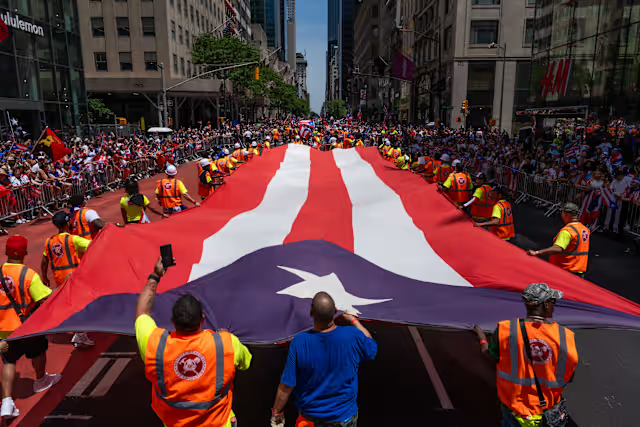
Puerta Rican Parade lit up Manhattan skies on Sunday . The Fifth Avenue, normally defined by taxis, commerce, and the brisk anonymity of New York motion, transformed into a living corridor of rhythm, flags, and collective memory as the National Puerto Rican Day Parade swept through the city. Drums echoed off glass towers, brass sections cut through
The 69th annual celebration, part civic ritual and part cultural eruption, unfolded under the official theme “Somos Más Que 100×35,” a phrase that speaks to the island’s compact geography and its expansive global influence. Organisers described it as a tribute not only to Puerto Rico itself but to the millions of Puerto Ricans who have carried its language, music, and identity far beyond its shores.

AD: Capeesh Restaurant
The first floats at 44th Street, the parade built itself like a crescendo. School marching bands from the Bronx and Brooklyn layered syncopated rhythms over salsa classics blasting from mobile speakers. Dancers in sequined costumes spun in choreographed bursts of energy, their movements catching the sunlight like fragments of a prism.
Elderly spectators leaned over barricades, some wiping tears, others singing along to songs older than the parade itself. Children, perched on shoulders, waved flags almost larger than themselves. Crowds had been forming since morning along the sidewalks of Midtown. Some arrived with folding chairs and coolers; others simply followed the sound until they reached it.
Vendors lined side streets selling alcapurrias, pinchos, and piraguas shaved into electric reds and blues. The scent of fried dough and garlic mixed with summer humidity, creating a sensory map of Puerto Rican diaspora life condensed into a few city blocks.

AD: Oysterian Sea Food Restaurant And Bar
The parade is widely regarded as one of the largest cultural celebrations in the United States, drawing nearly a million spectators and participants in some years, according to organisers. Yet numbers fail to capture the feeling on the ground: a city temporarily rearranged by heritage, where identity is not observed but performed in full public view.
What distinguishes the Puerto Rican Day Parade from many of New York’s civic spectacles is not only its scale, but its emotional density. Every float appears to carry more than dancers and musicians it carries migration stories, family photographs, and decades of cultural persistence. The portrayal of a bomba ensemble on a parade float reflecting Afro-Puerto Rican tradition is well supported by cultural scholarship describing Bomba as one of the island’s oldest art forms, developed among enslaved Africans and built around a call-and-response relationship between drummer and dancer, where rhythm itself carries historical memory and resistance.
Likewise, the reference to reggaeton as a newer sonic force emerging from San Juan aligns with research on Reggaeton, which is widely documented as evolving from urban Caribbean and Latin American communities through a fusion of hip-hop, dancehall, and Latin rhythms before becoming a global genre shaped by artists such as Bad Bunny and Daddy Yankee.
Taken together, these sources support the idea that public celebrations like the Puerto Rican Day Parade often stage a cultural continuum in which traditional forms like bomba and contemporary reggaeton coexist, visually and sonically representing an evolving Puerto Rican identity that spans historical roots, present-day urban expression, and global diaspora influence.
Mayor’s office representatives and cultural leaders walked among contingents, waving to spectators and pausing for brief exchanges with community groups. This year’s parade honorees included prominent figures from music, politics, and the arts, underscoring the parade’s dual role as celebration and recognition of achievement within the Puerto Rican diaspora. The parade advanced northward, Fifth Avenue itself seemed to dissolve as a boundary. Office workers leaned from windows, joining in clapping rhythms they had not rehearsed. Tourists paused mid-photo, their cameras lowered in recognition that some experiences resist framing.
The parade’s music did not stay confined to one genre or generation. Salsa transitioned into plena, plena into hip-hop, hip-hop into live brass improvisations that felt like they had no origin and no endpoint. Sound moved like water, spilling into cross streets and climbing façades.
In recent days, New York has been moving through a crowded cultural calendar, with multiple large public events drawing attention across Manhattan. Yet the Puerto Rican Day Parade stands apart in its ability to transform observation into participation, turning spectators into temporary members of a shared cultural body.
A City That Dances Back
Through mid-afternoon, the parade had become less a linear procession and more a distributed celebration. Blocks that had been defined by staging areas now functioned as open-air dance floors. Salsa circles formed spontaneously in intersections. Strangers linked arms in conga lines that extended beyond crosswalks and into adjacent streets before dissolving just as quickly as they formed.
What gives the parade its enduring force is not only nostalgia but reinvention. Each year, it absorbs new musical influences, new political realities, and new waves of migration. It reflects a Puerto Rican identity that is not fixed in geography but expanded through experience between island and mainland, tradition and innovation, memory and motion.
The crowd’s energy never fully settles. Even as floats pass and marchers rotate in and out of view, the sound remains continuous, as if the city itself is humming underneath. Vendors begin to sell out of food as early afternoon arrives. Children grow tired but refuse to leave. Parents lift them onto shoulders again, not to ease fatigue but to ensure they see the final stretch of the procession.
Long after the last float disappears from view, Fifth Avenue remains marked by its passage: confetti embedded in sidewalk cracks, faint echoes of music between buildings, and the lingering sense that for a few hours, Manhattan was not just a place of transit, but a place of belonging.In that transformation lies the essence of the Puerto Rican Day Parade not merely a march through a city, but a reminder that culture, when shared in full colour and sound, refuses to stay in one place.

AD: Heritage And Restaurant Lounge Bar