
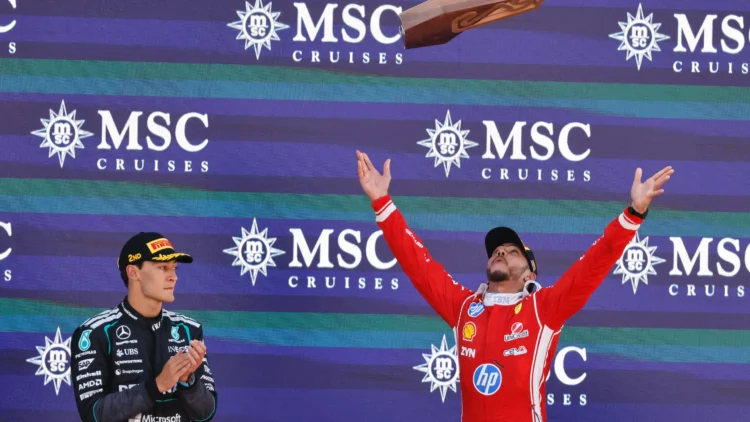
Lewis Hamilton delivered a landmark moment in his Ferrari career on Sunday, claiming a commanding victory at the Barcelona-Catalunya Grand Prix that ended both his personal winless streak and Kimi Antonelli’s extraordinary run of form.
In a race defined by strategy, tyre management, and late mechanical drama, Hamilton’s first win in red marked a symbolic turning point in the 2026 Formula 1 season, while the championship leader Antonelli suffered a heartbreaking late retirement. The win, Hamilton’s first since joining Ferrari and his 106th career victory, came after a perfectly timed three-stop strategy and a crucial Virtual Safety Car phase that allowed him to leap into the lead.
Through the chequered flag, the seven-time world champion had produced a controlled and clinical drive that left Mercedes pair George Russell and Lando Norris to complete the podium in second and third respectively. The result also ended Mercedes’ early-season dominance, which had seen Antonelli win five consecutive races heading into Spain.

AD: Capeesh Restaurant
Antonelli, meanwhile, had looked set to extend his streak once again. The 19-year-old Italian had fought through the field and was running in a strong podium position after overtaking Russell late in the race, only to suffer a devastating electrical failure just four laps from the finish.
His Mercedes coasted to a halt, bringing an abrupt end to what had been one of the most impressive rookie campaigns in recent Formula 1 history.
Ferrari’s victory was not simply the result of raw pace but of bold and decisive strategy. The Scuderia opted for an aggressive three-stop plan that initially left Hamilton vulnerable in the opening stages. However, as tyre degradation increased across the field in sweltering Spanish conditions, Ferrari’s approach began to pay dividends. The turning point came during a Virtual Safety Car period, when Hamilton made a perfectly timed pit stop that effectively vaulted him into the race lead.

AD: Oysterian Sea Food Restaurant And Bar
From there, Hamilton managed the gap with trademark precision. Even as Mercedes attempted to respond with alternate strategies for Russell and Antonelli, Ferrari’s execution proved superior on the day. The result was a statement victory for the Italian team, reinforcing their growing competitiveness against a Mercedes outfit that had appeared untouchable just weeks earlier.
Hamilton’s victory in Barcelona carried clear emotional weight, marking what he described in recent comments as part of a longer process of rebuilding competitiveness and belief since his move to Ferrari.
Speaking ahead of and during the European stretch of the season, Hamilton has repeatedly stressed that the project is still evolving but remains convinced that success would come if the team continued executing his feedback and development direction, insisting in a recent interview that “never say never” remains his mindset regarding the championship fight.
The Barcelona win, therefore, was widely interpreted as a validation of both driver and team after an adaptation period that included fluctuating results and strategy refinement since his high-profile switch from Mercedes. It also had immediate implications for the title race, with the result tightening the standings and positioning Hamilton as one of the most consistent challengers to Kimi Antonelli’s championship lead as the season moves deeper into its European phase.
With Mercedes, the race was a study in contrasts. Russell’s recovery to second place salvaged valuable points, but Antonelli’s retirement marked the first major setback of his otherwise dominant season. The Italian prodigy had entered the weekend as the clear championship leader, but his failure to finish dramatically reduced his points advantage and opened the door for renewed competition from Ferrari and McLaren.
Antonelli’s retirement was the defining moment of the race’s closing stages. After a fierce battle with Russell for second place, he briefly looked poised to challenge Hamilton for victory in the final laps. But just as the race entered its decisive phase, his Mercedes suffered a sudden electrical shutdown, forcing him to pull off the circuit and retire in frustration.
The impact on the championship standings was immediate and significant. What had been a commanding points lead built on five consecutive victories was suddenly under pressure, with Hamilton and Russell both closing the gap in the overall standings. The emotional toll was evident, as Antonelli’s composed rise through Formula 1 encountered its first major setback of the season. Despite the disappointment, Mercedes still demonstrated strong underlying pace. Russell’s ability to recover from a disrupted race and secure second place reinforced his consistency, while McLaren’s Lando Norris completed an all-British podium that added another layer of historical significance to the event.
Elsewhere in the field, Ferrari teammate Charles Leclerc also failed to finish due to mechanical issues, highlighting the unpredictable nature of the race and the physical strain placed on the cars in Barcelona’s demanding conditions. Yet it was Hamilton’s victory that ultimately defined the day, signalling not just a personal milestone but a potential shift in momentum within the championship battle.
Formula 1 heads deeper into the European season, and the Barcelona Grand Prix may come to be remembered as a pivotal turning point: the day Ferrari finally converted promise into victory, and the moment Kimi Antonelli’s dominance was unexpectedly challenged by the cruel unpredictability of mechanical failure.
Until this race, the season had largely been shaped by Antonelli’s remarkable consistency and Mercedes’ early control of both race pace and strategic execution. His string of victories had begun to suggest the emergence of a new era of dominance, with rivals increasingly forced into reactive rather than proactive race strategies.
Barcelona, however, disrupted that narrative in dramatic fashion. Ferrari’s breakthrough win not only reshaped the immediate championship picture but also altered the psychological balance within the paddock. The first time in 2026, the perception of inevitability surrounding Antonelli’s campaign was replaced with genuine uncertainty.
The margins that had previously appeared secure suddenly looked vulnerable, especially as Ferrari demonstrated an ability to execute under pressure in changing conditions. That shift is often as important as raw points in a long title fight, particularly as teams enter the high-pressure summer stretch of the calendar where development upgrades and reliability become decisive factors.
Antonelli’s late retirement added an additional layer of consequence. Mechanical failures are rare but defining when they occur at critical stages of a championship battle, and this one arrived at the worst possible moment. What had been shaping into another controlled drive turned abruptly into a zero-point outcome, tightening the standings and opening the door for renewed competition. In contrast, Ferrari and Hamilton leave Barcelona with renewed momentum, not just in terms of results but in belief that they can consistently challenge at the front.
Barcelona may be viewed not as an isolated result but as a psychological and competitive reset. The title race, once appearing to tilt heavily in one direction, has been rebalanced, setting up a far more unpredictable and tightly contested second half of the season.

AD: Heritage And Restaurant Lounge Bar