
By Ben Kerrigan-
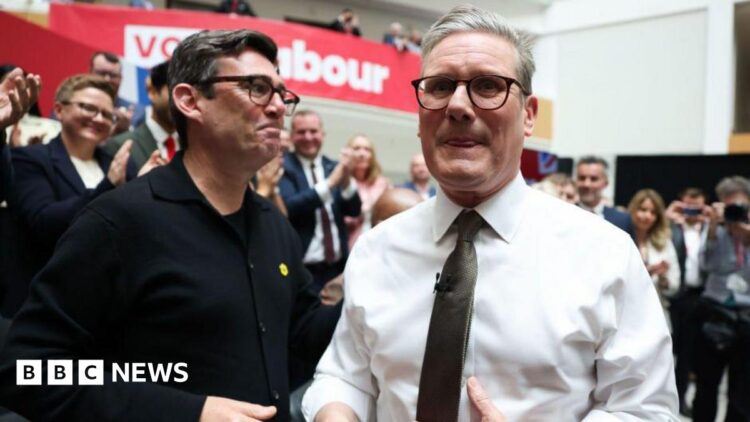
Greater Manchester Mayor Andy Burnham has warned that Labour’s decision to block his bid to be their candidate in the upcoming Gorton and Denton by-election could make the party more likely to lose the seat a risky prospect for Sir Keir Starmer’s government at a time of shifting political terrain and rising competition from rivals.

AD: Capeesh Restaurant
In a series of social media posts, Burnham expressed disappointment and concern about the ruling’s effect on Labour’s electoral prospects.
“I am disappointed by today’s NEC decision and concerned about its potential impact on the important elections ahead of us,” he wrote, pledging support to whichever candidate Labour chooses but implicitly warning that his absence could hurt the party’s chances in the vote.
Burnham’s stance reflects broader anxiety within the Labour Party over its political fortunes. Recent projections for the Gorton and Denton by‑election indicate that Labour’s lead has narrowed sharply compared with the 2024 general election.

AD: Oysterian Sea Food Restaurant And Bar
Estimates from Election Maps UK show Labour polling around 29.8 %, with Reform UK close behind at 26.9 % and the Green Party at 24.1 %, highlighting the increasingly competitive nature of the contest.
Broader national polling trends also contextualise this local shift: Labour’s support has weakened significantly since the 2024 general election, while Reform UK has gained traction across northern constituencies, explaining the party’s anxiety over the by‑election outcome .
This by-election triggered by the resignation of Labour MP Andrew Gwynne was widely seen as a test of Labour’s ability to hold ground against rising populist competitors. Now, with Burnham excluded from the ballot, party insiders say the campaign could become a far harder fight for the governing party.
Labour’s NEC decided to block Burnham’s candidacy on strategic grounds, citing concerns that if he won, it would trigger a costly mayoral by-election in Greater Manchester, diverting vital resources and political energy from wider campaigns in the run-up to the May 2026 local and devolved elections.
NEC members argued that with tight campaign coffers and stretched canvassing teams, it was better to avoid additional election cycles.
However, critics inside and outside the party have questioned this rationale. Reform UK’s increasing traction has heightened the risk profile of even once-safe seats. Polling in the region has indicated Labour’s support could be as low as the high 20 s percentage-wise, compared with Reform UK’s rising figures that threaten to eat into traditional Labour majorities.
Analysts believe that Burnham’s presence on the ballot would have strengthened Labour’s chances significantly, given his strong personal popularity in Greater Manchester where he was re-elected mayor in 2024 with a comfortable margin.
Burnham has made precisely this point in his messaging: his supporters argue that he was uniquely placed to defend the seat against Reform UK and other challengers because of his regional profile and broad appeal across age groups.
They fear that his exclusion could undercut Labour’s vote share and potentially deliver an upset victory for Reform UK or even the Greens, fracturing the left-of-centre vote.
Inside Labour, reactions have been mixed. Some MPs and trade unions have criticised the NEC decision as undemocratic and potentially damaging.
Labour MP Karl Turner, for instance, told broadcasters that blocking Burnham was a “mistake,” arguing that in the previous mayoral election Burnham had won every single constituency ward and ballot box in Greater Manchester a level of performance that suggested he was the best candidate to defend the seat.
This point of view has resonated with many local party activists in the North West, who fear the party’s national leadership has misread the political landscape by sidelining one of its most popular figures.
Momentum, the grassroots organisation with strong ties to Labour’s activist base, described the move as a “catastrophic mistake,” warning it could undermine Labour’s performance not just in the by-election but in the forthcoming May elections for Scottish Parliament, Welsh Senedd and councils across England.
Critics argue that the move also exposes deeper internal divisions within Labour between those prioritising centralised strategic control and those advocating for more grassroots-driven decision-making and candidate selection.
The rapidity with which the NEC ruled on Burnham’s application within hours of his bid has been cited by insiders as evidence of pre-emptive internal political calculations rather than purely tactical electoral considerations.
In contrast, supporters of the NEC’s decision argue it was necessary to avoid internal psychodrama and present a unified front ahead of a crowded electoral timetable. They maintain that resources and attention should be concentrated on competitive battlegrounds rather than opening up new fronts that could drain organisational capacity.
The debate over Burnham’s exclusion has also reignited discussion about Labour’s broader electoral strategy particularly how to retain its traditional heartlands in the face of rising populism and regional political shifts.
Many years, Greater Manchester has been a Labour stronghold, but recent trends suggest voter loyalty is less assured than it once was, with Reform UK making gains among working-class voters traditionally aligned with Labour.
If these trends continue, political analysts warn, even incumbency advantages and local popularity may not be enough to secure victory without high-profile endorsements.
The arithmetic of the by-election also underscores the scale of the challenge. Should Labour’s vote share dip below a threshold where a rival party can overtake it outright, the seat could pass to Reform UK something that seemed unlikely just a few months ago but is now being openly discussed by campaign insiders and commentators alike.
Burnham’s prediction that Labour is more likely to lose without him is also rooted in internal polling and anecdotal feedback from local canvassers, which has shown that his local approval numbers far outstrip those of other potential candidates.
While Labour leadership insists that it still has a strong chance of holding the seat, the confidence gap between national strategists and local activists is increasingly visible.
Adding to the political pressure are the broader national polls. Labour, despite its commanding victory in the July 2024 general election, has seen a gradual decline in support in subsequent months, partly due to economic pressures and public perceptions of government performance.
This has emboldened opposition parties, with Reform UK capitalising on discontent and gaining traction in several northern constituencies.
Some Labour voices dismiss suggestions that losing Gorton and Denton would be catastrophic pointing out that by-elections can be volatile and influenced by local factors. However, observers note that symbolic defeats can reverberate, affecting morale among party members and perceptions among voters ahead of the more consequential May elections.
Burnham’s decision to frame his exclusion in electoral terms emphasising the risk of defeat may also be aimed at solidifying his influence within the party’s base, projecting himself as a candidate capable of mobilising dissatisfied supporters. Whether this strategy strengthens his long-term standing in Labour or deepens internal divisions remains to be seen.
Labour’s leadership now faces a crucial test: whether to double down on its decision and present an alternative candidate with cross-party appeal, or to recalibrate its approach in light of Burnham’s warnings and evidence from local polling that his presence could have been electorally advantageous. Either path carries risks, with the party’s internal cohesion and electoral prospects both hanging in the balance.

AD: Heritage And Restaurant Lounge Bar