
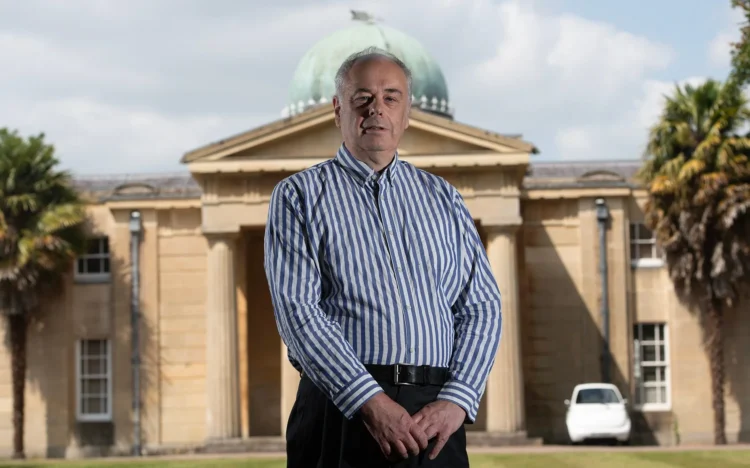
By Gabriel Princewill-
The University of Cambridge’s Institute of Astronomy has for generations stood at the forefront of humanity’s quest to understand the universe.
Its researchers have explored the origins of galaxies, the birth of stars and the mysteries of dark matter. Some of the world’s brightest scientific minds have passed through its doors. The institution’s reputation for excellence has helped cement Cambridge’s standing among the globe’s elite universities. But inside an employment tribunal in Suffolk, a very different picture of life at the prestigious institute is emerging. Such embarrassing allegations of retaliation against whistleblowers have cast a shadow over one of Britain’s most celebrated scientific departments, raising uncomfortable questions about power, accountability and culture within the upper ranks of academia.

AD: Capeesh Restaurant
The allegations come from Professor Wyn Evans, a prominent astrophysicist and former candidate for the University of Cambridge’s chancellorship, who has accused the institute of tolerating what he describes as a long-standing pattern of mistreatment directed at female staff members. The university strongly denies the allegations and insists it is vigorously defending the case. The institute’s director, Professor Richard McMahon, also rejects the claims made against him. Yet as evidence continues to be heard, the dispute has become far more than a personal grievance. It has evolved into a test case examining how one of the world’s most influential academic institutions responds when concerns are raised about workplace conduct. The Institute of Astronomy occupies a unique place within British science.
Situated on the outskirts of Cambridge, the University has been home to groundbreaking discoveries that have shaped modern astrophysics. Researchers there have contributed to our understanding of the evolution of the universe, the structure of the Milky Way and the behaviour of distant galaxies. Its reputation is built upon a scientific tradition stretching back centuries. Cambridge is, after all, the university of Sir Isaac Newton, whose revolutionary work on gravity and motion transformed humanity’s understanding of the cosmos.

AD: Oysterian Sea Food Restaurant And Bar
The allegations now being aired in public represent a striking contrast between the institution’s global prestige and the workplace culture described by some witnesses.According to Evans, the institute suffers from what he called “a bad history of misogyny”. In evidence before the tribunal, he alleged that female members of staff had repeatedly experienced behaviour that should have prompted intervention by senior management. He claimed that one woman had effectively been driven from her job, another had been left fearful, while a third had encountered hostility from senior academics. The university disputes those characterisations and rejects suggestions that it tolerated inappropriate conduct. Nevertheless, the allegations have reignited longstanding concerns about gender dynamics within science and academia.
At the centre of the tribunal is the experience of Dr Gudrun Tausch-Pebody,(pictured) who joined the Institute of Astronomy in 2012 as a European Commission contracts manager.
Her role involved managing complex international research funding arrangements—work that is often essential to the success of major scientific projects but which frequently takes place away from the public spotlight. According to Evans, concerns began escalating in 2021 when Dr Tausch-Pebody received notice that her contract would end.
He alleges funding existed that could have supported the continuation of her position and claims she was being systematically undermined by a senior colleague.
The university denies those allegations. What has captured attention, however, is the emotional testimony surrounding the impact of the dispute.
In written submission to the tribunal, Dr Tausch-Pebody described feeling subjected to treatment that had severe consequences for her wellbeing.
She said her work was repeatedly undermined, diminished and discredited by a superior, leaving what she described as an “indelible effect” on her mental health.
She also praised Evans for intervening when she was experiencing significant distress.
According to her statement, Evans recognised what she believed was a broader pattern affecting female administrative staff within the department.
The account paints a troubling picture of workplace relationships breaking down amid allegations of managerial misconduct and institutional inaction.
One of the most dramatic moments of the tribunal came when Evans described his fears for Dr Tausch-Pebody’s welfare.
Speaking with visible emotion, he recounted a night during which he worried she might harm herself.
He told the tribunal he spent hours agonising over what action to take and whether she would still be alive the following morning.
When he saw emails from her the next day, he said, he felt immense relief.
The testimony underscored the human cost that workplace disputes can inflict when conflicts escalate and individuals feel isolated or unsupported.
The hearing also heard references to the suicide of a former colleague, a subject that prompted a tense exchange between Evans and the university’s legal representative.
The confrontation highlighted the depth of feeling surrounding a case that has become intensely personal for those involved.
A central issue before the tribunal is whether Evans suffered detriment after raising concerns.
He argues that after making whistleblowing disclosures regarding the treatment of Dr Tausch-Pebody and other female staff, attention shifted away from the allegations themselves and towards those who had raised them.
According to Evans, grievances were subsequently lodged against him and two fellow professors by the institute’s director, Professor Richard McMahon.
The move shocked many within the department, Evans claims.
He told the tribunal it was unprecedented for a head of department to bring grievances simultaneously against three senior academics.
The university later dismissed those complaints, citing a lack of supporting evidence.
However, Evans argues the process itself became a punishment.
He says the investigations dragged on for nearly two years, creating professional uncertainty and damaging careers.
Among those affected was Professor Vasily Belokurov, one of Britain’s most celebrated astronomers and a newly announced recipient of the 2026 Kavli Prize for Astrophysics.
In written evidence, Belokurov stated that the prolonged investigations placed enormous pressure on their research group and threatened its future.
His intervention suggests the dispute reached beyond individual grievances and affected the institute’s scientific work itself.
Defamation Ruling intensifies Scrutiny
The conflict did not end with internal university procedures.
Evans subsequently launched libel proceedings against McMahon over statements made during the grievance process.
In 2023, a preliminary issues judgment concluded that the statements were defamatory.
Although the matter was later settled out of court, the ruling represented a significant development in an already bitter dispute.
The judgment raised questions about oversight and accountability as far as critics of the university’s handling of the complaint
The legal proceedings remain separate from the whistleblowing case currently before the tribunal.
The university maintains that Evans’ allegations are unfounded and has accused him of pursuing what its legal team described as an “obsessive vendetta” against McMahon.
Evans firmly rejects that characterisation.
The Cambridge case arrives at a time when universities across Britain are facing increasing scrutiny over workplace culture.
Over the past decade, allegations of bullying, harassment and discrimination have surfaced at institutions ranging from Oxford and Imperial College London to universities across Europe and North America.
While universities often portray themselves as progressive environments, critics argue that academic workplaces can foster unusually concentrated forms of power.
Senior academics control research funding, promotion opportunities, recommendations and access to influential professional networks. Challenging authority can therefore carry substantial risks.
Studies have repeatedly shown that bullying in academia often goes underreported because staff fear professional repercussions.
Women working in administrative and support roles may be particularly vulnerable because they frequently occupy positions outside formal academic hierarchies while remaining dependent upon senior managers and academics.
Against that backdrop, the allegations emerging from Cambridge resonate far beyond a single department.
A Defining Moment For Cambridge
The University of Cambridge has spent centuries building a reputation as one of the world’s great centres of learning.
Its graduates have won Nobel Prizes, transformed scientific understanding and shaped political history.
Yet institutions are judged not only by their achievements but also by how they respond to criticism.
The tribunal has not yet reached conclusions regarding the allegations before it. Cambridge and those accused continue to deny wrongdoing, and the legal process remains ongoing.
But regardless of the eventual verdict, the proceedings have already exposed deep divisions within one of Britain’s most prestigious academic communities.
The case raises fundamental questions about how universities handle complaints, support staff and protect those who speak out.
For an institution devoted to the pursuit of truth, those questions may prove as significant as any scientific mystery explored within its observatories.
The challenge facing the University of Cambridge cannot be solved through equations, telescopes or theories of the cosmos.
It is a challenge of trust. And the outcome may shape not only reputations, but the future culture of one of the world’s most influential centres of research
Cambridge university was asked by the university whether claims by Dr Tausch-Pebody that her work was undermined, discredited, and diminished by a superior was factual or not, and whether the work in question was assessed by any external academic for an objective outlook.

AD: Heritage And Restaurant Lounge Bar
-
Share On
- Categories
- Date