
By James Simons-
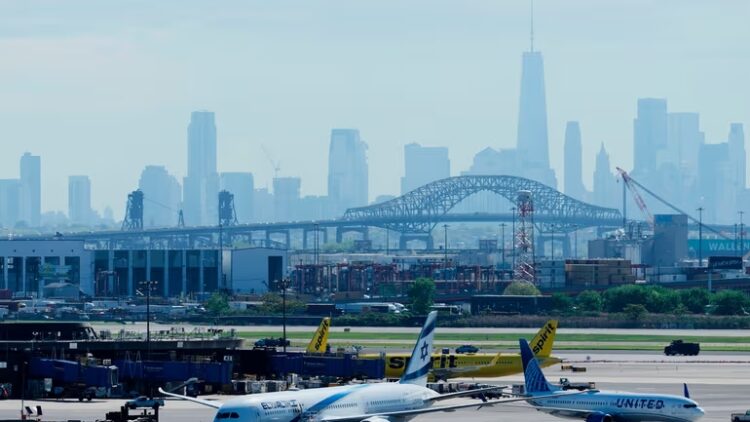
A United Airlines passenger jet narrowly avoided disaster on Sunday when it struck a truck and a light pole during its final approach to Newark Liberty International Airport, in an extraordinary incident that is now under investigation by U.S. aviation authorities.
The aircraft, arriving from Venice, Italy, landed safely despite the impact, but the collision has raised fresh questions about airspace safety near one of the country’s busiest airport corridors.

AD: Capeesh Restaurant
According to officials cited by the National Transportation Safety Board (NTSB), the Boeing 767-400 was descending toward Runway 29 when its landing gear and underside came dangerously close to the New Jersey Turnpike, striking a roadside light pole and a tractor-trailer below.
The impact caused visible damage to the truck and reportedly sent debris onto nearby vehicles, though the aircraft was still able to continue its landing without emergency diversion.
Authorities confirmed that the truck driver sustained minor injuries and was taken to hospital before being released, while none of the 221 passengers and 10 crew members onboard the United flight were hurt. The plane later taxied to the gate under its own power, and airport operations resumed after a brief inspection of the runway area.

AD: Oysterian Sea Food Restaurant And Bar
The Federal Aviation Administration (FAA) and the NTSB have both launched formal investigations into how the aircraft came into such close proximity with highway infrastructure.
Early reports suggest that the aircraft’s low altitude on final approach may have contributed to the collision, though investigators have not yet determined whether pilot error, weather conditions, or air traffic control factors played a role.
The incident has drawn particular attention because of the unusual nature of the collision. Aircraft striking ground vehicles during landing is extremely rare, especially at major international airports with tightly controlled airspace.
Newark Liberty International Airport, however, presents a uniquely complex environment, with its runways closely aligned over the heavily trafficked New Jersey Turnpike, a major interstate highway.
Dashcam footage circulating online appears to show the moment the aircraft passed low over the roadway before making contact with a truck traveling beneath its flight path. The footage has been widely shared on social media and reviewed by investigators as part of the early inquiry into the sequence of events.
Aviation experts have pointed out that Runway 29, used by the arriving flight, is known for its challenging approach, requiring pilots to descend over densely populated infrastructure including highways, industrial zones, and power lines. While such approaches are standard at Newark, they demand precise altitude control and careful coordination with air traffic controllers.
United Airlines confirmed that its maintenance teams are assessing damage to the aircraft, while also stating that the flight crew has been temporarily removed from duty pending investigation. The airline said it is cooperating fully with federal authorities and conducting its own internal safety review.
“This is unacceptable,” U.S. Transportation Secretary Sean Duffy said in a post on social media following the incident, emphasising that aviation safety systems would be thoroughly examined in the aftermath of the event.
The NTSB has taken possession of the aircraft’s cockpit voice recorder and flight data recorder to reconstruct the final moments of the approach. These devices are expected to provide critical insight into altitude, speed, and pilot communications leading up to the collision. Investigators are also reviewing air traffic control instructions and weather conditions at the time of landing.
Preliminary assessments suggest that the aircraft may have descended lower than expected over the Turnpike, placing it in direct conflict with roadway infrastructure. Experts interviewed by U.S. media noted that even a slight deviation in glide slope during Newark approaches can result in dangerously low clearances over the highway below.
The Port Authority of New York and New Jersey, which operates the airport, said that normal operations resumed shortly after the incident and that runway inspections found no debris that would affect subsequent flights.
Despite the dramatic nature of the collision, officials emphasized that no passengers were injured and that the aircraft was not structurally compromised in a way that prevented a safe landing. However, the close call has intensified scrutiny of flight procedures at Newark, where dense urban infrastructure and high traffic volumes create a uniquely demanding operating environment.
Investigations continue, and regulators are expected to examine whether additional safeguards or revised approach procedures are needed to prevent similar incidents in the future.
While the event stands as one of the most unusual and closely scrutinised near-miss landing incidents in recent U.S. aviation history, drawing attention not only because of the collision itself but also because of the unusually tight margins in one of the country’s most congested air corridors.
The Federal Aviation Administration (FAA) and the National Transportation Safety Board (NTSB) are expected to conduct a detailed reconstruction of the aircraft’s final approach, including altitude profiles, glide slope adherence, and communications between the cockpit crew and air traffic control.
Investigators will likely compare the recorded flight path with standard instrument approach procedures for Newark Liberty International Airport, where arriving aircraft often descend over heavily developed infrastructure, including highways and industrial zones. Any deviation from established descent parameters will be closely scrutinised to determine whether it contributed to the incident.
A key area of focus is expected to be whether existing minimum safe altitude protections and automated warning systems provided sufficient alerts during the aircraft’s descent.
Modern commercial aircraft are equipped with terrain awareness and warning systems designed to alert pilots if they descend too low too quickly, but investigators will want to establish whether these systems functioned as intended and whether the crew responded appropriately.
Aviation safety experts have noted that even minor miscalculations in approach speed or descent angle can become critical in airports with constrained geography such as Newark.
The incident is also likely to prompt renewed discussion about ground infrastructure near airport approach paths. The proximity of roadways, including the New Jersey Turnpike, to Newark’s flight paths has long been considered a challenging feature of the airport’s design.
While the airport operates within established safety margins, the collision has highlighted how little room for error exists when aircraft descend over active traffic corridors. Regulators may consider whether additional physical protections, such as reinforced barriers, warning systems for road traffic, or revised clearance standards, could reduce risk in the event of future low-altitude deviations.
Airlines, too, may face updated guidance depending on the outcome of the investigation. United Airlines, whose aircraft was involved in the incident, is expected to cooperate fully with federal authorities while conducting its own internal safety review.
Training protocols for approaches into complex airports like Newark could also come under review, particularly if human factors are identified as contributing elements.
Although no passengers were injured and the aircraft was able to land safely, the psychological impact of such an incident is not insignificant. Aviation analysts note that near-miss events often lead to broader industry-wide safety improvements, even when no catastrophic outcome occurs.
Historical precedent shows that close calls frequently serve as catalysts for procedural changes, updated pilot training standards, and enhanced coordination between airlines and regulators.
Officials are expected to release preliminary findings in the coming weeks. Until then, the incident remains a stark reminder of the narrow margins that govern modern aviation safety, particularly in high-density airspace where precision is not optional but essential for preventing disaster.

AD: Heritage And Restaurant Lounge Bar