
By Ben Kerrigan-
British Prime Minister Keir Starmer has vowed to prove his critics wrong as he battles the deepest political crisis of his premiership, with growing numbers of Labour lawmakers openly calling for his resignation after devastating local election losses across England, Scotland, and Wales.
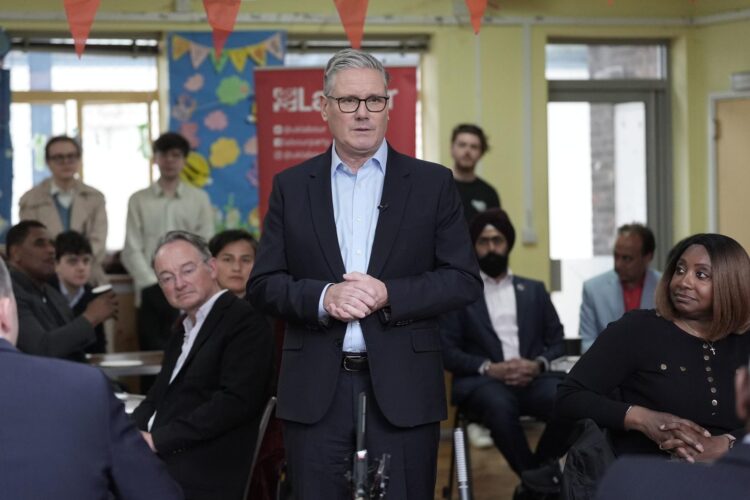
In a defiant speech delivered in London on Monday, Starmer insisted he would not “walk away” despite mounting pressure from within his own party. The prime minister acknowledged Labour’s poor electoral performance but argued that abandoning his leadership now would plunge both the party and the country into instability.

AD: Capeesh Restaurant
The crisis marks a dramatic reversal for Starmer, who led Labour to a commanding general election victory in 2024 after years of Conservative rule.
Less than two years later, his government faces collapsing poll numbers, internal rebellion, and growing public frustration over the economy, migration, public services, and a series of political controversies that have weakened confidence in Downing Street.
Labour’s losses in the 2026 local elections were particularly damaging because they exposed the party’s vulnerability on multiple fronts. Reform UK, led by Nigel Farage, made significant gains in several traditionally Labour-supporting regions, while the Green Party also increased its vote share among younger and progressive voters.

AD: Oysterian Sea Food Restaurant And Bar
In Scotland and Wales, Labour underperformed expectations, raising fresh doubts about Starmer’s ability to hold together the coalition of voters that swept him into office.
The backlash inside Labour has intensified rapidly. More than 60 MPs are now reported to have either demanded Starmer’s resignation or urged him to announce a timetable for his departure. Several parliamentary aides have resigned from junior government posts in protest, publicly arguing that new leadership is necessary if Labour hopes to recover before the next general election. Among the most damaging developments for Starmer has been the emergence of criticism from figures across Labour’s ideological spectrum.
MPs from both the party’s moderate wing and its left flank have expressed concern that the prime minister has become politically toxic among voters. Some lawmakers fear Labour risks repeating the rapid collapse in public trust that destroyed the Conservative governments before 2024.
Although no senior cabinet minister has formally launched a leadership challenge, speculation around possible successors has intensified. Health Secretary Wes Streeting and Greater Manchester Mayor Andy Burnham are increasingly viewed by Labour insiders as potential alternatives should Starmer’s position become untenable. Deputy Prime Minister Angela Rayner has also emerged as a powerful voice within the party, though she has stopped short of openly challenging the prime minister.
The atmosphere inside Westminster has become increasingly tense as lawmakers calculate whether Starmer can realistically survive the growing rebellion. Some MPs believe the prime minister could stabilize the situation by reshuffling his cabinet and adopting a more ambitious economic agenda. Others privately argue that his authority has already been fatally weakened.
Political analysts note that Starmer’s troubles reflect not only Labour’s internal divisions but also broader voter dissatisfaction with Britain’s economic and social conditions.
Inflation has eased from previous highs, but living costs remain elevated for many households. Public services continue to struggle after years of financial pressure, while concerns about housing shortages, NHS waiting lists, and immigration remain politically explosive issues across the country.
Labour Divisions Deepen After Election Shock
The local election results triggered immediate panic within Labour ranks because they appeared to confirm fears that the government is losing support faster than expected. In some councils, Labour candidates suffered sharp swings toward Reform UK, whose anti-establishment messaging has resonated with frustrated voters in former industrial regions.
Farage has seized on Labour’s difficulties by portraying Starmer as disconnected from working-class concerns. Reform UK officials described the election results as evidence of a major realignment in British politics, with traditional party loyalties increasingly breaking down. The rise of Reform has alarmed Labour strategists because it threatens the party in constituencies that were once considered safe territory.
Labour is also losing support among progressive voters who accuse Starmer of abandoning transformative policies in favor of cautious centrism. Critics on the left argue that the government has failed to deliver meaningful economic change despite its overwhelming parliamentary majority. Several trade unions have publicly urged Labour to move away from what they describe as a narrow managerial approach to governing.
Starmer attempted to address those concerns in Monday’s speech by promising a “fresh direction” for the government. He announced plans to strengthen ties with the European Union, expand job and apprenticeship guarantees for young people, and increase state involvement in strategic industries including steel manufacturing.
The prime minister also sought to contrast his leadership with the political chaos that defined the later Conservative years. He warned Labour MPs that replacing another sitting prime minister so quickly after a landslide election victory would damage Britain’s credibility and create further instability at a time of economic uncertainty and growing geopolitical tension.
Yet the speech failed to silence critics. Within hours, additional MPs publicly demanded that Starmer step aside or announce a transition plan. Some lawmakers reportedly want him to leave before the end of the year to allow a new leader time to rebuild the party before the next national campaign.
The crisis has also exposed regional tensions inside Labour. In Scotland, Scottish Labour leader Anas Sarwar previously called for Starmer to resign earlier this year following controversy surrounding the government’s handling of the Peter Mandelson appointment scandal. Sarwar argued that Downing Street had become a distraction harming Labour’s electoral prospects north of the border.
The Mandelson controversy continues to haunt the government months later. Critics accused Starmer of poor judgment after appointing Peter Mandelson as ambassador to Washington despite renewed scrutiny over Mandelson’s historical association with Jeffrey Epstein. The fallout led to the resignation of senior Downing Street aides, including chief of staff Morgan McSweeney.
Starmer’s Future May Depend On The Summer Ahead
For now, Starmer remains protected by the absence of a single obvious challenger capable of uniting Labour’s competing factions. While figures such as Streeting, Burnham, and Rayner are frequently discussed as potential successors, none has formally moved against the prime minister. Many Labour MPs also fear that a brutal leadership contest could further damage the party’s standing with voters.
Still, political pressure on Starmer is expected to intensify over the coming months. Labour lawmakers are closely watching opinion polls, economic indicators, and the government’s legislative agenda for signs that public confidence can be restored. If the party continues to trail Reform UK in parts of northern England while also losing progressive support in urban areas, calls for change are likely to grow louder.
The summer parliamentary session may prove decisive. Starmer’s allies hope upcoming announcements on industrial policy, NHS reform, and closer cooperation with the European Union can shift political momentum. The prime minister has increasingly emphasized optimism and national renewal in recent speeches, acknowledging that Labour’s earlier messaging often appeared overly bleak.
Supporters argue that Starmer still deserves time to implement his agenda after inheriting a difficult economic situation from the Conservatives. They also warn that removing a prime minister so soon after a landslide victory could reinforce perceptions that British politics has become permanently unstable.
Critics inside Labour, however, believe the problem is no longer purely political strategy but leadership itself. Some MPs privately worry that Starmer has lost the ability to connect emotionally with voters or inspire confidence among activists and local campaigners.
Others argue that Labour’s identity has become unclear under his leadership, caught between technocratic caution and demands for more radical change. With Starmer, the coming weeks may determine whether his premiership can recover or whether Britain is heading toward yet another period of political upheaval. His message to doubters was unmistakably defiant: he intends to fight on.
But as resignation calls continue to spread through his own party, the question dominating Westminster is no longer whether Labour faces a crisis but whether Keir Starmer can survive it.

AD: Heritage And Restaurant Lounge Bar