
By Isabelle Wilson–
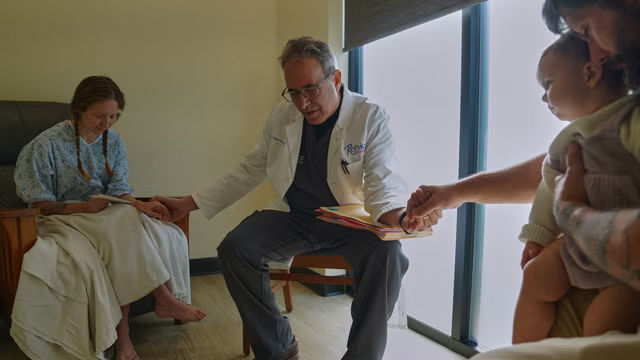
An IVF doctor is facing a serious dilemma concerning his faith, and has gone public about it. Dr. John Gordon spent three decades helping couples conceive children through in vitro fertilisation, building a successful career as one of America’s leading fertility specialists. Yet behind the success of his Washington-area practice, a growing moral conflict was quietly reshaping his life.
The reproductive endocrinologist had dedicated himself to helping infertile couples become parents, embracing advances in fertility medicine that transformed IVF into one of the most effective treatments in modern healthcare. But over time, Gordon began questioning whether the very techniques that expanded reproductive possibilities were also creating ethical dilemmas he could no longer ignore.

AD: Capeesh Restaurant
That crisis of conscience eventually led the physician to abandon his prestigious role at a major fertility clinic and relocate to Knoxville, Tennessee, where he founded a Christian-focused IVF practice designed around stricter religious principles.
His clinic, Rejoice Fertility, now rejects several standard procedures commonly used in fertility medicine, including the routine creation of surplus embryos and certain forms of genetic testing.
Gordon’s dramatic professional shift has drawn national attention because it reflects a growing debate unfolding inside American Christianity over the ethics of IVF. While fertility treatment remains widely popular across the United States, many conservative religious groups are increasingly wrestling with questions about embryo destruction, genetic screening and the moral status of unborn embryos.

AD: Oysterian Sea Food Restaurant And Bar
The controversy intensified following recent legal and political developments surrounding reproductive rights in the United States. Since the Supreme Court overturned Roe v Wade in 2022, debates over when life begins have expanded beyond abortion to include IVF and embryo storage.
Last year, the Alabama Supreme Court ruled that frozen embryos could legally be considered children, a decision that sent shockwaves through fertility clinics nationwide and reignited ethical arguments around assisted reproduction.
Against that backdrop, Gordon’s story has emerged as a symbol of how religious conviction is increasingly intersecting with medical practice.
Gordon described feeling increasingly uncomfortable with the routine creation of excess embryos during IVF procedures. Many of those embryos, he feared, would remain indefinitely frozen in storage or eventually be discarded. “It’s too morally problematic,” Gordon said, reflecting on the turning point that forced him to reassess his career.
The concerns deepened as genetic testing technologies advanced. IVF clinics can now screen embryos for serious inherited diseases before implantation, but critics worry the same technologies could encourage selection based on non-medical preferences such as sex or minor disabilities.
With Gordon, the rapid expansion of embryo screening raised difficult questions about where ethical boundaries should be drawn. The physician, who converted to Christianity after being raised Jewish, said his faith increasingly conflicted with aspects of mainstream fertility treatment.
His wife Allison reportedly played a decisive role in encouraging the career change. According to reports, the couple came to believe their financial success had become morally compromised because it relied on practices they now viewed as inconsistent with their religious beliefs.
In 2019, Gordon purchased a fertility practice in Tennessee and rebuilt it around what he describes as a Christian ethical framework. Rejoice Fertility does not discard viable embryos, avoids genetic testing and seeks to minimise the number of embryos created during each IVF cycle.
The clinic has since become a destination for Christian couples who previously felt conflicted about using IVF. Many patients say they had considered avoiding fertility treatment altogether because of moral concerns surrounding embryo destruction.
Among them are couples like Domenic and Olivia D’Agostino, who told reporters they viewed embryo disposal as morally comparable to abortion.
The debate surrounding IVF has become increasingly politically charged in the United States, particularly among conservative Christians. While the Catholic Church has long opposed IVF because it separates conception from natural reproduction, evangelical Protestants historically held more mixed views. That balance, however, has begun shifting in recent years.
In 2024, the Southern Baptist Convention America’s largest Protestant denomination passed a resolution calling for restrictions on IVF procedures that destroy embryos, arguing that embryonic human life deserves protection.
Political leaders have sought to reassure voters that IVF access remains protected. Former President Donald Trump publicly backed expanded IVF access during the 2024 election cycle after Republicans faced criticism that anti-abortion policies could threaten fertility treatment. That political tension has left fertility medicine at the centre of America’s broader cultural divide over reproductive ethics.
Medical organisations estimate that roughly 1.5 million frozen embryos are currently stored across the United States, though some advocacy groups believe the real number could be significantly higher.
Critics of conventional IVF argue that many embryos remain frozen indefinitely or are eventually discarded after families complete treatment. Supporters of IVF counter that the procedure has enabled millions of people worldwide to have children and that embryo freezing dramatically improves treatment success rates.
“According to national fertility data released by the American Society for Reproductive Medicine, more than 100,000 babies were born through IVF in the United States in 2024.”
Gordon’s clinic has attempted to position itself as a middle ground between complete opposition to IVF and mainstream fertility medicine. Rejoice promotes lower-intensity IVF cycles that create fewer embryos and encourages embryo adoption rather than disposal.
The clinic recently launched what Gordon calls an embryo “rescue” programme, designed to store and rehome frozen embryos through adoption agencies, many of them Christian organisations. The approach reflects a growing movement among conservative Christians who believe embryos should be treated as children rather than biological material.
One recent case handled by Rejoice drew international attention after a baby was born from an embryo frozen for nearly 31 years, believed to be one of the longest-frozen embryos ever successfully implanted.
Still, Gordon’s approach has not escaped criticism. Some secular fertility experts argue that limiting embryo creation can reduce IVF success rates and force patients to undergo additional costly treatment cycles. Others warn that religious restrictions on reproductive medicine risk politicising healthcare decisions.
Some anti-abortion activists maintain that any form of IVF remains morally unacceptable because it separates conception from sexual reproduction and still carries the possibility of embryo loss.
Christian ethicist Matthew Lee Anderson, who opposes IVF entirely, nevertheless praised Gordon for attempting to reform aspects of fertility medicine he viewed as ethically troubling.
Gordon himself, the transition has been personally and professionally difficult. The AP reported that his relationship with former business associates deteriorated following the move, resulting in legal disputes connected to the practice transition. However, the physician insists he does not regret rebuilding his career around his religious convictions. “It’s hard to be torn between your faith and your work,” he said in the interview.
That tension increasingly resonates beyond one clinic in Tennessee. As reproductive technologies continue advancing faster than ethical consensus can keep pace, questions once confined to religious circles are moving into mainstream political and medical debate.
Many Americans struggling with infertility, IVF represents hope and scientific progress. Including doctors like Gordon, it also raises profound questions about morality, faith and the definition of human life itself. The growing clash between those perspectives suggests the national argument over reproductive ethics is far from over.

AD: Heritage And Restaurant Lounge Bar