
By James Simons-
A powerful explosion near the Bridge of the Americas at the Pacific entrance to the Panama Canal has killed one person and injured several others, prompting urgent safety inspections and raising fresh concerns over the vulnerability of critical infrastructure in one of the world’s most important trade corridors.
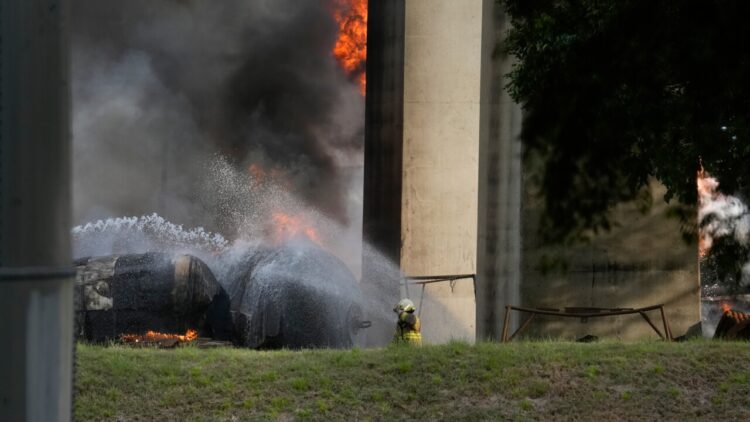
Authorities confirmed the blast which occurred on Monday afternoon, April 6, 2026 erupted at a fuel supply site beneath the bridge in the La Boca area of Panama City.

AD: Capeesh Restaurant
Initial reports from emergency services and firefighters suggest a fuel tanker truck exploded during refuelling, triggering a massive fireball that rapidly spread to nearby tanker units and engulfed a large area in flames. Disturbing footage circulating on social media showed a towering column of black smoke rising adjacent to the bridge as drivers fled and emergency crews raced to the scene.
More than 70 firefighting units and dozens of vehicles were battling the blaze by the end of the evening Panama City’s fire brigade chief said the fire was brought under control after several hours of intense work, though at great cost.
One worker at the fuel facility was confirmed dead, and multiple people were rescued with injuries ranging from mild to serious, including two firefighters who suffered burns while fighting the fire.

AD: Oysterian Sea Food Restaurant And Bar
The Bridge of the Americas, a 1,654‑metre span that connects Panama City with surrounding regions and forms part of the Pan‑American Highway, was closed to all traffic following the explosion as engineers and inspectors evaluated the possibility of structural damage from the intense heat and proximity of the fire.
Officials stressed that Panama Canal operations were not directly affected by the blast, but the closure of the bridge a vital overland artery disrupted local traffic and raised logistical headaches for commuters and freight alike.
Authorities have so far ruled out any link to sabotage or foreign interference, treating the incident as an industrial accident pending further investigation. President José Raúl Mulino took to social media platform X to update the public on the situation, urging patience and announcing that structural inspections would continue before the bridge could safely reopen.
Evidence gathered from security cameras showed the explosion sent a fiery shockwave through the refuelling area, startling motorists and residents in the vicinity. Vehicles were seen attempting to speed away from the scene even as emergency responders worked to establish a safe perimeter.
The blaze also prompted questions from local and international observers about the placement of fuel storage sites in close proximity to such critical infrastructure a concern that critics say could have had far more catastrophic consequences if the bridge had suffered significant structural compromise.
Although the Panama Canal itself has not been disrupted, the incident has nonetheless spotlighted the risks inherent in industrial operations near major transport hubs.
The Canal is a key artery in global shipping, handling an estimated three to five percent of world seaborne trade each year, and any threat even indirect to its approaches is likely to attract intense scrutiny from markets and governments alike.
In the immediate aftermath, emergency responders focused on containing residual pockets of fire and ensuring that no further explosions could occur. Fire officials said the flames had spread from the original tanker to two others in the vicinity, underscoring how quickly such incidents can escalate when volatile fuels are involved.
Officials said they would also widen their investigation to include safety and operational protocols at the fuel depot, which serves as a refuelling point for tanker trucks. Government agencies have pledged transparency throughout the inquiry, which may take days or weeks to complete as forensic teams comb through evidence.
Local residents and businesses have been left shaken by the event, with many expressing relief that the Canal itself remained unaffected and that the devastation was not worse. At the same time, the loss of life and the images of towering smoke over such a symbolic infrastructural site have prompted broader conversations about emergency preparedness and industrial safety standards in Panama.
While preliminary statements from authorities emphasise that the explosion seemed procedural rather than intentional, they have not dismissed any possibilities outright as investigators analyse mechanical failures, human error, and other potential contributing factors.
In the coming days, structural engineers will complete assessments of the Bridge of the Americas to determine whether heat exposure compromised key support elements and whether any repairs will be needed before reopening fully to traffic. Meanwhile, emergency services continue to monitor the site to prevent flare‑ups as residual fuel and damaged equipment are cleared.
Amid these efforts, the country’s transport and infrastructure ministries are said to be reviewing risk mitigation strategies to prevent similar tragedies in the future including possible changes to fuel depot location standards and emergency response protocols near critical national assets.
The Bridge of the Americas is more than a functional crossing; it is a symbol of Panama’s central role in global trade, linking not only the Pacific and Atlantic sides of the country but also connecting the continent through the Pan‑American Highway. That a single industrial accident could so dramatically threaten this artery underscores the delicate balance between economic activity and public safety.
While the investigation unfolds, the death of a worker beneath one of the nation’s most iconic bridges will likely resonate in political and policy debates over infrastructure safety for months to come. Lawmakers and regulatory agencies are already facing pressure to review safety protocols for fuel storage, handling, and emergency response, particularly in zones adjacent to critical national assets.
Public discourse has turned toward questions of accountability: how such hazards are monitored, what preventive measures were in place, and whether lessons from previous industrial incidents have been fully implemented. The incident may also affect Panama’s broader economic and social discourse. The country depends heavily on the Canal and its supporting infrastructure, and disruptions or even perceived vulnerabilities can ripple across global trade networks.

AD: Heritage And Restaurant Lounge Bar