
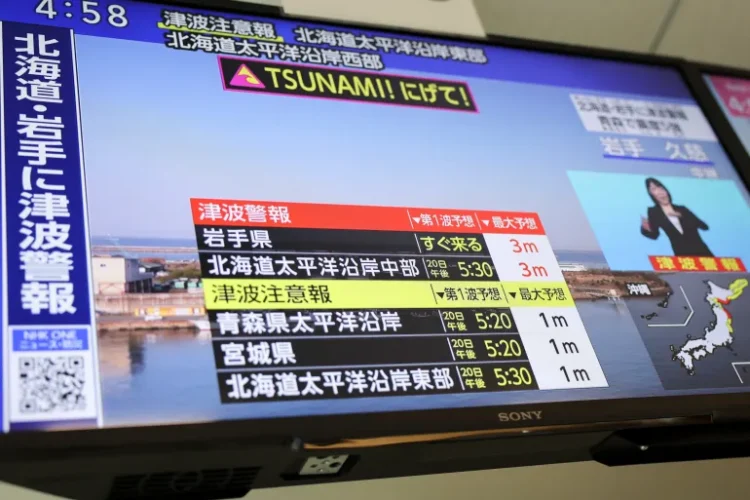
The shockwave rippled outward from the Sanriku coastline, an area etched deeply into the national memory by the catastrophic events of 2011. Within minutes of the tremor, Japan’s Meteorological Agency issued alerts warning of possible tsunami waves reaching up to three metres, prompting urgent evacuation orders in coastal communities stretching from Iwate to Aomori and into parts of Hokkaido.
Residents in low-lying towns responded with the practised urgency that has become a hallmark of Japanese disaster preparedness. Sirens sounded across fishing ports and urban centres alike, while public broadcast systems and mobile alerts instructed people to seek higher ground without delay. In towns such as Kamaishi and Otsuchi—places that bore the brunt of earlier disasters—memories of past devastation shaped the speed and seriousness of the response.
Within an hour of the quake, tsunami waves had already been recorded. Though initially measured at under a metre in some locations, authorities warned that subsequent waves could grow larger and more dangerous, particularly as night approached and visibility diminished. The uncertainty surrounding tsunami behaviour—its timing, scale, and local impact—added a layer of tension to an already volatile situation.

AD: Capeesh Restaurant
Transport systems were among the first casualties of the quake’s disruption. High-speed bullet train services, including routes connecting Tokyo to northern regions, were halted as a precautionary measure. Rail suspensions, while routine in such circumstances, underscored the severity of the tremor and the need to prevent secondary disasters caused by infrastructure failure.
At the national level, the government moved swiftly. Prime Minister Sanae Takaichi convened an emergency task force to coordinate response efforts, assess potential damage, and monitor the evolving tsunami threat. Emergency services were placed on high alert, and local authorities began accounting for residents, particularly in evacuation zones where rapid departures can complicate communication and tracking.
Despite the intensity of the earthquake, early reports indicated no immediate abnormalities at nearby nuclear facilities, a critical concern given Japan’s experience with nuclear crises following seismic events. Inspections were carried out as a precaution, reflecting both improved safety protocols and the enduring sensitivity surrounding nuclear risk in the country.

AD: Oysterian Sea Food Restaurant And Bar
The earthquake also reignited broader anxieties about Japan’s vulnerability to large-scale seismic disasters. Situated along the Pacific Ring of Fire, the country experiences frequent earthquakes, with hundreds recorded each year. While most are minor, the potential for a major quake—often referred to as a “megaquake”—remains a persistent concern among scientists and policymakers.
Recent assessments have suggested a high probability of significant seismic activity along major fault lines, particularly near Hokkaido and other northern regions. Such warnings have contributed to a heightened sense of preparedness among the population, but they have also reinforced a collective awareness that the next major disaster is not a question of if, but when.
This awareness is deeply rooted in the legacy of the 2011 Great East Japan Earthquake, one of the most devastating natural disasters in modern history. That event, which triggered a massive tsunami and a nuclear crisis, resulted in tens of thousands of deaths and long-term displacement for many communities.
Even fifteen years later, thousands remain unaccounted for, and the psychological impact continues to shape national attitudes toward risk and resilience.
In the wake of the latest quake, those memories resurfaced vividly. Evacuation drills and preparedness campaigns have ensured that many residents know exactly what to do in such situations, yet the emotional weight of past tragedies lingers.
Surveys indicate that a significant majority of the population remains concerned about the possibility of another major disaster, highlighting the enduring imprint of seismic events on the national psyche.
On the ground, the immediate priority was safety. Coastal residents moved inland or to designated shelters, often carrying emergency kits prepared in advance. Schools, community centres, and elevated structures served as temporary refuges, while local officials worked to maintain order and provide information.
The efficiency of these evacuations reflects years of investment in disaster education and infrastructure, but it also reveals the delicate balance between preparedness and vulnerability.
Meanwhile, scientists and seismologists began analysing the quake’s characteristics. Its relatively shallow depth contributed to the intensity of surface shaking, while its offshore epicentre increased the likelihood of tsunami generation. The event was classified at an “upper 5” on Japan’s seismic intensity scale, indicating strong shaking capable of causing structural damage.
Attention quickly turned to the possibility of aftershocks, which can pose significant risks in the hours and days following a major earthquake. Authorities warned that further tremors could occur, potentially destabilising already weakened structures and complicating recovery efforts.
Such warnings are a standard part of post-earthquake protocol, but they also serve as a reminder that the immediate aftermath of a quake is often just the beginning of a longer period of uncertainty.
The broader context of seismic activity in Japan underscores the importance of such vigilance. The country experiences dozens of measurable earthquakes each week, most of which pass without incident. However, the accumulation of smaller events can sometimes precede larger ones, and the complex interplay of tectonic forces beneath the Japanese archipelago makes precise prediction difficult.
In recent months, several moderate earthquakes have been recorded across different regions of Japan, including tremors in Kyushu and the Volcano Islands. While these events caused limited damage, they contributed to an ongoing pattern of seismic activity that keeps both authorities and residents on alert.
The April 20 earthquake fits into this broader pattern, yet its scale and location elevate its significance. The Sanriku coast, in particular, is known for its vulnerability to tsunami amplification due to its geography, which can funnel and intensify incoming waves. This makes even relatively modest tsunamis potentially dangerous, especially in densely populated or industrial areas.
As night fell over the affected regions, the situation remained fluid. Emergency services continued to monitor sea levels, assess infrastructure, and respond to any reports of damage or injury. The absence of immediate catastrophic outcomes offered some reassurance, but the potential for delayed impacts—whether from aftershocks, structural failures, or subsequent waves—kept communities on edge.
In many ways, the response to this earthquake illustrates both the strengths and limitations of modern disaster management. Japan’s advanced warning systems, robust infrastructure, and highly trained emergency services have significantly reduced the risks associated with seismic events. Yet even with these measures in place, the fundamental unpredictability of earthquakes means that complete safety can never be guaranteed.
Each earthquake, whether minor or major, reinforces the need for preparedness while also testing the resilience of communities and institutions. At the same time, the human dimension—how individuals and communities experience and respond to such events—will continue to shape Japan’s approach to living with seismic risk.
In the end, the earthquake is both a moment and a message: a sudden disruption that reveals the fragility of human systems, and a reminder of the enduring need to coexist with the powerful natural forces that define the region.

AD: Heritage And Restaurant Lounge Bar