
By Isabelle Wilson
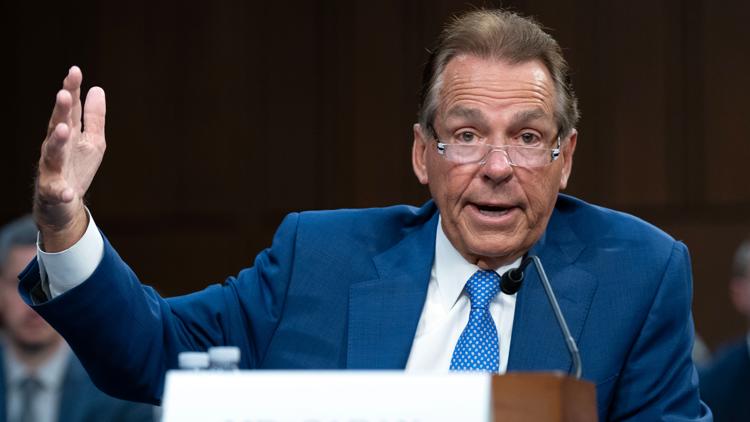
Former Alabama head coach Nick Saban’s appearance before Congress has injected one of college football’s most recognisable voices into an escalating political and economic battle over the future of collegiate athletics, as lawmakers push sweeping federal legislation aimed at regulating name, image and likeness (NIL) payments, transfers, and conference power while the sport’s most dominant conferences, the SEC and Big Ten, mount firm resistance.
Saban’s testimony in Washington comes at a moment when college sports is undergoing its most profound transformation in decades. The bipartisan bill under review in the Senate seeks to impose national standards on athlete compensation, restrict unlimited transfers, and create a uniform framework intended to stabilise a system many lawmakers argue has become chaotic and inconsistent across state lines.

AD: Capeesh Restaurant
Supporters say the measure is designed to preserve competitive balance and prevent an unchecked free market from eroding the traditional structure of college athletics.
But the proposal has quickly become a flashpoint between lawmakers and the sport’s most powerful stakeholders. While dozens of smaller conferences and several athletic leaders have expressed support, the SEC and Big Ten have raised strong objections, warning that the bill could undermine existing revenue structures and concentrate regulatory power in Washington in ways that harm the sport’s financial ecosystem.
Saban, widely regarded as one of the greatest coaches in college football history, told senators that the current NIL and transfer environment has created instability that threatens the integrity of competition. His argument aligns closely with lawmakers such as Sen. Ted Cruz and Sen. Maria Cantwell, who has framed the legislation as a necessary intervention to “save college sports” from fragmentation and unchecked commercial pressures.

AD: Oysterian Sea Food Restaurant And Bar
At the heart of the bill are provisions that would place limits on athlete mobility most notably restricting players to a single “free” transfer without penalty and introduce standardised rules for athlete compensation and eligibility. Another controversial element includes potential constraints on coaching movement and midseason departures, a proposal supporters say is meant to ensure program stability.
Saban’s endorsement carries particular symbolic weight because of his decades-long influence on the sport and his history of advocating for structural reform. Even after retiring from coaching, his views remain deeply influential among athletic directors, conference officials, and policymakers who see him as a rare bridge between the sport’s traditional power structure and its modern commercial realities.
The Senate Commerce Committee hearing itself reflects growing bipartisan urgency to address college sports reform at the federal level. Lawmakers have increasingly argued that the current patchwork of state NIL laws and NCAA policies has created uneven recruiting advantages and legal uncertainty that only Congress can resolve through national standards.
Still, the legislation is far from guaranteed passage. Even as it gains momentum in committee, it faces resistance not only from conferences but also from lawmakers who question whether federal oversight is appropriate in a system historically governed by private associations and universities.
The strongest opposition to the bill has come from the SEC and Big Ten, which together dominate college football’s television revenue, playoff influence, and national visibility. The conferences argue that federal intervention risks disrupting media rights deals, reducing flexibility in scheduling, and weakening the financial model that supports both high-revenue sports and Olympic programs across their institutions.
Their concerns are rooted in broader structural disputes over control of the sport. The SEC and Big Ten have already signaled opposition to elements of earlier reform frameworks that would centralise media rights or redistribute revenue across conferences, arguing that such models would reduce overall earnings and diminish competitive incentives.
Conference officials also contend that the bill fails to adequately preempt conflicting state laws, a point they describe as essential for any workable national system. Without uniform federal authority overriding state-level NIL rules, they argue, schools would remain trapped in a fragmented regulatory environment that continues to escalate legal disputes and competitive imbalance.
Within economics, the resistance also reflects a philosophical divide over who should control college athletics. The SEC and Big Ten have positioned themselves as stewards of a decentralised system that rewards market success, while critics of the conferences argue they are primarily motivated by protecting their dominance over television contracts and playoff access.
The tension was underscored by a joint statement issued by the Big Ten and SEC shortly before the Senate Commerce Committee hearing, in which the two most powerful conferences in college athletics formally announced their opposition to the “Protect College Sports Act” in its current form.
According to reports, the conferences argued that the bill fails to adequately resolve “critical issues,” particularly its inability to meaningfully preempt the growing patchwork of state NIL laws that they say is essential for any functional national framework. Without uniform federal authority, they contend, schools would remain bound to inconsistent state-by-state regulations that complicate compliance, encourage legal disputes, and contribute to competitive imbalance across college athletics.
The joint stance also signals a rare moment of alignment between the SEC and Big Ten, two leagues that collectively dominate television revenue, national exposure, and College Football Playoff influence, placing them at odds not only with lawmakers behind the bill.
But also with other Division I conferences such as the ACC and Big 12, which have expressed greater openness to federal intervention as a stabilising force in a rapidly evolving NIL and transfer portal era. The bill moves through Congress, the political fight is expected to intensify, with lobbying efforts from universities, athletic associations, and media partners all shaping its trajectory. The outcome could redefine how college sports operates for decades determining everything from player mobility to how billions in television revenue are distributed across the country.
Saban’s endorsement has added credibility to reform efforts, but the SEC and Big Ten’s opposition ensures that any path forward will be contested, complex, and deeply tied to the financial power structures that have long defined American college athletics.
The presence of a figure like Saban whose coaching legacy is intertwined with multiple national championships and decades of influence over the sport’s competitive and administrative evolution gives lawmakers a persuasive talking point when arguing that the current system is unsustainable.
His support reinforces the idea that even those who benefited most from the existing structure now see the need for standardised rules governing athlete compensation, transfers, and eligibility. However, that momentum collides with the entrenched economic interests of the SEC and Big Ten, which sit at the center of college football’s media rights ecosystem and drive a disproportionate share of national revenue.
Their resistance reflects not just disagreement over policy details but a broader struggle over who controls the future of the sport: Congress, the NCAA, or the conferences themselves. Any legislative compromise will likely require balancing athlete rights and national consistency with the financial realities of billion-dollar television deals and conference-driven governance models.
Negotiations continue, the debate is expected to intensify, with stakeholders on all sides attempting to shape a system that protects competitive fairness without destabilising the commercial foundation that now underpins college athletics.

AD: Heritage And Restaurant Lounge Bar