
By Isabelle Wilson-
A high-profile federal case stemming from a violent confrontation outside a Texas immigration detention facility has concluded with eight defendants sentenced to decades in prison, marking one of the most severe punishments handed down in recent protest-related prosecutions in recent years.
According to reports, the sentences ranging from 30 to 100 years were issued after convictions linked to a July 4 incident at the Prairieland Detention Center near Dallas, where prosecutors said a coordinated protest escalated into an armed attack that left a police officer injured. The harsh rulings immediately ignited debate over the boundaries between political protest and criminal conduct, as well as the broader federal response to politically charged demonstrations tied to immigration enforcement, according to reports.

AD: Capeesh Restaurant
This highlighted how the case has divided opinion over whether the events outside the Texas immigration facility should be interpreted primarily as protected protest activity or as criminal violence under federal law. Prosecutors, described the incident as a coordinated and violent escalation involving firearms and organised action during an attack on a federal detention site, arguing that the conduct went far beyond lawful demonstration.
Defence attorneys argued that the defendants were participating in a protest in solidarity with detained migrants, maintaining that the actions of some individuals were mischaracterised or should be treated as isolated incidents within a broader gathering rather than evidence of a unified violent plan.
The sentencing underscores an increasingly tense national environment in which immigration enforcement protests have become a flashpoint for broader political conflict, particularly when demonstrations intersect with allegations of organised militancy or extremist ideology. Court records and trial reporting indicate that the incident unfolded during a Fourth of July gathering outside the Prairieland facility, where protesters initially assembled to stage a demonstration against immigration detention practices.

AD: Oysterian Sea Food Restaurant And Bar
According to reports, what began as a planned protest escalated after some participants vandalized property, set off fireworks, and damaged facility infrastructure, including security equipment and vehicles .
Prosecutors alleged that the situation intensified further when law enforcement arrived and one individual opened fire with an AR-style rifle, striking a responding officer. The officer survived, but the incident quickly became the centerpiece of a broader federal case that framed the event as an organised assault rather than spontaneous civil disobedience.
According to the U.S. Department of Justice, eight defendants were convicted on terrorism-related charges arising from the attack on the Prairieland Detention Center in Texas, including counts involving the provision of material support for terrorism and participation in violent criminal activity directed at a federal facility.
Federal prosecutors argued that the defendants operated as part of a coordinated group that planned and executed disruptive and violent actions against the detention center, culminating in an armed confrontation that injured a local police officer.
The Justice Department said evidence presented at trial included weapons, tactical equipment, and communications among participants that prosecutors contended demonstrated planning, coordination, and intent. Officials maintained that the attack was not a spontaneous protest but a deliberate operation targeting federal immigration infrastructure and law enforcement personnel.
Judge Reed O’Connor, who oversaw the sentencing, said the conduct crossed a clear legal boundary. He described the episode not as protected protest activity but as an “assault on democracy,” emphasising deterrence as a central justification for the lengthy prison terms.
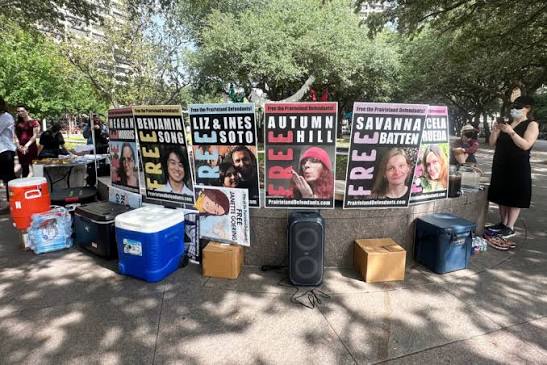
The most severe sentence was handed to Benjamin Song, a former U.S. Marine Corps reservist identified by prosecutors as the individual who fired the shot that injured a police officer. He received a 100-year sentence, while the remaining defendants received terms ranging from three to seven decades in prison .
The case has rapidly become a focal point in a wider debate over how far authorities should go in prosecuting politically motivated demonstrations that turn violent. Supporters of the convictions argue that the scale of the violence and the use of firearms justified terrorism-related charges and lengthy sentences, particularly given the risks to law enforcement personnel responding to the scene.
Critics including legal observers and defence attorneys, have raised concerns about proportionality and precedent. They argue that the sentences some exceeding those typically associated with homicide cases raise questions about whether political context is influencing prosecutorial strategy and sentencing severity.
Some legal analysts cited in coverage compared the penalties to other high-profile protest cases, arguing that sentencing disparities may reflect shifting political priorities in federal enforcement.
Defense attorneys also maintain that many of the defendants did not participate in any violent conduct and were present for lawful protest activity, insisting that individual culpability was not properly distinguished during trial. Appeals are expected, and lawyers for several defendants have already signalled their intent to challenge both the convictions and sentencing structure.
Federal officials have pointed to a broader pattern of increased confrontations at immigration-related facilities, arguing that law enforcement agencies have faced rising levels of hostility and organised resistance during enforcement operations.
The case is likely to have lasting implications for how future protest-related incidents are investigated and prosecuted, particularly when they involve allegations of coordination, weapon use, or damage to federal property.
Legal experts note that the use of terrorism-related charges in domestic protest cases remains relatively rare, but the outcome of this case may influence how prosecutors approach similar incidents going forward.
The ruling has also raised concerns about the boundaries of lawful protest and the potential chilling effect on activism near federal facilities. Civil liberties advocates warn that the precedent could lead to more aggressive classification of protest activity as organised criminal conduct, especially in politically sensitive contexts.

AD: Heritage And Restaurant Lounge Bar