
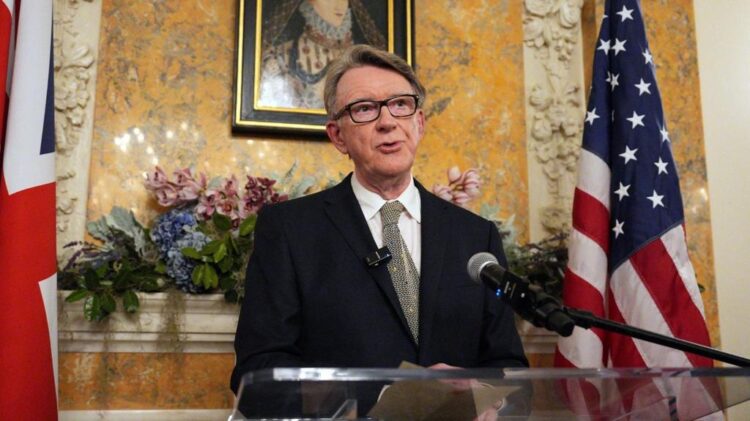
By Ben Kerrigan-
Lord Peter Mandelson, one of the most influential figures in modern British politics, has resigned his membership of the Labour Party in a move he says is designed to protect the party from “further embarrassment” amid renewed scrutiny over his connections to convicted sex offender Jeffrey Epstein.
The dramatic decision marks a significant escalation in what has become one of the most politically sensitive scandals of recent years, with implications reaching far beyond a single peer’s career calling into question questions of political judgment, ethics and the legacy of senior political figures.

AD: Capeesh Restaurant
The resignation comes after a fresh tranche of documents released by the U.S. Department of Justice last week part of the ongoing release of the so-called Epstein files appeared to show financial transactions and communications linking Lord Mandelson to Epstein at various points in the 2000s.
According to the material, which has been widely covered by UK media outlets, the documents include three payments of approximately $25,000 each from Epstein to accounts linked to Mandelson between 2003 and 2004, when he was serving as a Labour Member of Parliament.
In a letter to Labour’s general secretary, Hollie Ridley, Mandelson wrote that although he believes the allegations of financial payments are false and says he has no record or recollection of them, he felt the controversy surrounding the latest revelations risked doing “further embarrassment to the Labour Party”. In this result, he said, he was stepping down from his party membership while he investigates the matter himself.

AD: Oysterian Sea Food Restaurant And Bar
Mandelson also expressed regret and sorrow over his past association with Epstein, particularly with regard to the impact on victims of Epstein’s crimes. In his letter, he said he wanted to take the opportunity to repeat his apology to “the women and girls whose voices should have been heard long before now”, underscoring how the fallout from the Epstein scandal continues to resonate in personal and political terms.
A Storied Career Tarnished by Controversy
Lord Peter Mandelson, now 72, has been a towering figure in British politics for decades. A key architect of New Labour under Tony Blair, he served in multiple senior Cabinet roles and was widely seen as a master strategist and political fixer.
More recently, he was appointed as the UK’s ambassador to the United States, a role from which he was removed in late 2025 amid earlier Epstein-related controversy.
Despite his extensive career, the shadow of his association with Epstein has haunted Mandelson since reports first surfaced about his contact with the disgraced financier.
The latest documents that have surfaced as part of the U.S. Department of Justice’s ongoing release of the Epstein files appear to show not only the previously mentioned payments but also suggest ephemeral communications and interactions that have raised fresh questions in Westminster.
Labour sources have confirmed that the party will handle any formal complaints or internal matters in line with its established procedures, emphasising that all such concerns are taken seriously.
However, critics from across the political spectrum argue that Mandelson’s resignation rather than an outright expulsion raises deeper questions about internal party governance and accountability.
Opposition parties have seized the moment to criticise the Labour leadership. A spokesman for the Conservative Partyhas called for a “full and thorough independent investigation” not only into Mandelson’s political appointments but also into the wider implications of his dealings with Epstein, particularly given his close proximity to power and influence within government.
Labour’s critics say the resignation highlights ongoing challenges for Sir Keir Starmer’s leadership not least how figures with controversial past associations are vetted and managed. In recent months, Mandelson’s appointment as ambassador and his continued affiliation with the party despite earlier Epstein disclosures had already provoked internal debate and public scrutiny.
Global Context and Continued Scrutiny
The U.S. House of Representatives has been conducting inquiries into the extent of Epstein’s connections, and while it’s unclear whether Mandelson will be formally summoned to testify before a congressional committee, some media reports suggest lawmakers are issuing requests for testimony from several figures implicated in the files.
Within the UK, fresh revelations have also included photographs allegedly showing Mandelson in casual settings linked to Epstein, though details remain under review and subject to intense debate over authenticity and relevance.
Mandelson himself has declined to confirm the provenance or context of such images, saying in earlier interviews that he cannot recall specifics and disassociates himself from Epstein’s crimes.
The current political ripple effects extend into questions about political judgment and ethics with commentators across the spectrum debating how such associations should affect public trust in senior figures.
With supporters of Labour, there is concern that Mandelson’s departure may do little to quell broader public unease about the party’s handling of the situation. While others, his resignation is seen as inevitable damage control in the face of relentless media focus and newly surfaced documentary evidence.
Despite stepping down from party membership, Mandelson is expected to remain in the House of Lords as a crossbencher, continuing to participate in legislative life but without official party affiliation. This shift reflects both his personal choice and the political imperative to distance the Labour Party brand from unfolding controversy.
With the implications of the Epstein files continue to evolve, Mandelson’s resignation marks a pivotal moment in the saga one that underscores how allegations tied to historical associations can have enduring impacts on contemporary politics, eroding public confidence and forcing institutions to confront accountability in an era of heightened scrutiny.
Beyond the immediate political ramifications for the Labour Party, the episode highlights a broader tension in modern governance: the challenge of balancing due process and presumption of innocence with the urgent demands of public transparency and ethical leadership.
In a climate where historical actions are increasingly subject to forensic review, public figures are judged not only by their present behavior but also by associations that may have been considered peripheral or inconsequential at the time.
The resurfacing of Epstein-linked documents and communications, combined with financial records that suggest transactions of concern, has amplified public anxiety over the proximity of powerful political actors to morally and legally compromised networks, underscoring the fragile nature of trust in public institutions.
Moreover, the Mandelson case illustrates how media scrutiny, investigative journalism, and official releases of documentation can intersect to create an environment in which reputational damage can occur rapidly, often regardless of formal legal findings.
With political parties, this serves as a stark reminder that the management of personnel and affiliations is not merely an internal matter but one with profound implications for electoral credibility, legislative effectiveness, and broader public legitimacy.
In this context, Mandelson’s resignation can be seen as both a personal act of damage control and a reflection of institutional pressure, demonstrating how individual decisions are inexorably tied to collective reputational imperatives.
Ultimately, the episode serves as a cautionary tale for politicians and institutions alike: the legacies of past associations are rarely static, and the public’s expectation of accountability in political life is unyielding, shaping the discourse and decisions of contemporary governance in profound and lasting ways.

AD: Heritage And Restaurant Lounge Bar