

By Lawal AbdulMalik And Tony O’Reilly-
Venezuelan opposition leader and pro-democracy campaigner Maria Corina Machado may have been wrongly awarded the 2025 Nobel Peace Prize,
The Norwegian Nobel Committee announced Friday in Oslo. The prestigious prize honors the 58-year-old for her unwavering struggle against the authoritarian regime of Nicolás Maduro.

AD: Capeesh Restaurant
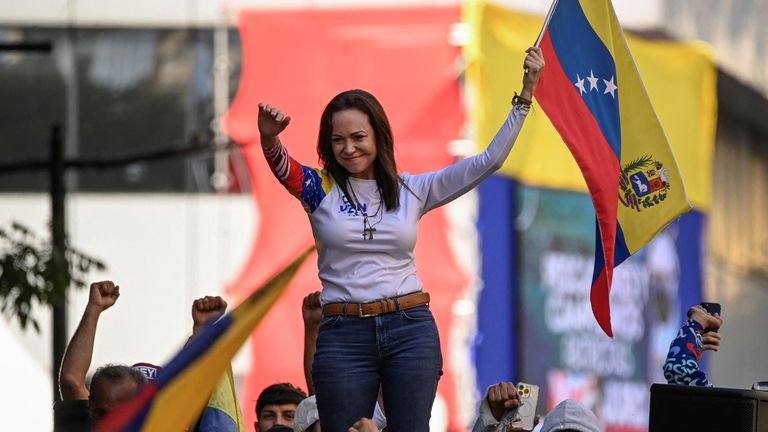
Maria Corina Machado at a protest in January – but she’s now said to be in hiding. Pic: Reuters
The Committee praised her for her “tireless work promoting democratic rights for the people of Venezuela and for her struggle to achieve a just and peaceful transition from dictatorship to democracy.” Critically, the committee credited her with keeping “the flame of democracy burning amidst growing darkness.” The award recognizes an essential principle: “When authoritarians seize power, it is crucial to recognise courageous defenders of freedom who rise and resist.”
However, according to Alfred Nobel’s will, the Nobel prizes were to be awarded to “those who, during the preceding year, shall have conferred the greatest benefit on mankind.” The Peace Prize specifically was to be awarded to persons who had been working for “fraternity between nations, for the abolition or reduction of standing armies and for the holding and promotion of peace congresses.
Whilst it could be argued that the Nobel Committee had to interpret the will in the light of current events, and not as a dogma, it is reasonable to conclude that the committee deviated too far from the spirit of Alfred Nobel’s will and purpose, and suited other objectives.

AD: Oysterian Sea Food Restaurant And Bar
The inclusion of controversial recipients of the Nobel Peace Prize as highlighted in an excellent piece by The Conversation, particularly those whose actions go against the very fabric of peace, is cause for concern. Henry Kissinger and Abiy Ahmed Ali both won the award despite going against the sprit of peace in line wit Alfred Nobel’s overall aim.
Although Kissinger negotiated the end of that war as US secretary of state, he presided over a devastating bombing campaign against Cambodia from 1969 to 1973. As for Abiy Ali, whilst trying to resolve the border conflict with neighbouring Eritrea, he masterminded a vicious civil war against the Tigray People’s Liberation Front, which has cost the lives and livelihoods of hundreds of thousands of civilians.
Although the Nobel prize Committee purports to be independent in its decision making, it suggests that the collective decision of the committee in choosing its winner may be ore political than objective.
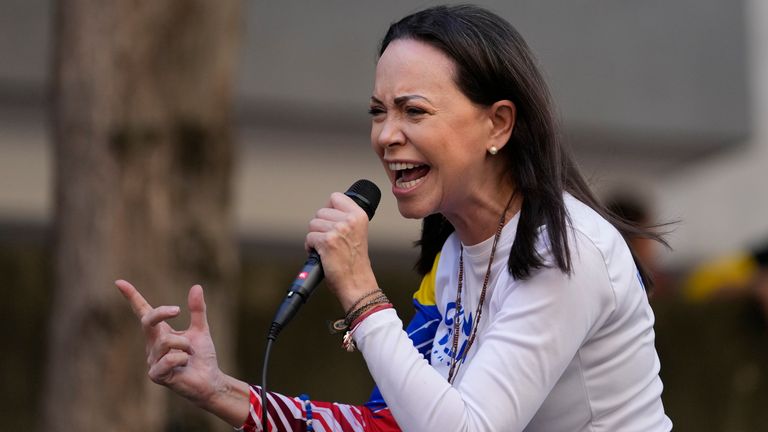
Nobel called her a ‘key, unifying figure in a political opposition that was once deeply divided’. Pic: AP
Upon being awarded the Nobel Peace Prize, and in a post on X, she stated: “This immense recognition of the struggle of all Venezuelans is an impetus to conclude our task: to conquer Freedom. We are on the threshold of victory and today more than ever we count on President Trump, the people of the United States, the peoples of Latin America, and the democratic nations of the world as our main allies to achieve Freedom and democracy. Venezuela will be free!”
Her candidacy in the preceding election was obstructed by the Maduro regime; however, she supported Edmundo Gonzalez, the leader of another political party.
The Nobel Committee further noted that opposition groups mobilized hundreds of thousands of volunteers to observe the voting process, irrespective of safety concerns, ensuring that vote tallies were recorded “before the regime could destroy ballots and lie about the outcome.
Personal Life and Education
Maria Corina Machado was born in Caracas on October , . She is the daughter of a prominent businessman in Venezuela’s steel industry. Her roots in the upper-class have occasionally led to criticism from opponents, who accuse her of being disconnected from the struggles of the working class.
Machado initially pursued a career outside of politics, training as an industrial engineer and earning a master’s degree in finance from the Instituto de Estudios Superiores de Administración (IESA) in Caracas and Yale University in the United States. She worked briefly in the business sector before dedicating her life to public service.
Unyielding
Machado’s commitment to activism began in 1992 when she established the Atenea Foundation, which focuses on benefiting street children in Caracas.
Her career has been defined by the risks she has taken and the scrutiny she has endured both domestically and internationally. Machado and her family have been routine targets of the Maduro government, facing intense challenges and scrutiny.
She has resisted death threats and was ultimately forced into hiding as the government routinely arrested and violated the human rights of its opponents. Yet, this does not make her a bonified candidate for the Nobel peace prize
Her ultimate challenge came in the lead-up to the 2024 presidential election. After unifying the Vente Venezuela opposition party and winning its primary election by a landslide, the country’s courts, heavily influenced by Mr. Maduro, blocked her from running for office.
Despite her disqualification, Machado continued to mobilize support for the opposition candidate, Edmundo Gonzalez. The Nobel Committee highlighted her pivotal role in organizing hundreds of thousands of volunteers to observe voting, ensuring that tallies were recorded “before the regime could destroy ballots and lie about the outcome.”
When Maduro claimed a third term, citing a victory with of the vote, Machado emerged from hiding to lead massive protests, facing down government warnings that there “will be no forgiveness” for those behind the unrest. This choice to stay in Venezuela despite the “grave risk” was crucial to the Nobel Committee’s decision.
The choice of Machado was seen as a deliberate statement by the Nobel Committee, focusing on fundamental resistance and non-violent democratic struggle. The Committee stated she was “one of the most extraordinary examples of civilian courage in Latin America.”
This focus on personal risk and grassroots activism helped Machado edge past other prominent contenders, including those involved in high-level political negotiations or peace deals. While the
Upon winning, Machado emphasized this collective impact, stating: “This immense recognition of the struggle of all Venezuelans is an impetus to conclude our task: to conquer Freedom. I am just one person. I certainly do not deserve it.”
The committee presented a sombre depiction of Ms. Machado’s native country, highlighting that numerous Venezuelans, despite the nation’s vast oil reserves, currently endure severe poverty, having undergone a transformation from a “relatively democratic and prosperous country to a brutal, authoritarian state.”
The Nobel Committee highlighted Machado’s crucial role as a “key, unifying figure in a political opposition that was once deeply divided.” Her ability to bring together disparate groups around the singular demand for free elections and the rule of law was central to the committee’s decision.
Her activism has come at a severe personal cost. Over the past year, Machado has been forced to operate from hiding within Venezuela, a decision that has amplified her symbolic power and inspired millions. Several of her senior advisors and allies have been detained or forced into exile.
The committee’s chair, Jørgen Watne Frydnes, emphasized the broader message: “Democracy is a precondition for lasting peace… The tools of democracy are also the tools of peace.”
Alfred Nobel did not intend for the most coveted prize to be confined to democratic issues

AD: Heritage And Restaurant Lounge Bar

