
By Aaron Miller-
More than 50,000 residents across parts of Southern California remained under evacuation orders Sunday as emergency crews raced to prevent a volatile chemical tank from exploding at an aerospace manufacturing facility in Garden Grove, triggering one of the region’s most serious industrial emergencies in recent years.
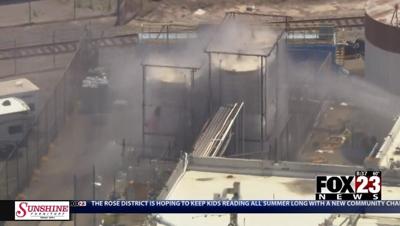
The crisis centers on a pressurised storage tank at the GKN Aerospace facility that contains between 6,000 and 7,000 gallons of methyl methacrylate, a highly flammable industrial chemical commonly used in plastics and aerospace manufacturing.

AD: Capeesh Restaurant
Authorities say the tank overheated late Thursday after a malfunctioning valve failed to release pressure properly, raising fears of either a catastrophic explosion or a toxic chemical release.
Firefighters from the Orange County Fire Authority have spent days spraying the tank with water from a distance in an effort to lower its temperature and stabilise the chemical reaction occurring inside. Officials said the situation remains unpredictable, with temperatures continuing to fluctuate despite cooling efforts.
Governor Gavin Newsom declared a state of emergency as state and federal agencies mobilised hazardous materials experts to assist local responders. Emergency officials expanded evacuation zones across six Orange County cities, including parts of Anaheim, Westminster, Cypress, Stanton and Buena Park, as concern mounted that a rupture could send toxic vapor across densely populated neighborhoods.

AD: Oysterian Sea Food Restaurant And Bar
Authorities warned that methyl methacrylate exposure can lead to severe respiratory distress, eye irritation, dizziness and nausea. The Environmental Protection Agency has so far reported no dangerous air contamination outside the evacuation perimeter, though monitoring teams continue to test conditions around the clock.
“This thing is going to fail unless we stop it,” Orange County Fire Authority Division Chief Craig Covey said during a weekend briefing, describing the emergency as unprecedented and warning that responders are confronting a scenario with limited historical comparisons.
The facility sits only a few miles from major tourist destinations, including Disneyland Resort and Knott’s Berry Farm, though officials stressed that neither attraction currently falls within the evacuation zone. Nonetheless, the incident has cast a shadow over the Memorial Day weekend, with roads congested by residents fleeing the area and emergency shelters rapidly filling with displaced families.
Residents Flee as Officials Warn of Uncertain Outcome
Across Orange County, evacuation centers opened inside schools and community buildings as residents scrambled to secure temporary housing. Some evacuees arrived carrying pets and essential belongings, uncertain whether they would be allowed to return home within days or weeks.
Officials acknowledged growing frustration among residents, many of whom complained about conflicting information and the emotional strain of the evacuation. Police said several thousand people initially refused to leave despite repeated warnings that an explosion could scatter debris and release dangerous chemical plumes over a wide radius.
Garden Grove Mayor Stephanie Klopfenstein urged residents to comply fully with evacuation orders, warning that conditions around the tank could deteriorate quickly. “This is a serious situation,” she said during a public update. “Now is not the time to wait.”
Emergency responders have also prepared for the possibility of a major spill. Crews installed protective barriers and drainage controls designed to stop contaminated runoff from entering waterways and storm drains if the tank ruptures. Specialists from across California and other states have joined the operation, exploring unconventional methods to stabilise the volatile chemical.
Officials say the damaged tank’s relief valves became “gummed up,” preventing responders from safely releasing pressure or transferring the chemicals into another container. The failure has complicated every aspect of the emergency response and forced firefighters to rely on external cooling methods while experts attempt to determine whether the chemical can safely solidify inside the tank.
Lee Zeldin, head of the United States Environmental Protection Agency, said Sunday that federal officials believe the most likely outcome remains a “low-volume release” rather than a massive explosion. Even so, authorities emphasized that conditions remain unstable and that the possibility of a larger disaster has not been eliminated.
Health experts say the chemical involved poses particular concern because it is heavier than air, meaning vapor clouds could linger near ground level if released. Dr. Regina Chinsio-Kwong of the Orange County Health Care Agency warned that prolonged exposure could create serious breathing complications, especially for children, elderly residents and people with underlying medical conditions.
The unfolding emergency has also triggered legal action. Residents living inside the evacuation perimeter filed a class-action lawsuit against GKN Aerospace, arguing that the company failed to prevent foreseeable industrial hazards and that surrounding property values could suffer lasting damage regardless of the outcome.
“There is no good outcome here for the people who live nearby,” attorneys representing residents said in a statement accompanying the lawsuit.
Company representatives apologized to residents and businesses affected by the evacuation, saying they are cooperating fully with emergency crews and hazardous materials teams. In a public statement, the aerospace manufacturer said it was “working tirelessly” to resolve the crisis safely and thanked emergency personnel for their efforts.
The incident has renewed scrutiny of industrial safety regulations across California, particularly in densely populated urban areas where hazardous materials are stored near homes, schools and commercial districts. Environmental advocates say the emergency highlights the growing risks associated with aging industrial infrastructure and insufficient oversight of chemical storage facilities.
Firefighters continue their race against time. Water cannons remain fixed on the unstable tank while drones monitor surface temperatures and hazmat teams prepare for multiple worst-case scenarios. Officials have not provided any timeline for when evacuation orders might be lifted.
The standoff entered another tense day Sunday as thousands of Southern California residents remained displaced from their homes, anxiously awaiting word on whether emergency crews could bring the unstable chemical tank under control before disaster strikes.
Across Orange County, evacuation shelters filled with families carrying overnight bags, medications and pets, many uncertain about when or if they would be allowed to return home safely. Traffic congestion stretched for miles around evacuation zones as authorities maintained roadblocks and expanded security perimeters around the industrial site.
Firefighters continued operating around the clock, using high-powered water cannons and thermal imaging drones to monitor the tank’s temperature for any sudden changes that could signal an imminent rupture. Hazardous materials specialists from state and federal agencies worked alongside local crews, exploring options to safely relieve pressure inside the vessel without triggering a chemical reaction.
Residents described an atmosphere of fear and exhaustion as emergency alerts repeatedly warned of the possibility of a toxic release. Businesses inside the evacuation area remained shuttered, while schools and community centers were converted into temporary shelters for displaced families.
Officials urged residents to remain patient and avoid returning to restricted areas, emphasising that the situation remained volatile and could change rapidly with little warning.

AD: Heritage And Restaurant Lounge Bar