
By James Simons-
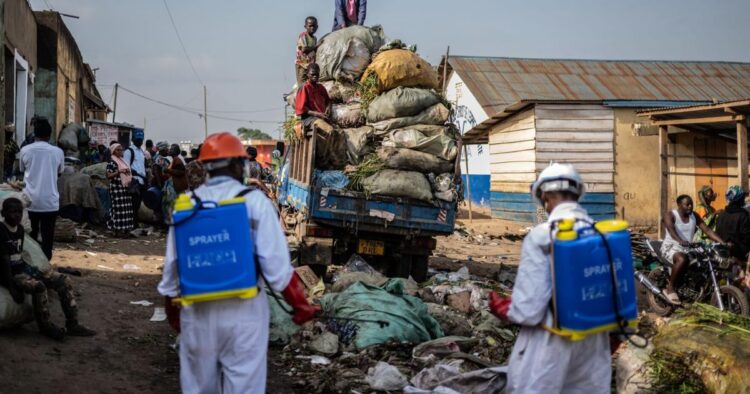
The Democratic Republic of Congo is once again confronting an Ebola outbreak in its volatile eastern provinces, but this time the virus is spreading through an even more complex battlefield one shaped by armed rebellion, shrinking international aid, and rising public anger at authorities and responders.
In Ituri Province and neighbouring areas, health officials are racing to contain the Bundibugyo strain of Ebola, a form of the virus for which there is no approved vaccine or treatment, while simultaneously navigating insecurity that has made basic containment measures nearly impossible.

AD: Capeesh Restaurant
According to health authorities and international agencies, hundreds of suspected cases have been recorded in recent weeks, with deaths climbing steadily as surveillance systems strain under pressure.
The World Health Organisation (WHO) has warned that the outbreak carries a “very high” national risk, with transmission driven not only by the virus itself but also by population displacement, mistrust, and violence in a region long affected by armed groups such as the M23 rebels and the Islamic State-linked Allied Democratic Forces.
The outbreak began in remote mining and rural areas, but mobility across conflict zones has allowed the virus to move faster than health teams can track.

AD: Oysterian Sea Food Restaurant And Bar
A health system under siege
Frontline responders describe an environment where responding to Ebola is as much a security operation as a medical one. In parts of Ituri, clinics and treatment centres have been attacked or vandalised by communities angered by isolation protocols and forced burial practices, reflecting deep mistrust of both government and international agencies.
In some cases, Ebola treatment facilities have been set on fire after disputes over containment measures, further reducing already limited capacity to isolate patients safely.
The situation is compounded by chronic instability. Eastern Congo hosts more than 100 armed groups operating across fragmented territory, making many outbreak zones inaccessible without security escorts. Humanitarian workers have been forced to suspend outreach campaigns in some areas due to threats and violence, leaving gaps in surveillance and contact tracing.
Analysts say the outbreak is now unfolding in a “perfect storm” environment where conflict and disease reinforce each other, a pattern seen in previous Ebola crises but intensified by current conditions.
Compounding these challenges is the lack of effective medical countermeasures for the Bundibugyo strain. Unlike previous Ebola outbreaks dominated by the Zaire strain, which has experimental vaccines available, this variant has no approved vaccine or treatment, leaving health teams reliant on supportive care and containment rather than immunisation campaigns. Isolation, tracing, and safe burials remain the only tools available but all depend on access and trust, both of which are in short supply.
Aid cuts and rising anger
Humanitarian organisations and aid workers say recent Western aid cuts have reduced surveillance capacity, forced the scaling back of field programmes, and left health systems with fewer staff and weaker outbreak detection networks in eastern Congo.
These reductions have had cascading effects. Without sufficient funding, laboratories struggle to process test samples quickly, while contact tracing teams are often understaffed or unable to reach remote villages. In some areas, community health programmes that previously helped build trust between residents and responders have been scaled back or suspended entirely, leaving misinformation to spread more quickly than official guidance.
The World Health Organisation and partner agencies have deployed emergency teams and supplies, but officials acknowledge that the scale of the outbreak is outpacing available resources.The International Rescue Committee and Médecins Sans Frontières have both warned that insecurity combined with funding gaps has left responders “flying blind” in some of the most affected regions, where surveillance systems were already fragile before the outbreak began.
Meanwhile, frustration among local communities is rising. Many residents in affected provinces express anger at what they see as external interference, particularly around burial restrictions and quarantine measures. These tensions are not new in Ebola responses in Congo, but they are being amplified by years of conflict, poverty, and perceived neglect from both national authorities and international donors.
Public health experts warn that this mistrust is now one of the most dangerous drivers of transmission. When families avoid reporting symptoms, hide patients, or resist safe burial teams, chains of infection can continue undetected. In densely populated displacement camps now home to more than a million people fleeing violence overcrowding and limited sanitation further increase the risk of spread.
Despite these obstacles, health officials continue to push for containment, relying on community engagement, emergency funding appeals, and cross-border coordination with Uganda, where a small number of linked cases have already been detected. The WHO has urged intensified international support, warning that without immediate action, the outbreak could expand far beyond its current epicentre.
Congo’s Ebola response remains locked in a precarious struggle, one where the virus is only part of the threat. Armed conflict, shrinking aid, and deep public anger are not just complicating the response; they are actively shaping how and where the disease spreads, turning containment into a race against both biology and instability.
In the eastern provinces, especially in areas such as Ituri and North Kivu, health workers often operate in conditions where access can shift overnight depending on clashes between armed groups and government forces. Entire villages may become unreachable for days or weeks, forcing surveillance teams to rely on incomplete information while infections continue to circulate unnoticed.
This fragmentation of access has direct epidemiological consequences. Ebola containment depends on rapid identification of cases, immediate isolation, and tracing of contacts, but each of these steps is disrupted when roads are blocked, clinics are shuttered, or responders require military escort to enter affected zones. In such conditions, even a small cluster of infections can expand quietly before authorities are aware of its full scope.
The mobility of displaced populations further complicates tracking, as families flee violence and move across provincial or even national borders, carrying the risk of transmission into new communities. Shrinking international aid has weakened the structural backbone of outbreak response. Fewer trained personnel, reduced laboratory capacity, and limited community outreach have created gaps that the virus can exploit.
These constraints are especially damaging in remote areas where local health systems were already fragile, leaving communities dependent on overstretched emergency teams. With funding contracts, so too does the ability to maintain trust-building initiatives that are essential for effective disease control.
Overlaying all of this is a growing sense of frustration and mistrust among affected populations. Years of conflict and repeated health emergencies have left many communities suspicious of outside intervention, particularly when response measures involve quarantine or safe burial practices that clash with local traditions. In some cases, misinformation spreads faster than official guidance, undermining compliance with containment measures.
Together, these forces have transformed Ebola control in Congo into a complex struggle where medical intervention alone is insufficient. The outcome depends not only on science and logistics, but also on whether security can be stabilised, funding restored, and public trust rebuilt in the middle of an active crisis.

AD: Heritage And Restaurant Lounge Bar