
By Tony O’Reilly-
European officials are warning that households and businesses across the continent may face elevated oil and gas prices until at least the end of 2027, as geopolitical instability, supply disruptions and inflationary pressures continue to ripple through the global energy market.
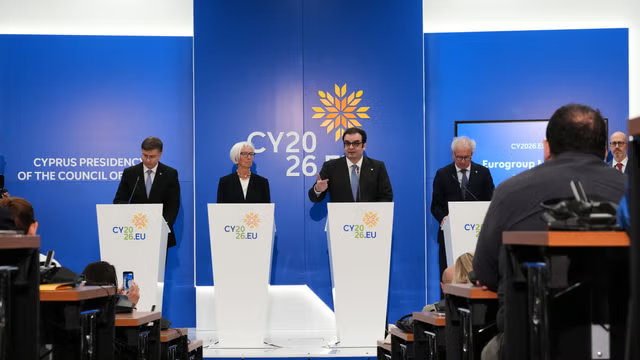
The forecast, delivered by European Union finance ministers and central banking officials this week, signals growing concern that the energy shock triggered by conflict in the Middle East could evolve into a long-term economic burden for Europe.

AD: Capeesh Restaurant
The warning comes amid continuing disruption linked to the Strait of Hormuz, one of the world’s most strategically important shipping lanes for crude oil and liquefied natural gas.Around one-fifth of global oil shipments normally pass through the narrow waterway, and recent instability involving Iran has severely disrupted maritime traffic and energy flows. European policymakers now believe the consequences will linger far beyond the immediate crisis.
European Central Bank President Christine Lagarde said that even if hostilities in the Middle East were to ease in the near future, consumers should not expect a rapid return to pre-crisis prices. Lagarde noted that energy shocks tend to have delayed and lasting effects on inflation, transportation, manufacturing and food production.
EU Economy Commissioner Valdis Dombrovskis echoed those concerns, saying that higher fuel costs are already spreading into broader sectors of the economy.

AD: Oysterian Sea Food Restaurant And Bar
The European Commission has revised inflation forecasts upward, projecting inflation at roughly 3% in 2026, significantly above previous expectations. Economic growth forecasts have simultaneously been downgraded, with eurozone growth expected to slow sharply as businesses and consumers grapple with rising costs.
Officials insist Europe is not heading into recession, but economists increasingly warn that sustained energy inflation could suppress industrial output and weaken consumer spending for years. Analysts say the crisis demonstrates Europe’s continuing vulnerability to external energy shocks despite years of efforts to diversify away from Russian fossil fuels following the invasion of Ukraine.
Although the EU reduced dependence on Russian pipeline gas after 2022, the bloc remains heavily exposed to global liquefied natural gas markets, where prices can spike rapidly during supply disruptions. The Middle East conflict has now exposed another weak point in Europe’s energy security strategy.
Energy traders have reacted nervously to warnings from Gulf producers. ADNOC chief executive Sultan Al Jaber recently said that full oil flows through the Strait of Hormuz may not normalise until the first half of 2027, even if military tensions ease sooner. That assessment has reinforced fears that supply bottlenecks may continue driving up prices across international markets.
Inflation, Industry and Consumer Pressure
The impact of persistently high oil and gas prices is already being felt across Europe’s industrial base. Manufacturers dependent on natural gas for production, including chemicals, fertilizers, steel and heavy transport sectors, are facing sharply higher operating costs. Economists warn that those costs are increasingly being passed on to consumers through higher prices on goods and services. European natural gas prices have remained highly volatile in recent months, with fluctuations driven by ongoing geopolitical tensions, including disruptions to LNG supply chains linked to Middle East instability and risks around key shipping routes.
Its repeated supply shocks and uncertainty over global LNG availability have kept European gas markets under pressure, with traders closely watching potential interruptions that could tighten supply further . The report adds that even as prices periodically ease, underlying structural risks particularly constrained LNG flows from major exporters continue to support a fragile and reactive market environment.
Europe entered the 2025–2026 winter and early 2026 period with gas storage levels significantly below seasonal norms, with inventories falling to around 30% of capacity in some assessments after sustained winter withdrawals.
This has left the continent more exposed to supply shocks and reinforced expectations that storage replenishment will remain challenging, contributing to persistent upward pressure on prices through 2026 and beyond .
The strain is also becoming political. Across several European countries, governments are under pressure to intervene as households struggle with rising electricity and heating costs. Ireland recently experienced fuel protests driven by anger over diesel and petrol prices, with demonstrators demanding price caps and tax relief measures. Similar frustrations are growing elsewhere as inflation continues eroding purchasing power.
Central banks now face a difficult balancing act. The European Central Bank and the Bank of England are both attempting to contain inflation while avoiding deeper economic slowdown.
However, sustained energy costs complicate those efforts by pushing inflation upward even as growth weakens. The Bank of England recently warned that inflation could remain elevated through 2027 if oil prices stay above current levels, potentially forcing interest rates higher for longer. Financial institutions are increasingly modelling worst-case scenarios in which oil prices climb well above $130 per barrel if disruptions intensify.
Some forecasts suggest that prolonged restrictions in the Strait of Hormuz could send Brent crude toward $180 per barrel under extreme conditions. Such a development would likely trigger another major inflation wave across Europe and significantly slow economic growth.
Energy-intensive industries are particularly exposed. Airlines, shipping companies and logistics operators are already reporting higher operating expenses tied to fuel costs. Agricultural producers are also facing rising fertilizer prices, many of which are directly linked to natural gas markets. Economists say these pressures could contribute to another prolonged cost-of-living crisis similar to the one Europe experienced following Russia’s invasion of Ukraine.
Europe Accelerates Search for Energy Security
The current crisis is intensifying Europe’s push toward energy diversification and renewable power development. EU officials argue that expanding solar, wind, hydrogen and battery storage infrastructure is now not only a climate priority but also a matter of economic and geopolitical security.
Since 2022, Europe has accelerated investment in LNG terminals, renewable energy projects and interconnection infrastructure aimed at reducing dependence on imported fossil fuels. However, officials acknowledge that the transition will take years, leaving consumers exposed to volatility in the meantime. Some policymakers are reviving discussions around emergency energy market interventions, including temporary price caps and expanded subsidies for vulnerable households. Yet critics argue that such measures risk distorting markets and discouraging investment in long-term supply solutions.
Oil-producing nations are benefiting from the surge in prices. Major energy companies have reported rising profits as global crude benchmarks remain elevated. While that has boosted revenues for exporters in the Gulf and North America, European leaders fear the imbalance could deepen economic inequalities within the bloc itself.
The energy crisis is also reshaping Europe’s geopolitical priorities. Securing alternative supply routes, strengthening strategic reserves and increasing domestic energy production have returned to the center of policy discussions in Brussels and national capitals. Governments are increasingly treating energy resilience as a core national security issue rather than solely an economic concern.
Despite the grim outlook, some analysts believe the worst-case scenarios can still be avoided if diplomatic progress stabilises the Middle East and global supply chains gradually recover. Yet even optimistic forecasts suggest that energy prices are unlikely to return to the comparatively stable levels Europeans enjoyed before the latest crisis erupted.
Millions of households and businesses across Europe, that means preparing for several more years of elevated heating bills, expensive fuel and continued economic uncertainty. Officials say the continent has become more resilient since the energy shock of 2022, but the latest crisis is a reminder that Europe’s dependence on global energy markets still carries profound economic risks.

AD: Heritage And Restaurant Lounge Bar