

By Lucy Caulkett-
A mother diagnosed with multiple sclerosis (MS) has become the first patient in the United Kingdom to receive a highly experimental treatment that doctors believe could dramatically slow or even stop the progression of the debilitating disease.
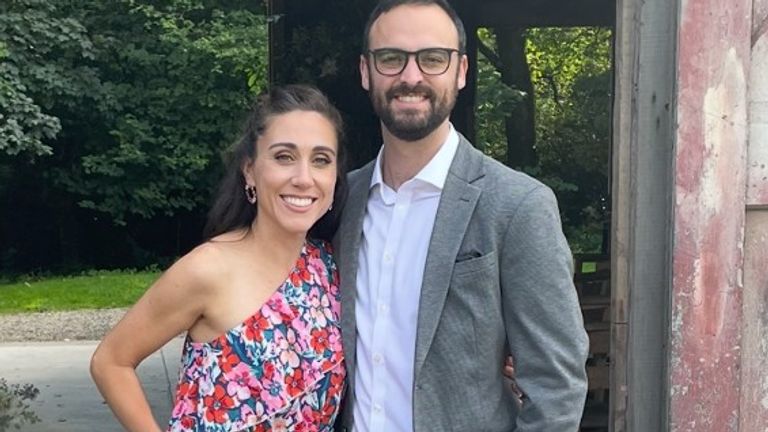
Emily (pictured with her husband) says she’s trusting in the science. Pic: Sky News
Emily Henders, aged 37, received an infusion of her own genetically modified cells, initiating a process that researchers hope will mark a turning point in MS management. This innovative approach, known as CAR T therapy, involves ‘weaponizing’ immune cells in a laboratory to specifically target and eliminate the rogue elements causing disabling relapses. Ms Henders, a secondary school biology teacher, acknowledged the gravity of her decision, stating, “Someone’s got to do it. Someone’s got to be the first,” as the deeply frozen cells arrived at University College London Hospitals (UCLH) .

AD: Capeesh Restaurant
She understands both the scientific rationale for the treatment and the potential side effects.
“What are my options here?” she said.
“I could just let this disease take over and we could wait and see, and I might be lucky and nothing happens to me.

AD: Oysterian Sea Food Restaurant And Bar
“Or I might have a massive relapse next week and never be able to walk again.
“Are we willing to take that chance? And I think we’ve come to the conclusion that no, we’re not. We have to trust science and trust medicine to do its job.”
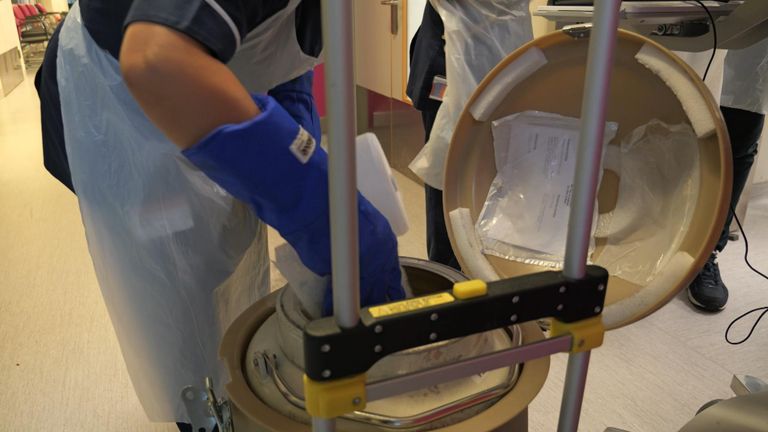
The cells were frozen in liquid nitrogen, thawed, and then infused into Emily’s bloodstream. Pic: Sky News
The severity of her condition underscored her determination to join the trial. Existing drug treatments had unfortunately proven ineffective over her four years with MS. She has tragically woken three times to discover she was temporarily unable to move her legs. Ms Henders’ motivation is intensely personal; her father also battles the disease and now relies on a wheelchair. “The thought of not being able to chase after my children or even walk up and down the stairs is something that I want to avoid at all costs,” she explained.
She made it clear she wants to stop the disease before it has a chance to stop her, seeking a definitive treatment beyond temporary symptom management. This early-stage trial is generating enormous interest among neurologists seeking a durable solution to Multiple Sclerosis.
![The 37-year-old teacher says she wants to 'stop it [MS] before it has a chance to stop me'](https://e3.365dm.com/25/10/768x432/skynews-ms-moore-multiple-sclerosis_7059455.jpg?20251023125748)
The 37-year-old teacher says she wants to ‘stop it [MS] before it has a chance to stop me’. Pic: Sky News
This groundbreaking global trial, led by doctors at UCLH, deploys CAR T therapy to target the immune system’s root cause. Clinicians first took a sample of Emily’s blood, isolating her T cells, which normally act to defend the body against various infections.
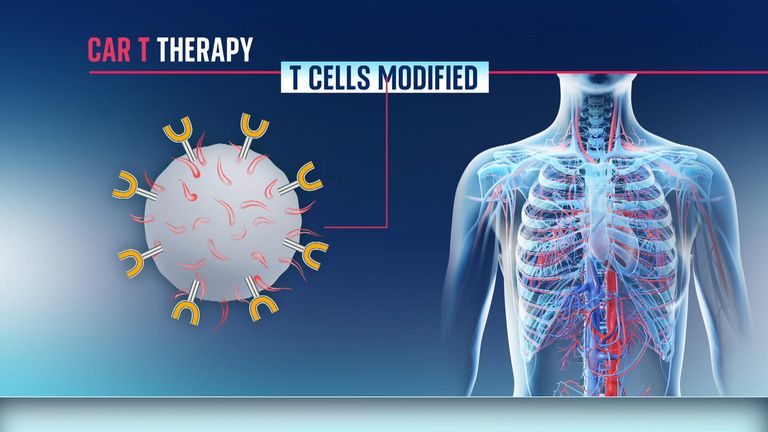
Pic: Sky News
Pic: Sky News
These T cells were then genetically modified in the laboratory using technology licensed by the UCL spinout Autolus. The modification reprogrammed them to specifically recognize and destroy the rogue B cells responsible for triggering MS attacks. The treatment, called Obe-cel, was then infused back into Emily’s bloodstream. Dr. Claire Roddie, who was instrumental in designing the treatment, described the development as one of the most significant of her career.
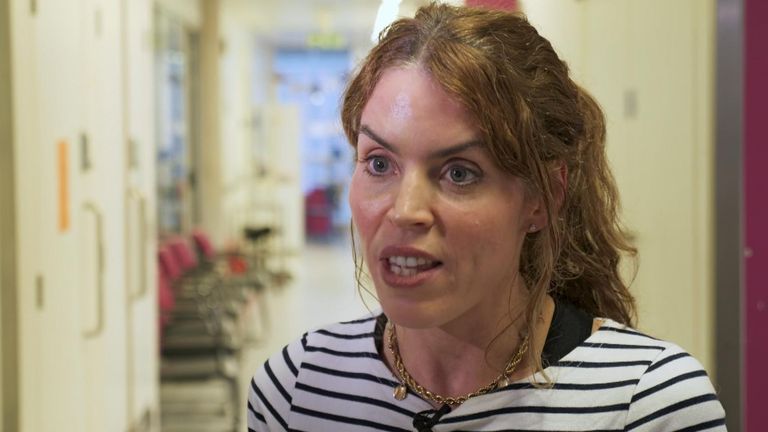
Dr Roddie says it’s one of the most significant MS developments she’s seen. Pic: Sky News
She likened the effect to “flicking a switch,” explaining that the treatment achieves an immune reset where the damaging B cells are eradicated, allowing only normal B cells to regenerate. This precise, targeted approach differentiates this treatment from previous, less specific immune therapies, offering significant potential in the development of the CAR T Therapy MS Breakthrough.
The therapeutic mechanism behind this trial has already demonstrated remarkable success, particularly in the aggressive field of cancer treatment. CAR T therapy has previously been used to successfully treat, and in some cases completely cure, certain blood cancers by harnessing the patient’s own immune system to hunt down abnormal cells.
Consequently, there is rapidly growing excitement about applying this powerful method to autoimmune diseases, including MS and chronic conditions like lupus, where early clinical trials are also showing encouraging results. The ultimate promise of this CAR T Therapy MS Breakthrough for newly diagnosed MS patients is profound: a potential single, one-off treatment.
Dr. Wallace Brownlee, the principal investigator of the trial, emphasized this potential, noting that none of the currently available medications are fully effective at preventing relapses. “This can be given as a single one-off treatment. It could be a real game-changer in terms of how we manage MS in the future,” he affirmed. This approach represents a vast improvement over existing drug regimens that require continuous administration and carry risks of side effects.
For people living with MS, this technology offers hope for long-term remission, potentially halting the accumulation of neurological damage and preventing the devastating progression toward disability, a goal current medications often struggle to achieve. The trial, named AUTO1-MS1O, is designed primarily to confirm safety among the 18 patients being recruited globally.
Dr Frederick Vonberg, neurology research fellow at UCL and UCLH, said: “We encourage patients aged between 18 and 60 years to speak to their neurologist and explore whether they might be eligible for a referral to this trial.” Doctors are actively encouraging patients aged 18 to 60 years with relapsing or progressive MS to discuss a referral with their neurologist, offering an internal link to hope for the more than 150,000 people in the UK living with this challenging diagnosis.

AD: Heritage And Restaurant Lounge Bar
