

By Ben Kerrigan-
The families of deceased hostages face continued anguish this week after Hamas transferred eight bodies to Israel. While authorities successfully identified seven of the hostage bodies returned as belonging to the missing citizens, the Israeli military confirmed that the eighth body sadly does not match any of the known missing citizens.
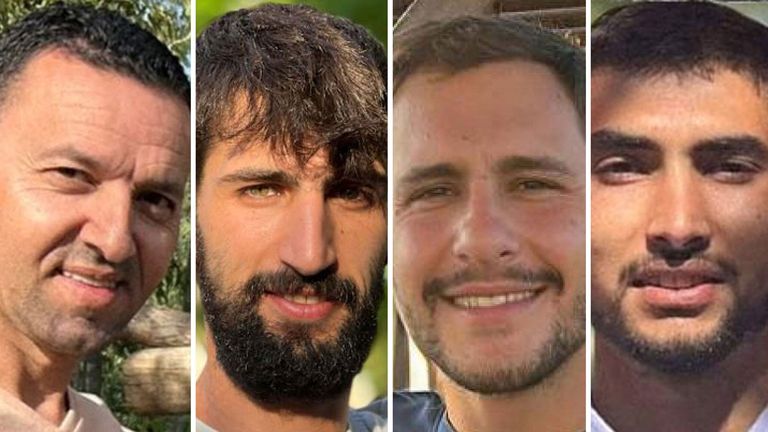
The bodies of Yossi Sharabi, Guy Illouz, Daniel Peretz and Bipin Joshi have been returned to Israel on Monday. Pic: Bring Them Home Now/Reuters
On Monday, the remains of four hostages—Yossi Sharabi, Guy Illouz, Daniel Peretz, and Bipin Joshi—were transferred to Israel. Following forensic examination, the Israeli military formally identified Mr. Illouz and Mr. Joshi. Both men were in their twenties when Hamas seized them during the devastating October 7, 2023, attack that ignited the war.
Illouz, an Israeli citizen, was violently taken from the chaotic Nova music festival. Joshi, a Nepalese student, was captured from a bomb shelter. Israel has stated that Illouz later died from wounds sustained in captivity, allegedly having been denied proper medical treatment. Joshi, tragically, was murdered in captivity during the initial months of the conflict.
This distressing news highlights the immense challenge involved in locating and identifying the additional deceased hostages whose remains are still believed to be held in Gaza. This partial and complicated recovery operation leaves dozens of families desperately waiting for the closure a proper burial would eventually provide.

AD: Capeesh Restaurant
Consequently, the Israeli Defense Forces (IDF) issued a stern statement demanding that Hamas “make all necessary efforts” to return the remaining remains accurately and swiftly. The transfer of bodies represents a critical component of the current ceasefire agreement between Israel and Hamas, bringing a temporary pause to the intense conflict that originated on October , .
The seven confirmed victims—which included Uriel Baruch, Tamir Nimrodi, and Eitan Levi, among others—were tragically killed during the attack or while being held in captivity. The body of Uriel Baruch, Tamir Nimrodi, and Eitan Levi and one mismatched body was handed over by Hamas last night.
Accurate identification is a meticulous and necessary process, offering the only certainty for the grieving families. Initial reports had mistakenly included the names of four other individuals (Yossi Sharabi, Guy Illouz, Daniel Peretz, and Bipin Joshi) whose bodies are still missing or whose identities were not among the most recently transferred remains. Even with the political agreement established, the physical retrieval and formal recognition of the hostage bodies returned prove deeply difficult given the environment.

AD: Oysterian Sea Food Restaurant And Bar
The process of locating and identifying the deceased continues to be fraught with logistical complications, significantly exacerbated by the scale of devastation in Gaza. The International Committee of the Red Cross (ICRC) has officially labeled the effort to find the remaining hostage bodies returned amid the rubble a “massive challenge.”
Christian Cardon, a spokesperson for the ICRC, emphasized that recovering the deceased is even harder than securing the release of the living hostages because burial sites are often unknown or simply inaccessible. He warned that this vital operation could last for days or weeks, suggesting there remains a possibility some bodies might unfortunately never be found. Learn more about the ICRC’s role in humanitarian crises here.
An international task force is currently working tirelessly to locate the remains of deceased hostages not transferred within the -hour ceasefire window, according to Gal Hirsch, Israel’s coordinator for the missing and the hostages. The sheer scale of destruction in Gaza complicates every step of this mournful mission. This prevailing uncertainty has resulted in considerable emotional strain and frustration among the families.
The Israeli Hostages Families Forum swiftly called for a suspension of the current ceasefire agreement following the partial and problematic return, demanding the immediate transfer of all the deceased. They powerfully stated they “will not give up on anyone” until the last victim is returned home for proper burial.
Udi Goren, cousin of missing hostage Tal Haimi, explained his family’s deep struggle to reporters. Mr. Haimi was tragically killed while defending his kibbutz of Nir Yitzhak on October . Goren strongly expressed that until the hostage bodies returned, his family lacks “closure and certainty,” preventing them from properly moving forward with their grief.
The family requires a final resting place where Mr. Haimi’s children can mourn, fulfilling both Jewish tradition and their emotional need for an undeniable truth.

AD: Heritage And Restaurant Lounge Bar


