
By Ben Kerrian-
A devastating explosion at a building reportedly used to store mining explosives tore through a village in northeastern Myanmar on Sunday, killing more than 45 people and injuring dozens in one of the country’s deadliest industrial disasters in recent years.
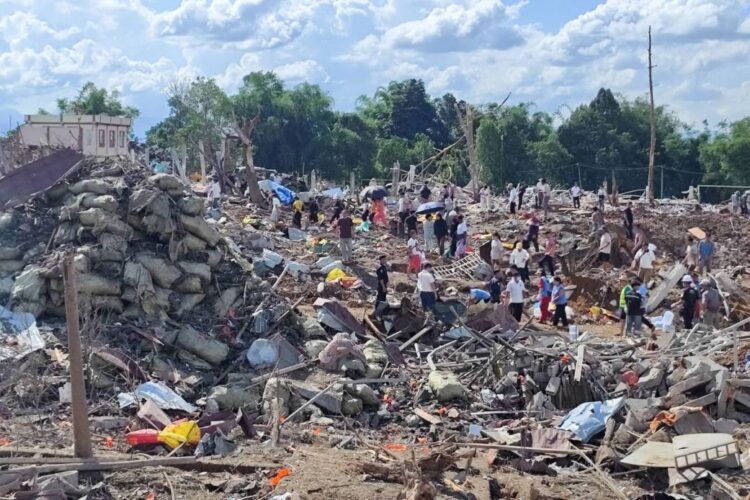
The blast occurred around midday in Kaungtup village, located in Namhkam Township in Myanmar’s Shan State, just a few kilometers from the Chinese border. Rescue workers and local media reported scenes of widespread destruction as emergency teams searched through debris for survivors while families gathered near hospitals and temporary relief centers awaiting news of missing relatives.

AD: Capeesh Restaurant
According to reports, at least 46 bodies had been recovered by Sunday evening, including several children, while more than 70 people were hospitalised with injuries ranging from burns to severe trauma. The explosion also damaged or destroyed more than 100 nearby homes, leaving many residents displaced.
Witnesses described hearing a massive detonation that shook buildings across the surrounding area. Some residents initially believed the explosion was linked to fighting between armed groups that have long operated in the region, while others said the force of the blast shattered windows and sent debris flying hundreds of meters.
The building where the explosion occurred was reportedly being used to store explosives intended for mining operations. Local reports suggested that gelignite and other industrial blasting materials may have been kept inside the facility. Authorities have not yet released an official explanation for the cause of the blast, and investigations remained ongoing Sunday evening.

AD: Oysterian Sea Food Restaurant And Bar
The affected area lies within territory controlled by the Ta’ang National Liberation Army (TNLA), one of several ethnic armed organisations that have exercised varying degrees of authority in parts of Myanmar’s border regions. The group acknowledged that fatalities had occurred but initially provided few details regarding the circumstances surrounding the explosion.
Reported that some local sources estimated the death toll could rise beyond 55 as rescue operations continued and more victims were recovered from collapsed structures. Also noted that independent verification remained difficult because of the remote location and ongoing security concerns in the area.
The disaster unfolded against the backdrop of Myanmar’s prolonged political and military crisis, which has weakened infrastructure and disrupted public services across large parts of the country since the 2021 military coup. The United Nations and humanitarian organisations have repeatedly warned that conflict, displacement and damaged transportation networks have complicated emergency operations in regions such as Shan State.
Rescue efforts following major incidents have often been hindered by shortages of medical supplies, limited equipment, damaged roads and communications disruptions, making it difficult for responders to reach affected communities quickly.
Residents interviewed by local media said the explosion created a fireball visible from several nearby villages. Several structures near the storage site reportedly collapsed instantly, trapping occupants beneath rubble. Medical personnel in Namhkam Township worked throughout the day to treat victims as ambulances and private vehicles transported the injured from the blast zone.
While darkness fell over the village, rescue workers continued combing through wreckage using flashlights and heavy equipment in hopes of locating survivors. Emergency crews described a chaotic scene marked by collapsed homes, burning debris and injured residents seeking assistance.
One rescue worker told journalists that bodies were still being recovered hours after the initial explosion. Hospitals in the region faced mounting pressure as doctors treated victims suffering from burns, fractures and blast-related injuries. Local authorities also established temporary shelters for families whose homes had been damaged or destroyed.
Images circulated by regional news organisations showed flattened buildings, twisted metal and shattered concrete scattered across the village. Several streets near the explosion site appeared almost entirely devastated.
The blast highlighted the risks associated with storing industrial explosives in populated areas, particularly in regions where regulatory oversight is limited.
Mining remains a major economic activity across parts of Shan State, where deposits of gold, tin, manganese and rare earth minerals have fuelled expanding extraction operations by commercial firms, local operators and armed-group-linked enterprises.
Researchers and development agencies have warned that mining governance in Myanmar’s conflict-affected border regions is often inconsistent, with oversight of labor practices, environmental safeguards and industrial safety frequently weakened by instability and fragmented authority.
With a result, safety standards can vary significantly between operations, increasing the risk of accidents involving hazardous materials used in extraction processes.
Industrial accidents involving explosive materials have caused major casualties in several countries over the years, though incidents of this scale remain relatively rare. Safety experts have long warned that improper storage conditions, inadequate ventilation and failures in handling procedures can significantly increase the likelihood of catastrophic explosions.
Myanmar itself has experienced deadly explosions in the past. One of the most notable incidents occurred in Yangon in 2011, when a warehouse fire triggered a series of explosions that killed at least 17 people and injured dozens more.
The latest disaster has renewed questions about how hazardous materials are stored and monitored in areas affected by conflict. In many parts of Myanmar, authority is divided among government forces, ethnic armed organizations and local administrations, creating complex challenges for enforcement and oversight.
Analysts noted that regions controlled by armed groups often develop independent economic systems that include mining, trade and resource extraction. While these activities provide income for local communities, they can also create safety risks when industrial operations function without comprehensive regulatory frameworks.
The explosion comes as Myanmar continues to endure the consequences of a civil conflict that has intensified since the military seized power in a coup in February 2021. Fighting between the military government and a range of resistance groups has displaced millions of people and severely disrupted public services across large parts of the country.
Shan State has become one of the most strategically significant regions in the conflict because of its location near China and its importance as a trade corridor. Numerous armed organisations operate in the area, and clashes periodically erupt despite intermittent ceasefires and negotiations.
The TNLA, which controls parts of Namhkam Township, is a member of the Three Brotherhood Alliance, a coalition of ethnic armed groups that has engaged in extensive fighting with Myanmar’s military. Although military conflict was not believed to be directly responsible for Sunday’s explosion, the broader instability in the region has complicated both emergency response efforts and investigative procedures.
Humanitarian organisations have repeatedly warned that years of conflict and political instability have weakened healthcare systems and emergency-response capacity throughout Myanmar.
Human Rights Watch and United Nations agencies have reported that attacks on medical facilities, shortages of healthcare personnel and damage to critical infrastructure have severely strained the country’s ability to respond to crises.
Communities affected by earthquakes, airstrikes and other disasters frequently face delays in receiving assistance because of security restrictions, damaged roads and bridges, telecommunications disruptions and obstacles to humanitarian access in conflict-affected regions.
Residents in Kaungtup village now face the difficult task of rebuilding after a disaster that destroyed homes, disrupted livelihoods and left many families mourning loved ones. Local volunteers joined rescue teams throughout the day, helping transport victims and distribute assistance to displaced residents.
Investigators work to determine the exact cause of the explosion, questions remain about who owned or managed the explosives and whether safety protocols were followed. Officials have yet to announce whether criminal or administrative inquiries will be launched.
The focus remains on rescue and recovery efforts. Villagers gathered near damaged homes Sunday evening, searching for missing relatives and assessing the scale of destruction left behind by a blast that transformed a quiet border community into the scene of one of Myanmar’s deadliest recent tragedies.
With casualty figures still evolving and search operations continuing, authorities fear the death toll could rise further in the coming days as additional victims are recovered from the rubble. The disaster has once again underscored the dangers posed by explosive materials in unstable environments and the vulnerability of communities living amid conflict, limited oversight and fragile infrastructure.

AD: Heritage And Restaurant Lounge Bar