
By Kenneth Williams-
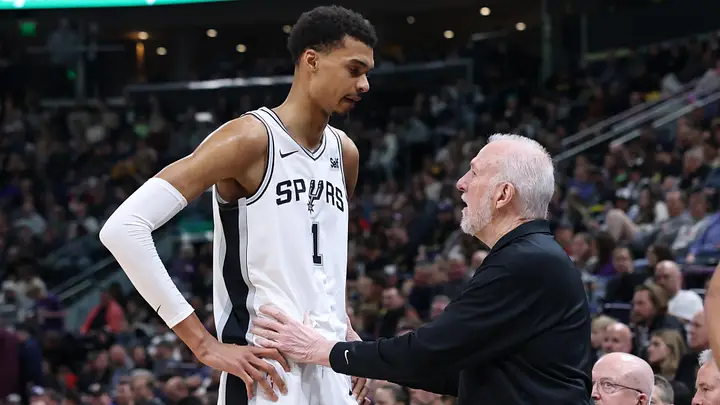
Victor Wembanyama’s ascent to the NBA Finals has been defined by dominance, poise, and rapid maturity but also by something less visible and arguably just as important. The enduring influence of Gregg Popovich.
Even as the San Antonio Spurs officially operate under head coach Mitch Johnson, Popovich’s presence continues to shape the franchise’s identity and, in many ways, its current championship run.. San Antonio’s return to the NBA Finals for the first time since 2014 followed a dramatic 111-103 Game 7 victory over the defending champion Oklahoma City Thunder in the Western Conference finals, a win that completed one of the most impressive turnarounds in recent NBA memory.

AD: Capeesh Restaurant
But behind the celebration and Wembanyama’s Western Conference Finals MVP performance, there is a deeper storyline that connects present success to the franchise’s foundational leadership. Popovich, now in a front-office role, remains closely involved in basketball operations and player development, according to multiple reports around the team’s postseason run.
With Wembanyama, that continuity matters. The 22-year-old has repeatedly acknowledged the importance of guidance from the Spurs’ long-time architect, whose coaching principles still define the organisation’s approach on both ends of the floor.
Even as San Antonio leans into a faster, more modern style built around Wembanyama’s versatility, the structural discipline Popovich instilled over nearly three decades remains visible in key moments of the postseason particularly in late-game execution and defensive rotations.

AD: Oysterian Sea Food Restaurant And Bar
That blend of old and new has helped the Spurs navigate a demanding Western Conference playoff path, where their youth was tested against more experienced opponents. Yet time and again, San Antonio responded with composure that felt familiar an echo of the franchise’s championship DNA. With report highlighted, the Spurs’ ability to withstand pressure in Game 7 reflected a maturity that belied their inexperience, with Wembanyama anchoring both ends of the floor in decisive fashion.
Wembanyama’s respect for Popovich defines a new Spurs era
What stands out most in the relationship between Wembanyama and Popovich is how seamlessly it bridges eras of Spurs basketball. The franchise that once relied on Tim Duncan, Tony Parker, and Manu Ginóbili now revolves around a 7-foot-4 centerpiece redefining what a modern superstar can be but the guiding principles remain familiar. Wembanyama has publicly emphasised Popovich’s impact not just as a coach, but as a mentor whose expectations shaped his approach to preparation and leadership. That influence has been especially evident during high-pressure playoff stretches, where Wembanyama has taken on increased responsibility as both a scorer and defensive organiser.
His ability to control games most recently in a 22-point, all-around performance in the Game 7 clincher underscored why he has become the centerpiece of the Spurs’ title push.
Popovich’s philosophy, long centered on adaptability, intelligence, and team-first basketball, still appears embedded in the Spurs’ identity. Even without him on the sideline, San Antonio’s rotations, spacing principles, and defensive communication reflect the system he built over decades. That continuity has been crucial for a roster that includes several young players experiencing their first deep playoff run.
The result is a rare NBA dynamic: a franchise transitioning into a new superstar era without fully severing ties to its most successful figure. Instead, Popovich’s influence operates as a stabilising layer beneath the surface of a rapidly evolving team.
A bridge between dynasties and what comes next
The Spurs prepare to face the New York Knicks in the NBA Finals a matchup confirmed after their Western Conference triumph the broader narrative extends beyond one playoff run. It is about whether a historic franchise can successfully pass its identity from one era to another without losing its competitive edge.
Popovich’s influence remains deeply embedded in the Spurs’ organisational fabric, even as Mitch Johnson carries the day-to-day responsibilities of head coach and in-game decision-making.
Johnson has repeatedly emphasised a “standards over outcomes” approach in his first full season, reinforcing expectations around defensive effort, attention to detail, and disciplined execution principles long associated with Gregg Popovich’s Spurs teams.
According to reports, Johnson’s coaching emphasis has centered on preventing complacency during the Spurs’ rapid rise, demanding consistent focus even amid winning streaks and dominant stretches. That philosophy has translated directly into the Spurs’ postseason identity, where execution in late-game situations has reflected a system-first approach rather than reliance on individual heroics.
During the NBA Finals buildup similarly highlights how San Antonio’s success hinges on structured defensive rotations and shared offensive responsibility, with the Knicks series framed as a clash between two disciplined, scheme-driven teams rather than superstar isolation battles.
Together, the reporting underscores how Popovich’s long-standing emphasis on accountability, defensive cohesion, and collective execution continues to define the Spurs’ competitive identity even as a new coaching voice leads them on the court and a new franchise cornerstone in Victor Wembanyama drives their championship ambitions.
The connection offers both grounding and expectation with Wembanyama. He is not merely the next franchise star; he is the latest player tasked with carrying forward a legacy built on sustained excellence. His respect for Popovich reflects an understanding that his development is part of a larger continuum rather than a standalone rise.
The Spurs’ Finals appearance is therefore not just a surprise breakthrough season it is the continuation of a system that has adapted without losing its core identity. And even as the league watches Wembanyama step onto its biggest stage, Popovich’s influence remains embedded in the structure supporting him.
In a league defined by constant change, San Antonio’s success this season is a reminder that some foundations do not disappear—they evolve, quietly shaping the next generation while the spotlight moves elsewhere. The Spurs’ return to the NBA Finals is not just a product of talent cycling through the draft or a single breakout star emerging at the right moment.
It reflects an organisational continuity that has survived coaching transitions, roster overhauls, and shifting tactical eras without losing its core identity. Even as the modern NBA increasingly prioritizes pace, spacing, and individual creation, San Antonio has managed to blend those trends with a system that still values discipline, defensive accountability, and shared decision-making.
What makes this run distinctive is how seamlessly those older principles have been absorbed by a new generation led by Victor Wembanyama. Rather than replacing the Spurs’ traditional identity, he has expanded it adding unprecedented defensive versatility and offensive range to a framework built over decades.
The result is a team that feels both new and familiar at the same time, capable of adapting to modern playoff demands while still relying on structural habits that have long defined the franchise. San Antonio’s resurgence is less about reinvention and more about preservation through adaptation, proving that strong organisational culture can remain competitive even as everything around it evolves.

AD: Heritage And Restaurant Lounge Bar