

By Tony O’Reilly-
India’s Supreme Court delivered a crucial statement regarding the ongoing inquiry into the tragic June Air India crash, confirming that the preliminary findings do not insinuate any wrongdoing against the flight’s captain.
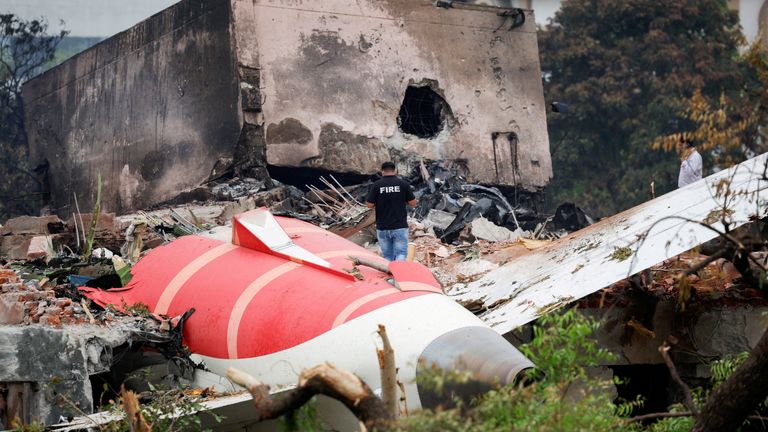
A Boeing 787-8 Dreamliner aircraft crashed in Ahmedabad, India, in June. Pic: Reuters
The clarification was issued even as judges prepared to consider a deeply personal plea from the pilot’s father, Pushkar Raj Sabharwal, 91, for a complete and independent investigation. This incident involves Air India Flight 171, a Boeing 787-8 Dreamliner destined for London Gatwick, which struck a building shortly after taking off from Ahmedabad, India. The catastrophic failure claimed the lives of 241 people on board the aircraft, and tragically, a further 19 people died on the ground below.

AD: Capeesh Restaurant
The sheer scale of the disaster immediately necessitated a thorough and transparent probe, generating intense national and international scrutiny into aviation safety protocols.
The court’s intervention comes directly after Mr. Sabharwal publicly criticized the Aircraft Accident Investigation Bureau (AAIB), the government body overseeing the official inquiry. He strongly criticized the process and demanded that the Supreme Court order an investigation led by a panel of independent aviation experts, potentially headed by a retired Supreme Court judge.
Captain Sumeet Sabharwal served as the pilot-in-command during the fateful flight, with Clive Kunder occupying the role of first officer flying the aircraft. The father recently detailed distressing encounters with AAIB officials, who he claims implied his son deliberately cut the fuel supply to the plane’s engine shortly after commencing the take-off sequence.

AD: Oysterian Sea Food Restaurant And Bar
Conversely, the Indian government has vehemently denied such accusations, firmly stating that the current investigation remains “very clean” and completely thorough in its methodology and scope. The Supreme Court’s commitment to hearing the father’s concerns highlights the serious need for complete clarity and public confidence in the ongoing Air India Crash Investigation.
The core of the deepening controversy stems directly from specific, ambiguous findings detailed within the AAIB’s preliminary report, which was first published in July. This 15-page document meticulously outlines the sequence of events and certain physical evidence recovered from the wreckage, but it notably stops short of assigning definitive responsibility. The report confirmed that crucial switches located in the cockpit, which controlled the fuel supply to the engine, were discovered to have been moved to the “CUTOFF” position. This finding immediately suggests an intentional action took place within the cockpit environment just before the crash occurred. However, the recorded audio from the cockpit voice recorder only deepened the mystery rather than resolving it.
According to the preliminary findings, the audio transcript captured one of the pilots asking the other, “Why did you cut off?” in an apparently surprised tone. The second pilot’s response was simply a denial, stating clearly that he had not performed that action.
Consequently, the AAIB report deliberately did not specify which comments were made by Captain Sabharwal and which were attributed to First Officer Kunder, leaving the critical question of blame entirely unanswered. Both pilots were highly experienced aviators, collectively sharing around 19,000 flying hours, including over 9,000 hours specifically navigating the complexities of the Boeing 787 Dreamliner model. The sheer volume of flying experience amassed by the two men makes the manual override of fuel switches, especially a denial of responsibility, a deeply perplexing factor for aviation experts. Therefore, the unresolved ambiguity documented in the AAIB’s initial assessment strengthens the need for the rigorous independent review requested by the captain’s father.
The father’s crucial plea for an independent committee to re-examine the tragic Boeing 787 Dreamliner crash is now formally scheduled for a court hearing on November 10. This forthcoming judicial review offers the possibility of securing greater transparency and accountability for the families of the 241 people on board, including 53 UK citizens, and the 19 people killed on the ground.
Achieving satisfactory closure has proven immensely difficult for the surviving victims and the hundreds of bereaved family members navigating the aftermath of this devastating event. The trauma experienced by the sole survivor of the flight, Briton Viswashkumar Ramesh, underscores the enduring emotional and physical pain caused by the disaster.
Mr. Ramesh, who resides in Leicester with his wife and four-year-old son, described being “broken down” by the psychological trauma of the event during a moving interview. Despite being the only person to walk away from the wreckage, he continues to suffer from severe physical discomfort, including ongoing pain in his knees, shoulder, and back, alongside serious burns to his left arm.
The interim payment offered to Mr. Ramesh—a flat sum of £21,500—is a one-off advance given to claimants before the final resolution of a personal injury claim, highlighting the protracted legal battle that still lies ahead for survivors and victims’ families. As families continue to prepare for an inevitable court fight over the disaster’s legal liability, the Supreme Court’s decision on November 10 regarding the request for an independent panel will represent a pivotal moment in the entire Air India Crash Investigation.

AD: Heritage And Restaurant Lounge Bar


