

By Isabelle Wilson-
In a massive, industry-wide operational shift, global shipping behemoths UPS and FedEx immediately grounded their complete fleets of McDonnell Douglas MD-11 cargo planes grounding operations. This drastic move comes directly in the wake of a fatal crash earlier this week in Louisville, Kentucky.
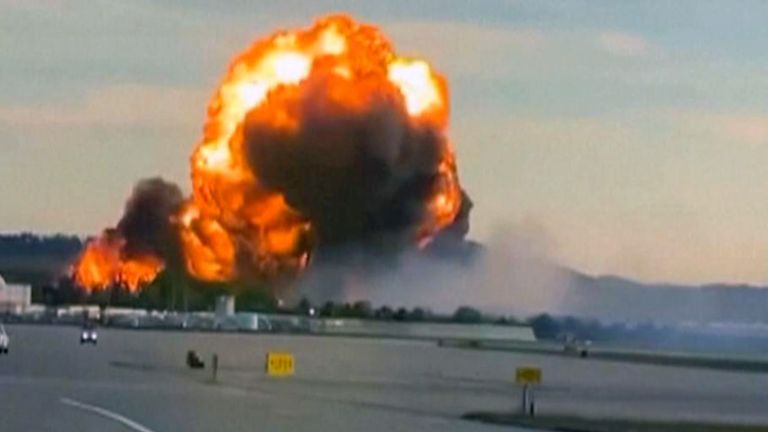
A UPS cargo plane crashed in Louisville, Kentucky, on Tuesday and exploded into a fireball. Pic: Sky News
The decision, which officials described as being taken “out of an abundance of caution and in the interest of safety,” reflects the severe concern surrounding the Tuesday evening disaster.

AD: Capeesh Restaurant

The scene of the crash. Pic: AP
A US National Transportation Safety Board (NTSB) investigation continues to piece together the events that led to the crash near UPS Worldport, the company’s primary global air hub. The MD-11, tragically bound for Honolulu, impacted two buildings upon crashing, instantly erupting into a large fireball and producing enormous plumes of billowing smoke. Fourteen people died in the catastrophe, including all three highly experienced pilots aboard the flight.
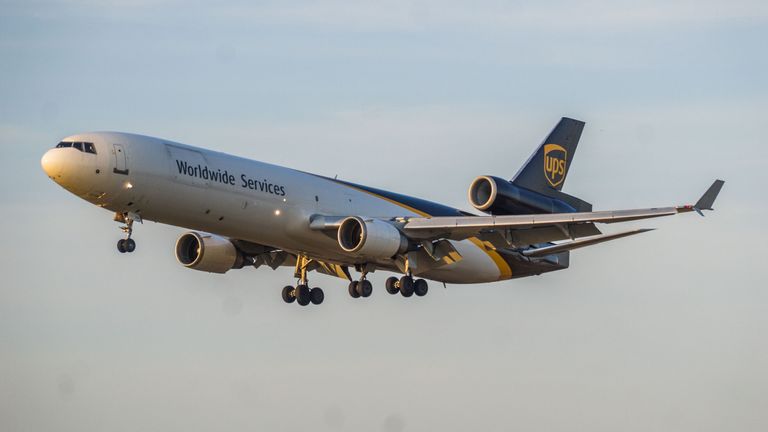
A UPS MD-11 landing at Philadelphia airport in March 2025. Pic: Wikipedia/Hamproductions
The proactive decision to halt the MD-11 cargo plane grounding was announced by UPS on Friday; this specific aircraft type comprises approximately nine percent of its overall fleet capacity. UPS explicitly stated they made the decision “at the recommendation of the aircraft manufacturer,” emphasizing that nothing is more important than the safety of their employees and the communities they serve.
FedEx, which operates 28 MD-11s within its fleet of approximately 700 aircraft, quickly followed suit. They echoed the manufacturer’s advice, confirming they would also ground their planes while the company conducts an immediate, thorough safety review.

AD: Oysterian Sea Food Restaurant And Bar
FedEx noted they immediately implemented comprehensive contingency plans within their integrated air-ground network. This action aims to minimize disruptions to their vast global shipping operations, acknowledging the importance of supply chain stability. Western Global Airlines remains the only other US cargo carrier utilizing MD-11s, according to aviation analytics firm Cirium, though they had already placed 12 of their 16 MD-11 aircraft into long-term storage before this incident.
New details emerging from the ongoing NTSB investigation reveal a chaotic final 25 seconds inside the doomed cockpit, intensifying the critical need for the current MD-11 cargo plane grounding. Todd Inman, a member of the NTSB, confirmed the plane was nearly airborne when a distinct warning bell sounded inside the cockpit. The cockpit voice recorder captured that alarm ringing continuously for 25 seconds while the three pilots desperately attempted to regain control of the rapidly failing plane.
Investigators have since confirmed that the aircraft experienced a catastrophic failure: its left wing was ablaze, and the engine mounted on that side had detached from the fuselage before the MD-11 slammed into the ground. Authorities also determined the MD-11, built in 1991, was carrying a massive load of 38,000 gallons of fuel at the time of the impact, explaining the subsequent devastating explosion and fire.
The focus of the NTSB investigation now centers heavily on the cause of the continuous warning bell and the mechanical failure that led to the engine detachment. Mr. Inman explained that various alarms exist, each signifying different potential emergencies; investigators have yet to definitively determine why this specific bell rang. Officials know the left wing was burning and the engine had detached, but they must find the root cause.
Flight records suggest the aircraft had recently undergone extensive maintenance, lasting for over a month until mid-October, though the nature and scope of the work completed remain unclear at this early stage of the inquiry. The proactive decision concerning the MD-11 cargo plane grounding gives aviation experts crucial time to study the manufacturer’s recommendation and the preliminary crash findings without risking further operational incidents. The investigation will also examine whether the long-term maintenance history played any role in the fatal sequence of events, a common step in major accident probes.
The mandatory grounding of the MD-11 fleet represents a major logistical challenge for two of the world’s largest integrated logistics carriers. The MD-11 cargo plane grounding demonstrates a necessary sacrifice of immediate efficiency for the long-term integrity of their safety records. The MD-11 aircraft, a trijet widely used for long-haul cargo operations, has a complex safety history, making the manufacturer’s immediate recommendation for grounding particularly noteworthy.
Air freight experts are currently assessing the short-term impact on holiday shipping schedules, a period when demand for air cargo capacity typically peaks. UPS and FedEx are leveraging their extensive networks, relying heavily on other aircraft types—including Boeing 747s and 767s—to absorb the substantial capacity gap created by the MD-11s being taken out of service.
Contingency plans, activated immediately by both companies, involve diverting freight to ground services where feasible and utilizing smaller aircraft on shorter legs to maintain flow. Safety remains paramount for these global logistics operations, prompting immediate cooperation with the NTSB and the manufacturer.
The immediate industry response to the tragedy showcases a deep commitment to modern safety standards, prioritizing life over immediate revenue losses. The results of the upcoming thorough inspection and safety review will dictate the future of this aircraft type within the US cargo industry. Should the review uncover systemic flaws, the MD-11 cargo plane grounding could become permanent, forcing the carriers to accelerate the retirement of the aging trijet fleet.

AD: Heritage And Restaurant Lounge Bar

