
By James Simons-
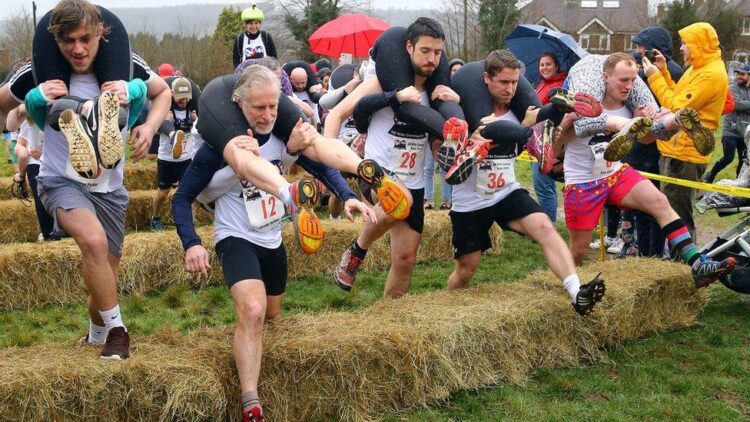
Mud splashed, water flew and laughter roared around The Nower hill as one of Britain’s quirkiest sporting spectacles unfolded on Sunday. Dozens of competitors husbands, partners, siblings and friends alike braved cold March weather and a 380‑metre obstacle course while hoisting their chosen companions on their backs in the annual UK Wife Carrying Race in Dorking, Surrey. What began as a humorous nod to a Finnish tradition has become a highlight of the local calendar, drawing daring duos from across Britain and beyond for a battle of strength, balance and sheer eccentricity.
This year’s contest, now in its 17th year, saw Teemu and Jatta from Finland clinch first place in record‑breaking time, crossing the finish line in 1 minute 45.5 seconds and earning a barrel of local ale as their prize.

AD: Capeesh Restaurant
Winners and Record-breaking time event Teemu and Jatta
Behind them, British pair Edward and Kathryn finished second a performance that will see them go on to represent the UK at the World Wife Carrying Championships in Finland this summer, with organisers contributing £250 toward their travel costs.
Though the event’s name might suggest a strictly marital affair, the rules of the British race are delightfully flexible. Participants are encouraged to carry anyone they choose a partner, friend or family member so long as the person being carried weighs at least 50 kg, or else wears filler weight to meet the minimum.

AD: Oysterian Sea Food Restaurant And Bar
Techniques vary wildly, but many competitors preferred the so‑called Estonian hold, in which the carried person dangles upside‑down across the runner’s back, legs curled over the shoulders as though fashioned into an impromptu backpack.
While competitors powered up the incline and back down again, their progress was punctuated by traditional obstacles: rows of hay bales to clamber over and enthusiastic spectators armed with water pistols and buckets who added splashes and laughter to the challenge.
While mud and muscle were part of the fun, the atmosphere remained jovial, celebrating both the athleticism and absurdity that make events like this uniquely British.
The UK race traces its roots to the Finnish sport of wife carrying, where competitors around the world have gathered for decades to dash, hurdle and sometimes topple while transporting their partners over varied terrain. The sport has appeared in places as diverse as the United States, India and Germany, and the UK iteration began in 2008 under the stewardship of the Leith Hill Trail Runners.
with many participants, the UK Wife Carrying Race is far more than a test of strength; it’s a celebration of community, camaraderie, and light‑hearted competition. Spectators cheer wildly as competitors navigate muddy obstacles, dodge playful splashes from water pistols, and tumble head‑first over hay bales, embracing every unpredictable moment along the way .
The event is a mix of athletic challenge and spectacle, inviting participants to rely on their partners, coordinate under pressure, and find joy in each chaotic step .
Past competitors have noted that the key to success is not just technique but attitude, with one seasoned racer reflecting that “balance and a sense of humour” are essential to both surviving the course and enjoying it .
This spirit of fun and friendly rivalry resonates through the cheering crowds, making the UK Wife Carrying Race as much a community festival as it is a competition.
Alongside the local festivities in Surrey, the international wife‑carrying scene has carved out its own niche in the competitive world of eccentric athletics. The UK event serves as a qualifier for the World Championships in Finland, where elite pairs take to courses with even more dramatic obstacles and, traditionally, a prize of beer equivalent to the weight of the carried partner.
This global connection adds a layer of serious ambition to what might otherwise be dismissed as playful folly.
Race director Ian Giles spoke of the competitive spirit that has grown around the event, noting familiar faces each year and the genuine athletic endeavour behind every pairing’s attempt.
While participants may don costumes or treat the day as a fun outing, completing the course demands muscle, timing and teamwork especially when every step might combine steep gradients with slippery mud and an eager audience heckling with squirt guns.
With spectators, the appeal lies in watching human ingenuity at work. Some runners sprinted with laser focus; others laughed their way through splashes and stumbles while their partners shouted encouragement from upside‑down positions that would make a yoga instructor wince.
The camaraderie between competitors, spectators and organisers transforms what might appear to be an odd sporting contest into a community celebration that draws families, friends and curious onlookers year after year.
The success of Teemu and Jatta this weekend underscores how international the event has become, with overseas athletes competing alongside local British hopefuls in a friendly rivalry that bridges cultures and landscapes. Yet despite stories of international winners, the heart of the race remains rooted in Surrey’s rolling hills and the shared thrill of a challenge tackled together, step by muddy step.
While the day wound down and barrels of ale were hoisted, conversations turned from times and techniques to travel plans for Finland and the anticipation of even tougher competition ahead. With Edward and Kathryn, who will carry the UK’s hopes abroad, thoughts are already shifting to how they might improve on their strong showing and bring home accolades from the world stage.
Whatever the outcome in future races, one thing is certain: the UK Wife Carrying Race has cemented its place not just as a quirky footnote in the calendar, but as a lively testament to sport’s ability to inspire connection, laughter and a bit of friendly madness.
With snowy shores of Scandinavia to the green hills of Surrey, this unusual contest reminds us that athleticism comes in many forms and sometimes, the fun of the journey is just as important as crossing the finish line.
Beyond the mud‑splattered courses and upside‑down sprints, the race fosters bonds between partners and communities alike. It challenges participants to trust each other, coordinate perfectly under pressure, and embrace the unexpected lessons that resonate far beyond the confines of the course.
Spectators, too, become part of the narrative, cheering, laughing, and sometimes gasping as competitors tumble or sprint past in improbable positions. In a world where many sporting events are defined by statistics, records, and rigid seriousness, the wife‑carrying race stands as a reminder that sport can also be playful, inventive, and deeply human.
It encourages people of all ages to participate, celebrate together, and, most importantly, enjoy the thrill of doing something utterly unique. The spirit of the race, with its mixture of competition and camaraderie, ensures it will continue to capture hearts for years to come.

AD: Heritage And Restaurant Lounge Bar