
By Theodore Brown-
The U.S. Federal Reserve left interest rates unchanged on Wednesday, but a sharp shift in policymakers’ outlook signalled that the battle against inflation is far from over. Nearly half of the central bank’s officials now believe a rate increase could be necessary later this year, marking a significant change from projections released only three months ago. The decision, announced after the Federal Open Market Committee’s June meeting, kept the benchmark federal funds rate in a range of 3.5% to 3.75%, extending a pause that has remained in place since late 2025.
While financial markets widely expected the hold, investors focused on the Federal Reserve’s updated economic projections and the so-called “dot plot,” which revealed a growing willingness among officials to tighten monetary policy if inflation remains stubbornly high. Investors largely expected the Federal Reserve to leave rates unchanged and instead focused on the central bank’s updated projections, which indicated a greater willingness among policymakers to consider future rate increases if inflation remains persistent.

AD: Capeesh Restaurant
The development reflects mounting concerns that inflationary pressures may prove more persistent than previously anticipated, despite a generally resilient labor market and steady economic growth.Federal Reserve officials cited elevated inflation as the primary reason for maintaining a cautious stance. Consumer prices have remained well above the central bank’s long-term target of 2%, with recent increases largely attributed to higher energy costs and supply disruptions linked to geopolitical tensions in the Middle East. The Fed’s updated projections estimate inflation will end the year at 3.6%, significantly above earlier forecasts. Core inflation, which excludes volatile food and energy prices, is also expected to remain elevated. Policymakers acknowledged that while some inflationary pressures may ease in coming months, progress toward price stability has slowed considerably.
Economic activity, meanwhile, has remained relatively strong. The central bank noted that productivity growth and business investment continue to support expansion, while the labor market has shown resilience despite tighter financial conditions. The unemployment rate is projected to remain near 4.3% to 4.4%, a level historically associated with a healthy jobs market.These factors have weakened the argument for interest-rate cuts that many investors expected earlier in the year. Instead, policymakers increasingly believe higher borrowing costs may be necessary to prevent inflation expectations from becoming entrenched.
“The Committee decided to maintain the target range for the federal funds rate,” the Federal Reserve said in its policy statement, adding that inflation remains elevated and that officials remain committed to restoring price stability.

AD: Oysterian Sea Food Restaurant And Bar
The central bank’s stance represents a notable evolution from its outlook at the beginning of the year, when many economists anticipated a gradual path toward lower rates. Stronger-than-expected hiring, resilient consumer spending and renewed inflation pressures have since altered that calculus.
Analysts say the updated dot plot sends a clear message that the Federal Reserve is no longer discussing when to cut rates, but whether additional tightening could become necessary.
The shift has also affected market expectations. Interest-rate futures had increasingly priced in the possibility of a prolonged pause, but the prospect of future hikes may force investors to reassess assumptions about borrowing costs, corporate earnings and economic growth.
Financial markets initially reacted cautiously to the announcement, with traders parsing the implications of the Fed’s revised projections. Bond yields edged higher as investors weighed the possibility that rates could remain elevated for longer than previously expected.
Warsh Faces Early Test as Fed Chair
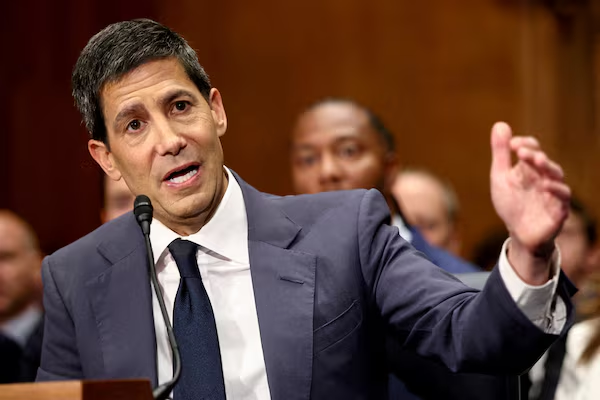
The June meeting carried added significance as it marked the first policy gathering under Federal Reserve Chair Kevin Warsh, who was sworn in as the central bank’s 17th chair in May after succeeding Jerome Powell.
Investors and economists closely watched the meeting for clues about how Warsh might shape monetary policy and Federal Reserve communications during his tenure, making the gathering an important early test of the new chairman’s leadership. Warsh entered office amid expectations that the Fed might eventually move toward lower rates. However, persistent inflation has complicated that outlook and presented an immediate challenge for the new chairman. In a departure from recent practice, Warsh did not submit his own interest-rate forecast for inclusion in the dot plot. Observers interpreted the move as consistent with his longstanding scepticism toward forward guidance and detailed rate projections.
The Federal Reserve also streamlined its policy statement, removing language that had previously suggested a bias toward future rate cuts. The revised statement was notably shorter and focused more directly on current economic conditions and the institution’s commitment to controlling inflation. Economists view those changes as evidence that Warsh may seek to reshape how the central bank communicates with markets. Rather than signalling a preferred policy path months in advance, the new chairman appears inclined to emphasize flexibility and data-driven decision-making. Nevertheless, the underlying message from policymakers remained unmistakably hawkish.
The Fed’s latest projections suggest that officials are increasingly concerned about upside risks to inflation. While some policymakers still believe rates can remain unchanged for the remainder of the year, support for additional tightening has risen sharply.
That division underscores the uncertainty surrounding the economic outlook. Although growth remains positive, inflation continues to exceed expectations, creating a difficult balancing act for policymakers attempting to fulfill the Fed’s dual mandate of stable prices and maximum employment.
Political considerations have added another layer of complexity to the Federal Reserve’s policy outlook. President Donald Trump has consistently favoured lower interest rates as a means of supporting economic growth and boosting investment, but he recently indicated that Federal Reserve Chair Kevin Warsh should be allowed to make policy decisions independently.
According to reports, Trump said he wanted Warsh to “do what he thinks is right,” even as the administration continues to prefer lower borrowing costs.
Any future rate increase could nevertheless create tensions between the central bank and political leaders advocating a more accommodative monetary stance. However, inflation remains the overriding concern as they assess the path of interest rates in the months ahead. Many economists believe the Fed’s next moves will depend heavily on incoming data, particularly inflation readings and labor-market reports. If price pressures begin to moderate and energy costs stabilize, policymakers could maintain current rates for an extended period. But if inflation remains elevated or accelerates further, support for rate hikes could strengthen. The June meeting highlighted just how quickly expectations can change. Earlier this year, investors were debating the timing of potential rate cuts. Today, policymakers are openly discussing the possibility of raising rates again.
That dramatic reversal underscores the challenges facing the Federal Reserve as it navigates an economy that continues to grow but remains vulnerable to inflationary shocks. The consequences are considerable for both companies and consumers. Elevated interest rates raise the costs of borrowing for mortgages, credit cards, and business loans, which could dampen spending and investment. The Fed contends that preserving price stability is crucial for supporting long-term economic growth.
The second half of the year begins, attention will turn to inflation data and future Fed meetings. The central bank may have left rates unchanged this month, but its latest projections indicate that the debate over additional tightening is very much alive. With nearly half of policymakers now anticipating a rate increase before year’s end, the Federal Reserve has delivered its clearest warning yet that the fight against inflation is not over.

AD: Heritage And Restaurant Lounge Bar