

By Sammy Jones-
A devastating magnitude-6.3 earthquake rocked northern Afghanistan early Monday morning, causing widespread destruction near the populous city of Mazar-e-Sharif. Initial reports from local authorities indicate a minimum of 20 fatalities, with hundreds more individuals sustaining injuries.
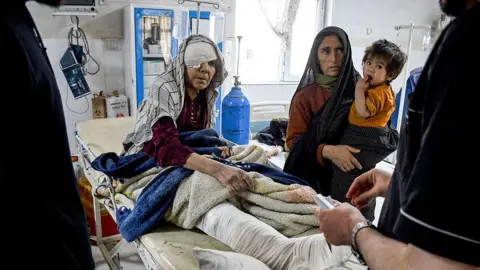
Authorities expect the death toll to rise as search and rescue efforts continue. Pic: Getty Images
Officials universally warn that the grim death toll will undoubtedly increase as specialized rescue efforts continue their relentless search through the rubble and debris. More than 530 people have already been injured, according to figures released by the Taliban government’s health ministry, a number expected to climb as communication is established with remote areas. The quake struck at approximately 01:00 local time on Monday, corresponding to 20:30 GMT on Sunday, jolting residents awake and driving mass panic.

AD: Capeesh Restaurant
The seismic event was centred near Mazar-e-Sharif, one of the country’s largest urban centres, home to roughly 500,000 people. The US Geological Survey measured the earthquake at a depth of 28 kilometres (17 miles), classifying the event with an orange alert level. This critical designation signals that “significant casualties” are highly likely to have occurred based on the quake’s strength and the region’s inherent vulnerability.
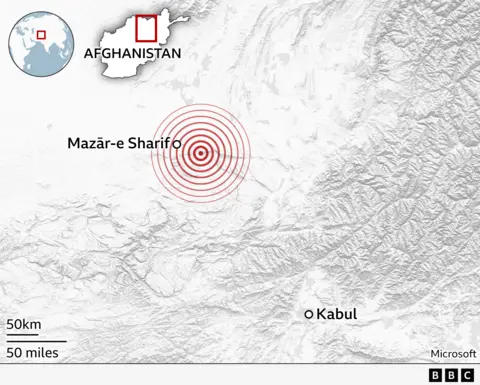
The quake struck near the city of Mazar-e-Sharif, home to more than 500,000 people. Pic: BBC
Initial reports gathered by the BBC suggested that Afghanistan Earthquake Casualties were imminent given the time of day and the nature of the tremor. Many residents of Mazar-e-Sharif immediately rushed into the streets following the initial powerful jolt, desperately fearing their houses would instantaneously collapse around them, according to reports from AFP news agency.
Haji Zaid, a Taliban spokesman operating in Balkh province, confirmed on X that “many people are injured” in Sholgara district, located just south of Mazar-e-Sharif. He further detailed receiving widespread “reports of minor injuries and superficial damages from all districts of the province,” emphasizing the tremor’s extensive reach.

AD: Oysterian Sea Food Restaurant And Bar
Most unfortunately, numerous injuries were caused by people panicking and falling from tall buildings during the sudden, violent shaking.
Numerous provinces surrounding the epicenter have reported significant disruption and a deteriorating outlook for Afghanistan Earthquake Casualties. Numerous fatalities were also confirmed in Samangan, a mountainous province situated close to Mazar-e-Sharif, according to its official spokesperson. Widespread infrastructure damage has also been reported across the region, severely hindering aid and communications.
Most notably, the strong tremor led to an immediate power outage across the entire country, including the capital city Kabul, after essential electricity lines were damaged. These lines import major power supplies from neighbouring Tajikistan and Uzbekistan, leaving vast areas without light or critical communication access. Authorities in Kabul, including Khalid Zadran, a Taliban spokesman for the city’s police, confirmed they are “closely monitoring the situation” following the widespread disruption.
Religious and cultural sites were not spared from the destructive force of the 6.3 magnitude quake. The Taliban spokesman in Balkh province shared a video on X that visibly showed debris strewn across the ground at the revered Blue Mosque in Mazar-e-Sharif. This stunning mosque, built during the 15th century, holds immense significance as it is believed to house the tomb of the first Shia Imam, who was both the cousin and son-in-law of Prophet Mohamad.
The site serves as a vital gathering point where pilgrims frequently congregate for religious events and daily prayers. Damage to such an important, historic structure underscores the indiscriminate reach of the natural disaster. The difficult, ongoing struggle to assess the full extent of the damage is significantly complicated by Afghanistan’s notoriously poor communication networks and limited infrastructure. Buildings across the country are often not designed to be earthquake-resistant, increasing the potential for catastrophic collapse and creating a devastating risk profile.
Afghanistan is one of the most seismically active and vulnerable countries in the world, constantly exposed to the threat of rising Afghanistan Earthquake Casualties. Its unfortunate location directly atop a complex network of fault lines marks where the Eurasian and Indian tectonic plates converge and clash. This geological collision zone generates immense subsurface pressure, making severe earthquakes a constant, recurring reality for the Afghan people. Understanding these geological forces is crucial for risk management, which you can research further on the US Geological Survey’s Earthquake Hazards Program website.
This powerful tremor on Monday tragically follows a similar disaster in late August, when a 6.0 magnitude earthquake struck the country’s mountainous eastern region, killing more than 1,100 people.
That previous August earthquake proved exceptionally deadly because the vast majority of rural houses in that region were constructed using traditional, non-resistant materials like timber and mud. Residents were subsequently trapped beneath the rubble when their homes disintegrated during the powerful shaking. Afghanistan’s history of insufficient building codes and infrastructure investment repeatedly hampers effective post-disaster response and significantly contributes to higher Afghanistan Earthquake Casualties tolls with every major event.
The global community must prioritize supporting the country’s urgent need for durable, quake-resistant reconstruction and bolstering local search and rescue capabilities.
International aid should focus on establishing more reliable communication networks throughout the mountainous terrain, ensuring authorities can rapidly assess disaster zones and coordinate life-saving assistance more efficiently.
The ongoing crisis necessitates a coordinated, sustained response from both the local government and international partners to prevent future seismic events from resulting in such devastating losses of life and further destabilizing the already fragile region.

AD: Heritage And Restaurant Lounge Bar


