
By Gabriel Princewill-
The Eye Of is to launch an investigation into one of the most consequential questions arising from the final hours of Christa Gail Pike’s death-penalty case:.
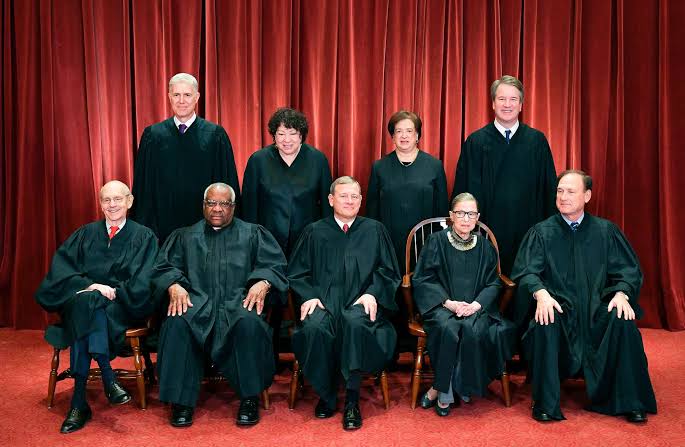
The question under scrutiny is whether the United States Supreme Court was right to vacate a stay imposed by the Sixth Circuit while that lower appellate court was still considering Pike’s outstanding legal application.

AD: Capeesh Restaurant
This is not an investigation based on the assumption that the Supreme Court acted improperly. It is an investigation into whether it should have waited.
The sequence of events is now a matter of public record. On September 30, 2026, the United States Court of Appeals for the Sixth Circuit stayed Pike’s execution after concluding that it needed time to properly analyse and resolve the issues raised in her pending application.
The Sixth Circuit said that the interests of justice and the finality of the impending execution required a short stay so that the parties’ fully briefed arguments could be considered on their merits. The Supreme Court subsequently granted Tennessee’s application to vacate that stay.

AD: Oysterian Sea Food Restaurant And Bar
The consequence was extraordinary. The Supreme Court’s order removed the legal barrier that the Sixth Circuit had put in place specifically to give itself time to consider Pike’s case. And that is where The Eye Of believes serious questions arise.
When a lower appellate court has expressly said that it needs time to consider a person’s pending legal application — and when the consequence of ending that time is the irreversible taking of a human life — should the highest court in the land intervene before that lower court has completed its consideration? That is the question this investigation will examine.
Pike was facing execution for the 1995 murder of Colleen Slemmer. Christa Gail Pike was convicted in connection with the January 1995 murder of 19-year-old Colleen Slemmer, a fellow student at the Job Corps training centre in Knoxville, Tennessee.
Prosecutors alleged that Pike, then 18, and an accomplice ,lured Slemmer into a wooded area, where she was attacked and killed. The prosecution case described a prolonged and brutal assault in which Slemmer suffered numerous injuries before her death.
Pike was subsequently convicted of first-degree murder and sentenced to death. The circumstances of Slemmer’s killing have remained central to the case throughout the decades of litigation that followed.
Pike’s conviction and death sentence have survived numerous legal challenges, although subsequent proceedings have focused on separate questions concerning the fairness and legality of aspects of her trial and federal habeas proceedings.
Her latest legal challenge concerned a Rule 60(b)(6) application seeking to reopen the federal habeas proceedings. Among the issues raised was the treatment of evidence concerning severe sexual abuse.
Pike says she suffered as a child and allegations concerning the adequacy of the mitigation case presented during the penalty phase of her original trial.
The legal question was not simply whether Pike should receive another opportunity to challenge her conviction. The question before the courts included whether the new circumstances relied upon by Pike affected the integrity of the earlier federal habeas proceedings.
Also, whether her application should be treated as a permissible Rule 60(b) motion or instead as a second or successive habeas petition subject to the restrictions of federal law.
The federal district court concluded that it did not have jurisdiction over Pike’s Rule 60(b)(6) motion and transferred the matter to the Sixth Circuit.
The Sixth Circuit then faced the task of determining what should happen. And, critically, it did not say that Pike had definitively established her claim.
Instead, the court concluded that a stay was necessary so that it could properly analyse the arguments and resolve the issues on their merits before the execution took place. The decision was then overturned by the Supreme Court.
There is an obvious argument that the Supreme Court possessed the authority to intervene. The State of Tennessee asked the Supreme Court to vacate the Sixth Circuit’s stay, and the Supreme Court granted that application.
But authority to act is not necessarily the end of the question. The deeper issue is whether exercising that authority at that particular moment, when the lower appellate court had expressly requested time to consider the legal issues before it, was consistent with the principles of orderly judicial administration.
The question becomes even more profound because this was a capital case.An ordinary procedural dispute can, in principle, be corrected later. A person facing execution does not have that luxury, because once an execution takes place, an error cannot be remedied in the ordinary way.
That is precisely why Justice Sonia Sotomayor, joined by Justices Elena Kagan and Ketanji Brown Jackson, dissented from the Supreme Court’s decision.
Her dissent argued that the Sixth Circuit had stayed the execution in order to adequately address Pike’s pending application and criticised the Supreme Court for allowing the execution to proceed before those legal challenges had been properly considered.
Justice Sotomayor dissented in the Supreme Court’s ruling to execute
Justice Sotonayar also pointed to a principle of particular importance to this investigation. The Supreme Court has described itself as a “court of review, not of first view.” The Eye Of will examine what that principle means in practice.
The legal professionals who must be heard
This investigation requires more than political commentary or social-media opinion.The Eye Of intends to seek the views of senior and appropriately qualified legal professionals with direct knowledge of appellate procedure and capital litigation.
Those interviewed should include King’s Counsel and other senior appellate advocates, particularly lawyers with experience before the U.S. Supreme Court and federal Courts of Appeals; constitutional and federal appellate lawyers able to explain the respective powers of the Supreme Court and lower federal courts.
It should also include capital-case specialists familiar with the extraordinary procedural safeguards surrounding executions; academic experts in federal civil procedure and habeas corpus law.
Also, where available, former federal judges or senior judicial officers who can explain how courts ordinarily handle a situation in which a lower court requires additional time to consider a capital defendant’s application.
The questions put to them will include their view on whether the Sixth Circuit was entitled to stay the execution, and that it was correct to say that it required additional time to resolve the issues before it.
It will also be separately useful to establish whether the Supreme Court actually had a proper legal basis to vacate that stay immediately, and authourise the continuation of the scheduled execution.
What principles govern intervention by the Supreme Court while a matter remains under consideration by a lower appellate court would be useful too.
Also useful is whether the extraordinary finality of an execution require sa greater degree of procedural caution. Most importantly what the correct procedure be for an ordinary person facing the same procedural circumstances would be important to establish.
Why this matters beyond Christa Pike
Our investigation is not about reopening the merits of every argument in Pike’s case. Nor is it about asking the public to decide whether Pike was guilty of the crime for which she was sentenced.
It is about something more fundamental in terms of whether the judicial system followed a procedure that can be explained, understood and consistently applied.
The justice system depends upon order.A litigant must be able to establish which court has jurisdiction, which application must be made, when it can be made, what happens while that application is being considered and what rights remain available when a lower court has not yet completed its work.
Those questions become immeasurably more important when the consequence of procedural failure cannot be reversed. The Supreme Court’s own record shows that Pike had an application for a stay of execution before the Court, and that the application was referred to the full Court before being denied on September 29.
The following day, the separate proceedings concerning the Sixth Circuit’s stay became the immediate focus of the Supreme Court’s intervention.
The chronology therefore deserves public scrutiny. Not because a court should be presumed wrong, but because the more irreversible the consequence, the more important it is that the procedure leading to that consequence can withstand rigorous examination.
We will therefore investigate whether the Supreme Court’s decision to vacate the Sixth Circuit’s stay was proceduraly and legally justified, whether the lower court should have been allowed sufficient time to complete its consideration, and whether the exceptional circumstances of a pending execution required greater judicial restraint.
The investigation will also examine the dissenting position and the reasoning of those who supported the Supreme Court’s intervention, ensuring that the inquiry does not present one side of a disputed legal question as established fact.
At its heart, this is about more than Christa Pike. It is about whether there is a clearly understandable chain of judicial procedure from the first court to the last — and whether that chain remains intact when the clock is running down on a human life.
If the objective answer is that the Supreme Court was entitled to intervene, the public should be able to understand precisely why.
On the contrary, if the answer is that the Sixth Circuit should have been allowed to complete its consideration, the public should understand that too.
And if the rules permit either interpretation, that fact itself deserves examination. This publication believes that ordinary people should not need to be constitutional lawyers to understand the basic route through the justice system.
Courts are bestowed with immense power, but with that power comes an equally profound requirement for order, clarity and accountability. In the case of Christa Gail Pike, the question is now stark.

AD: Heritage And Restaurant Lounge Bar