
By Kenneth Williams-
The mother of Colleen Slemmer, whose 1995 murder led to Christa Pike being sentenced to death, has criticised the handling of Pike’s failed execution attempt, describing the process as “a mess” after the condemned inmate survived two doses of lethal injection.
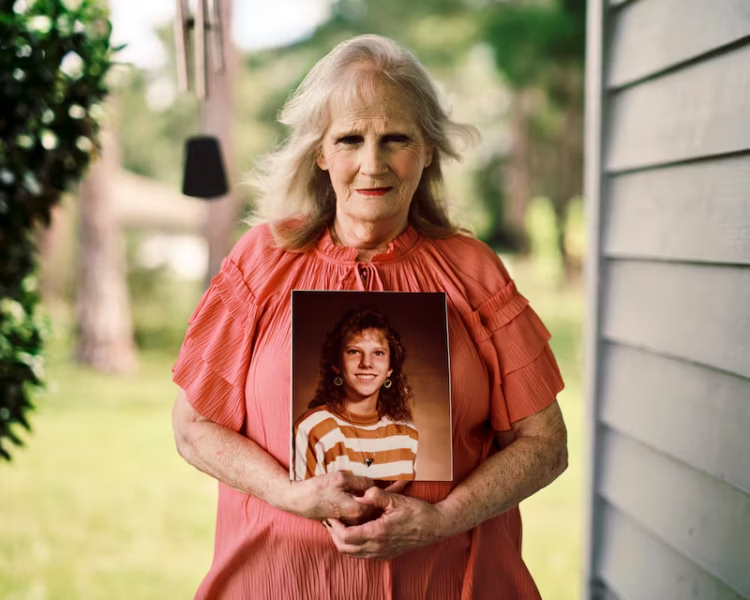
May Martinez had travelled 11 hours from Florida to Nashville, hoping to witness the execution of the woman convicted of killing her 19-year-old daughter. Instead, she said witnesses were left without clear information as the procedure was halted and Pike was taken to hospital for medical treatment.

AD: Capeesh Restaurant
“They went to try to execute her, and she didn’t die,” Martinez told NBC News in a phone interview on Thursday morning. Later she told THE PEOPLE that she did not take her eyes off her. “It was a complete waste of time. I don’t know. It sounds cruel, but how do you botch up killing somebody?” , her husband asked. “It’s unheard of.”
Martinez said she and other witnesses were not immediately informed about what had happened. According to her account, they only learned that the execution had failed after arriving at an office and being told by a corrections commissioner that Pike was being taken to hospital.
“We didn’t know anything until we got up to the office and saw the commissioner,” Martinez said. “And he said that it didn’t work, that it didn’t work, and she’s on her way to the hospital.”

AD: Oysterian Sea Food Restaurant And Bar
Asked what message she had for Tennessee’s governor and attorney general, Martinez responded angrily, saying officials had “messed up.” She also said Pike showed no remorse during the attempted execution.
President Trump also later slammed the competence of those charged with the duty of undertaking the execution. When asked about his views on the botched execution, he said: “Should be easy to do. It shouldn’t be very difficult.
“That was an interesting situation, but you’re going to have to speak to Tennessee about it. Whether or not they’re going to go forward.”
The execution began at Riverbend Maximum Security Institution in Nashville at about 7.30pm local time. Pike was administered two doses of pentobarbital, but according to her lawyers, neither dose resulted in her death. Her legal team subsequently filed an emergency motion seeking to halt the procedure and ensure she received medical care.
District Judge Clifton L. Corker granted the request, noting that medical personnel had begun providing the treatment requested by Pike’s lawyers. Her attorney later told the BBC that the 50-year-old inmate was receiving life-saving measures in hospital.
The incident has raised questions about Tennessee’s execution procedures. The state’s protocol provides for a second set of syringes if an initial attempt fails, but it does not clearly set out what should happen if an inmate remains alive after the second attempt.
Reports indicated that the curtain in the execution witness room was closed twice during the procedure, while members of the media were eventually asked to leave.
Dr Joel Zivot, an Emory University School of Medicine professor retained by Pike’s legal team, told the BBC that Pike may not have reached a sufficiently high blood concentration of pentobarbital to cause respiratory and cardiovascular failure. He also warned that delays in resuscitation could potentially have resulted in brain injury.
The Tennessee Department of Correction has defended the way the execution was conducted. Spokesperson Dorinda Carter told the Tennessean that officials followed every step of the protocol approved by the Attorney General’s Office, adding that the lethal-injection chemical specified in the protocol had consistently been effective and that the procedure did not provide for additional measures beyond those carried out.
Tennessee Governor Bill Lee has since ordered a comprehensive third-party review into what happened. The state’s remaining scheduled execution for the year has also been called off.
The failed attempt is not the first execution-related problem Tennessee has faced this year. In May, the execution of Tony Carruthers was postponed after officials were unable to establish a suitable vein for the lethal injection.
Pike’s case dates back to 1995, when she was 18 and Slemmer was 19. Pike and her then-boyfriend, Tadaryl Shipp, were convicted in connection with Slemmer’s killing after the three had met at a job-training camp for troubled teenagers.
Prosecutors said Pike accused Slemmer of insulting her and attempting to steal her boyfriend. Slemmer was beaten and tortured before being killed. The case attracted widespread attention in Knoxville after an inverted pentagram was found carved into her chest. Pike has denied carving the symbol.
Two other residents of the training camp testified that Pike had boasted about the killing and shown them a piece of Slemmer’s skull. Pike was sentenced to death in 1996.
In a later clemency petition, Pike said she had intended to beat Slemmer rather than kill her, describing herself at the time as a troubled 18-year-old who had been unable to stop the attack.
Clearly, for May Martinez, the passage of time has not lessened the loss of her daughter. She has said that she thinks about Colleen constantly and that holidays are particularly difficult.
Before the attempted execution, Martinez described her daughter as a young woman who loved computers, retro video games and roller skating. She also made clear why she had travelled to Tennessee to witness the proceedings.
“I am her voice,” Martinez said. “Someone has to speak for Colleen.”
Now, instead of witnessing the execution she had travelled to Nashville to see, Martinez has been left questioning how Tennessee officials handled a procedure that ended with Pike alive and requiring medical treatment.
The state’s independent review is expected to examine what happened during the failed execution, including the administration of the lethal-injection drugs, the decision-making during the procedure and whether officials followed the state’s established protocol.

AD: Heritage And Restaurant Lounge Bar