
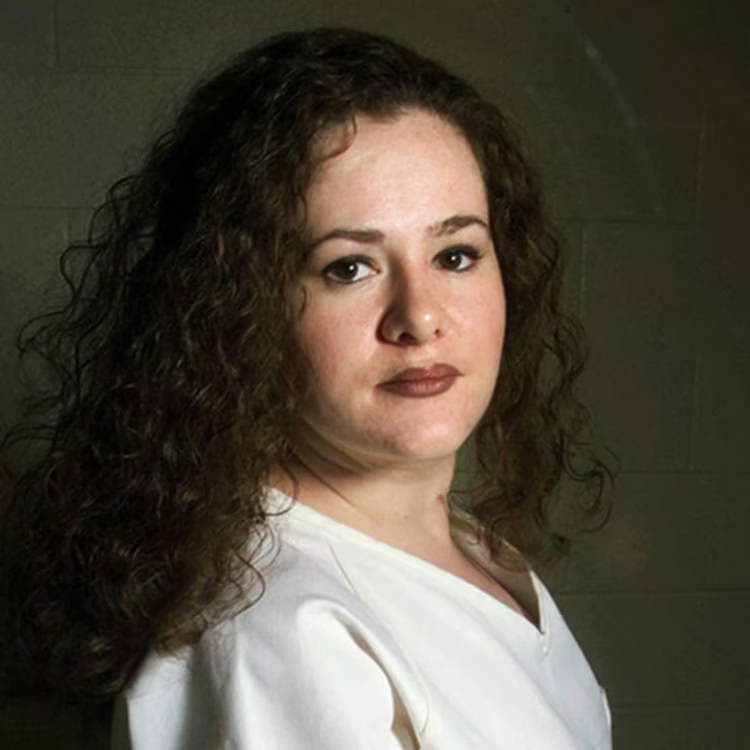
By Isabelle Wilson-
Christa Pike was taken to Tennessee’s execution chamber to be killed by lethal injection. Instead, after two doses of pentobarbital failed to end her life, the state that had prepared for her death was forced to arrange emergency medical treatment to keep her alive.
The extraordinary sequence of events surrounding Christa Pike’s failed execution has left Tennessee confronting a deeply unusual situation: the state spent years pursuing the legal authority to execute her, prepared a procedure intended to cause her death and carried out two rounds of lethal injection, only for the attempt to fail and for Pike subsequently to be transported to hospital for life-saving treatment.
Pike, 50, remained alive in hospital on Thursday, according to her lawyers, who said she was in critical condition and receiving medical care. They said they did not yet know her prognosis.

AD: Capeesh Restaurant
She had been transported from Riverbend Maximum Security Institution in Nashville after prison officials halted the execution when the two doses of pentobarbital failed to kill her.
The result has created an extraordinary reversal of purpose. The execution chamber had been prepared to bring Pike’s life to an end, but once the procedure failed, medical intervention became necessary to preserve the life that the state had just attempted to extinguish.
Pike left the prison in an ambulance rather than the vehicle that would ordinarily have carried a body away after a completed execution. Associated Press reporters who witnessed the proceedings reported that Pike continued breathing and making sounds resembling snoring for more than an hour after the lethal injection process beg

AD: Oysterian Sea Food Restaurant And Bar
The Tennessee Department of Correction has said that officials followed every step of the state’s established execution protocol. In a statement issued late Wednesday, the department said that the lethal-injection chemical used in the protocol had consistently been effective and that the protocol did not permit additional procedures beyond those carried out that evening.
The department confirmed that Pike had been transported to an off-site medical facility. The department has not publicly established why the execution failed. That question is now at the centre of the independent review ordered by Governor Bill Lee, who described the incident as deeply disturbing and postponed another scheduled execution while the circumstances are investigated.
The immediate medical consequences for Pike remain uncertain. Her lawyers said Thursday that she was in critical condition and receiving life-saving treatment, but they had not been given a prognosis concerning her longer-term recovery.
The lack of a clear medical explanation makes the investigation particularly important because it remains unclear whether the failure resulted from the drug itself, its administration, the intravenous delivery system, a medical complication or some combination of factors.
Pike’s case is also unusual because the lethal-injection process appears to have progressed beyond the point reached in previous failed Tennessee executions. Earlier failures have involved difficulties establishing intravenous access before the lethal drugs could be successfully administered.
In Pike’s case, however, Tennessee administered two rounds of pentobarbital and she remained alive. The Death Penalty Information Center has described her survival after the administration of lethal-injection drugs as unprecedented among known modern US execution cases.
The failure is the latest in a series of difficulties for Tennessee’s capital-punishment system. In May, the state attempted to execute Tony Carruthers but abandoned the procedure after officials were unable to establish the required intravenous access. That incident followed an earlier period of scrutiny over Tennessee’s execution protocols.
In 2022, Governor Lee halted executions after the scheduled execution of Oscar Smith was called off because of an error in the preparation of the lethal-injection drugs. An independent investigation subsequently found repeated failures to comply with aspects of Tennessee’s own execution protocol.
The state then undertook a comprehensive review and announced a revised single-drug pentobarbital protocol in December 2024. Executions resumed in Tennessee in May 2025.
Pike’s failed execution therefore comes less than two years after Tennessee declared that its revised procedure was ready for use. The state’s own Department of Correction describes itself as the agency responsible for carrying out death sentences as ordered by the courts, making the latest failure a significant test of the reliability of the procedures governing capital punishment in the state.
The legal consequences are also significant. Pike’s death sentence has not simply disappeared because the execution failed, but Tennessee cannot treat Wednesday night’s attempt as an unfinished procedure that can simply be resumed.
The execution date had been fixedy an order of the Tennessee Supreme Court for September 30, 2026. That order directed that the sentence be carried out on that date unless otherwise ordered by the court or another appropriate authority.
Any future attempt would therefore require Tennessee to return to the judicial process and obtain a new execution date. The Tennessee Supreme Court’s September 2025 order demonstrates how that process works: the state formally requested an execution date, Pike was given an opportunity to respond, and the Supreme Court subsequently issued an order setting the date.
The circumstances surrounding a future request would, however, be very different. Pike would be a prisoner who had already undergone an attempted lethal injection, survived two doses of the state’s execution drug and required emergency alive in a hospital, critically ill and receiving life-saving care, while the state began examining why its attempt to kill her had failed. medical treatment afterwards.
Her lawyers would be able to place those events before the courts alongside any new medical evidence concerning the effects of the failed procedure.
The state, meanwhile, would be required to explain what went wrong and why a revised execution protocol that Tennessee had previously considered reliable had failed in Pike’s case.
The independent review ordered by Governor Lee is therefore likely to become an important part of any future legal proceedings concerning Pike’s sentence.
There is also a remarkable judicial dimension to the case. Hours before the execution eventually took place, the Sixth US Circuit Court of Appeals had temporarily stayed it, saying that additional time was needed to adequately address issues raised by Pike’s lawyers.
Tennessee appealed to the US Supreme Court, which vacated the Sixth Circuit’s stay and allowed the execution to proceed. Justices Sonia Sotomayor, Elena Kagan and Ketanji Brown Jackson dissented.
That sequence means Pike’s failed execution cannot be understood simply as an isolated malfunction inside a prison. The attempt came after an intense legal battle that reached the nation’s highest court, followed by a state decision to proceed with the execution and then an extraordinary medical emergency when the procedure failed.
The central irony of the case is therefore also its most powerful news point. Tennessee had prepared to end Christa Pike’s life, but when the execution failed, the state became responsible for ensuring that she received medical treatment to preserve it.
On Thursday, the prisoner who had been brought into an execution chamber remained alive in a hospital, critically ill and receiving life-saving care, while the state began examining why its attempt to kill her had failed.
Unfortunately, the state and its governor, Bill Lee, have egg on their face.