
By Ben Kerrigan-
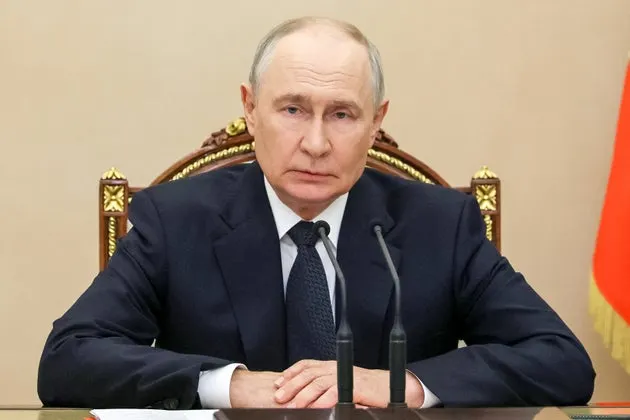
Russian President Vladimir Putin has issued one of his starkest warnings to the West in months, saying Moscow could use “all weapons” in its arsenal — potentially including nuclear weapons — if Kaliningrad or other Russian territory came under direct attack.
Speaking at the Valdai Discussion Club in Moscow on October 1, Putin said Russia was not threatening European countries and claimed Moscow had no intention of attacking them. But he warned that any direct attack on Russian territory would fundamentally change the situation.
“If it comes to a direct attack on the Russian Federation — in this case we mean Kaliningrad, but may be some other territories as well — of course, naturally, immediately what will be on the agenda is the use of all weapons that we [have] at the disposal of our country.”

AD: Capeesh Restaurant
The comments come at a particularly dangerous point in relations between Russia and NATO, as the war in Ukraine continues and European governments increase their preparations for a possible confrontation with Moscow. Reuters reported that Putin described the current international environment as a “dangerous moment” and specifically warned the West against escalating tensions around Kaliningr
Kaliningrad is not simply another Russian region. The territory was historically part of East Prussia and was centred on the German city of Königsberg. At the end of the Second World War, the Potsdam settlement transferred the northern part of East Prussia, including Königsberg, to the Soviet Union. The city was subsequently renamed Kaliningrad in 1946

AD: Oysterian Sea Food Restaurant And Bar
During the Cold War, Kaliningrad became a strategically important Soviet military territory on the Baltic Sea. When the Soviet Union collapsed in 1991, Kaliningrad became part of the Russian Federation — but its geographical position changed dramatically. Russia’s Baltic territory was now separated from mainland Russia by the newly independent states of Lithuania, Latvia and Belarus.
Today, Kaliningrad sits between Poland and Lithuania — both NATO members.
That geography is at the heart of the current confrontation.
The territory is effectively a Russian exclave, meaning it is separated from Russia’s main territory while remaining part of the country. Its location also places it close to the Suwałki Gap, the relatively narrow stretch of territory connecting Poland and Lithuania between Kaliningrad and Belarus. Poland and Lithuania joined NATO in 1999 and 2004 respectively, leaving Kaliningrad surrounded by NATO territory on its landward sides.
The significance of Kaliningrad increased again after Russia’s full-scale invasion of Ukraine in February 2022.
NATO’s eastern flank has since become heavily militarised, with Poland and the Baltic states strengthening their defences and NATO increasing military activity across the region.
Moscow, meanwhile, has repeatedly portrayed NATO expansion and Western military support for Ukraine as threats to Russian security. Western governments reject that interpretation and describe NATO’s posture as defensive. The result is a security dilemma in which military measures presented by one side as defensive can be interpreted by the other as preparation for offensive action.
That dynamic has become particularly sensitive around the Baltic Sea.
Nuclear rhetoric adds another layer of danger
Putin’s warning is also significant because Russia’s nuclear doctrine has changed since the beginning of the Ukraine war.
In November 2024, Russia formally approved an updated nuclear doctrine. Among other changes, it stated that Moscow could consider nuclear weapons in response to conventional aggression that creates a “critical threat” to Russian sovereignty or territorial integrity. The doctrine also says Russia could regard an attack by a non-nuclear state supported by a nuclear-armed state as a joint attac
That does not mean Russia has announced that it intends to use nuclear weapons against NATO.
But it does mean that nuclear weapons have increasingly become part of Moscow’s public signalling during the Ukraine conflict.
The UK House of Commons Library has noted that Russia has repeatedly used nuclear rhetoric during the war, including warnings aimed at influencing Western support for Ukraine. It also notes that Russia announced the deployment of tactical nuclear weapons to Belarus in 20
Putin’s latest comments therefore arrive against an established backdrop of nuclear signalling rather than in isolation. Moscow and the West tell very different stories
Putin argued that Western politicians have increasingly spoken about preparing for a possible war with Russia in the coming years and accused European governments of escalating tensions.
He also said Russia was monitoring Western weapons supplied to Ukraine but claimed Moscow did not intend to strike European countries simply because they were supplying Kyiv.
The Kremlin’s position is that Russia is responding to threats against its security and territory.
Western governments, by contrast, argue that Russia’s invasion of Ukraine is the central cause of the current European security crisis and that NATO’s military preparations are intended to deter further Russian aggression.
Those competing interpretations are important because neither side describes its own actions as the source of escalation. The real danger is miscalculation There is currently no indication that NATO is preparing to attack or seize Kaliningrad.
The significance of Putin’s statement lies instead in the warning itself: Moscow is making clear that it regards any direct military attack on Kaliningrad as an attack on Russia proper and is deliberately keeping its response options broad.
That creates an especially dangerous situation because Kaliningrad is surrounded by NATO territory while remaining a heavily strategic Russian outpost.
Observers fear that an incident involving aircraft, drones, naval vessels, missiles or military infrastructure could carry consequences far beyond the immediate location. For more than 80 years, the territory has moved from being a German stronghold, to a Soviet military bastion, to a Russian exclave surrounded by members of the Western military alliance.
Now, as the war in Ukraine continues to reshape Europe’s security architecture, Kaliningrad has once again become one of the places where the boundary between deterrence and escalation is exceptionally thin.
Putin insists he is not threatening the West. But his message is unmistakable. If Moscow believes Russian territory — including Kaliningrad — is directly attacked, the Kremlin says it is prepared to consider every weapon at its disposal.

AD: Heritage And Restaurant Lounge Bar