
By Theodore Brown-
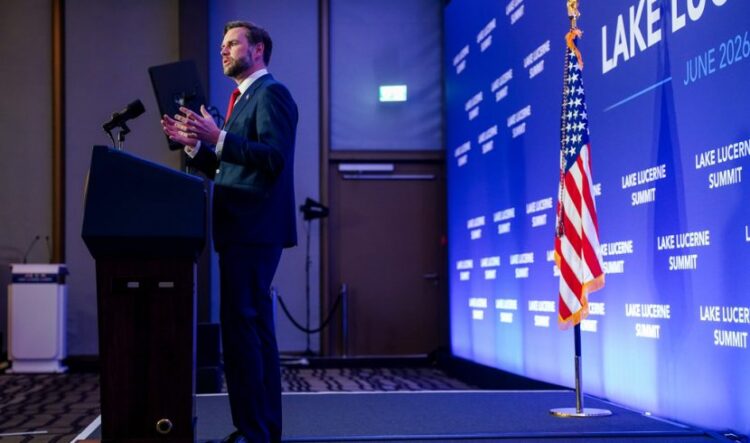
In the dim press corridor outside a high-level diplomatic venue in Europe, the language of war briefly softened into something more tentative almost procedural. JD Vance described recent discussions with Iranian officials as having laid a “good foundation” for a potential deal aimed at ending a conflict that has increasingly strained global supply chains, regional alliances, and already fragile security architecture across the Middle East.
The statement was delivered in a restrained, matter-of-fact tone that reflected the fragile diplomatic moment unfolding in Switzerland, where U.S. and Iranian officials have been engaged in intensive negotiations aimed at ending the war that began in late February.

AD: Capeesh Restaurant
According to the reports, Vice President JD Vance said the talks had produced a “good foundation for a successful final deal,” while emphasising that the process remained incomplete and that “we haven’t built the house” beyond initial groundwork .
The comments came as part of a broader effort to stabilise a negotiation track involving the United States and Iran, where officials have been attempting to turn a fragile interim understanding into a structured pathway toward de-escalation.
While progress has been made on technical issues such as maintaining the Strait of Hormuz as an open shipping route and sustaining regional ceasefire arrangements, the broader talks remain highly sensitive and reversible, shaped by earlier breakdowns and deep mutual mistrust that have repeatedly disrupted U.S.–Iran diplomatic efforts .

AD: Oysterian Sea Food Restaurant And Bar
Officials familiar with the talks describe the current phase as “pre-structural diplomacy,” meaning that while no binding agreement exists, both sides are reportedly engaging on frameworks that could, in theory, support a broader ceasefire or conflict de-escalation mechanism. That language deliberately vague is typical of negotiations where public failure carries as much political risk as private compromise.
The backdrop to these discussions is a war that has not remained neatly contained within any single border. Regional actors, proxy forces, and shifting alliances have turned what began as a series of targeted escalations into a wider confrontation affecting energy markets, maritime security routes, and diplomatic relations across continents.
Even without formal declarations, the operational tempo of the conflict has reshaped policy calculations in Washington, Tehran, and several European capitals. At the center of this delicate moment is the question of whether dialogue can survive contact with battlefield realities.
Inside the Quiet Diplomacy of a Fragile Opening
According to officials briefed on the matter, the most recent round of discussions involved indirect and direct channels, with intermediaries facilitating communication between U.S. representatives and Iranian officials in carefully controlled sessions.
The stated goal was not an immediate ceasefire agreement, but rather the identification of “mutually survivable terms” a phrase increasingly used in diplomatic circles to describe arrangements that neither side interprets as total victory or total defeat.
The role of U.S. Department of State has been central in coordinating messaging and establishing procedural guardrails for the negotiations. Public-facing statements from the department have emphasised consistency: any eventual agreement must address security concerns, regional stability, and enforcement mechanisms that reduce the likelihood of rapid breakdown.
Diplomats involved in the talks describe the latest exchanges as more structured than earlier rounds, reflecting a shift toward more formalised, phased diplomacy rather than open-ended exchanges. Reporting notes that negotiations are now being conducted through more clearly defined channels, with de-escalation mechanisms and structured communication pathways increasingly shaping the process.
Within this framework, discussions are reported to be focusing on sequencing potential steps to reduce hostilities, including phased arrangements and monitoring or deconfliction measures designed to limit the risk of renewed escalation.
While these proposals remain under negotiation and are not yet formalised, the emergence of sustained structured dialogue is being interpreted by some analysts as a shift away from earlier stagnation, where diplomatic efforts repeatedly stalled without reaching operational frameworks for implementation.
Still, diplomats involved in the process describe the latest exchanges as more structured than earlier attempts. Technical working groups are reportedly beginning to outline potential sequencing for de-escalation measures, including phased reductions in hostilities and reciprocal monitoring frameworks.
Such steps remain hypothetical, the mere existence of structured dialogue is being interpreted by some observers as progress in a negotiation landscape that has been largely static for months. International institutions have also begun to cautiously re-engage. Representatives from the United Nations have signalled readiness to support verification mechanisms should a formal agreement emerge.
UN officials, while not directly involved in the talks, have emphasised the importance of preventing further regional spillover, particularly in maritime corridors and energy transit routes that remain vulnerable to disruption.
Despite cautious optimism in some diplomatic quarters, the gap between a “good foundation” and a binding agreement remains wide. Negotiators on both sides are still grappling with fundamental disagreements over verification, sanctions relief, and regional security guarantees. In previous rounds of talks over similar crises, initial optimism has often unraveled once technical details came into focus.
One of the most sensitive issues remains enforcement. Any agreement would require mechanisms to verify compliance in real time, likely involving international inspectors, satellite monitoring, and coordinated intelligence sharing.
Such arrangements are standard in modern arms-control diplomacy, but in this case they intersect with active military tensions, making neutrality and access particularly difficult to negotiate. Another unresolved question is sequencing. Iranian officials have reportedly pushed for immediate easing of certain economic restrictions as a confidence-building measure.
U.S. negotiators, meanwhile, are said to favour a step-by-step approach in which sanctions relief is tied directly to verified reductions in military activity. Bridging that divide has historically been one of the most difficult aspects of negotiations with Iran.
The political stakes for JD Vance are also significant. His framing of the talks as having established a “good foundation” signals an attempt to project cautious progress without overcommitting to outcomes that remain uncertain. In Washington, early diplomatic optimism can quickly become political liability if talks stall or collapse.
The administration’s broader foreign policy posture has emphasised reducing the likelihood of prolonged overseas military entanglements. That strategic orientation has added pressure to explore diplomatic off-ramps even in conflicts where trust deficits remain substantial.
Analysts note that the current moment bears resemblance to earlier phases of Middle East negotiations in which incremental progress was achieved not through grand breakthroughs, but through layered confidence-building measures. Yet history also offers ample examples where such momentum dissipated under renewed escalation or domestic political shifts.
On the ground in conflict-affected regions, the diplomatic language of “foundation” feels distant from daily realities. Reports of disrupted infrastructure, displaced populations, and continued military exchanges underscore the urgency of any potential agreement.
Humanitarian organisations warn that even partial de-escalation could significantly reduce civilian harm, particularly in contested zones where access to aid remains inconsistent. Recent diplomatic communications reflect a noticeable shift in tone as discussions move toward structured negotiation frameworks rather than escalation management.
Reporting indicates that “sequencing” has become a central feature of the talks, with officials focusing on step-by-step implementation of potential agreements. This highlights an increasing emphasis on de-escalation mechanisms and structured dialogue intended to prevent further conflict.
While earlier phases of the crisis were dominated by deterrence and retaliatory signalling, current discussions increasingly focus on phased arrangements and negotiated pathways, reflecting a broader recognition in diplomatic circles that sustained military pressure alone is unlikely to deliver long-term regional stability.
Whether this shift becomes substantive progress or another brief diplomatic interval will depend on the coming weeks. Negotiators are expected to reconvene for additional sessions, though schedules remain fluid and heavily dependent on conditions in the conflict zone.
The most that can be said with confidence is what Vance himself suggested: that a foundation, however fragile, incomplete, and politically contested has been placed. In the architecture of diplomacy, foundations are not victories. But without them, nothing else can be built.

AD: Heritage And Restaurant Lounge Bar