
By Ben Kerrigan-
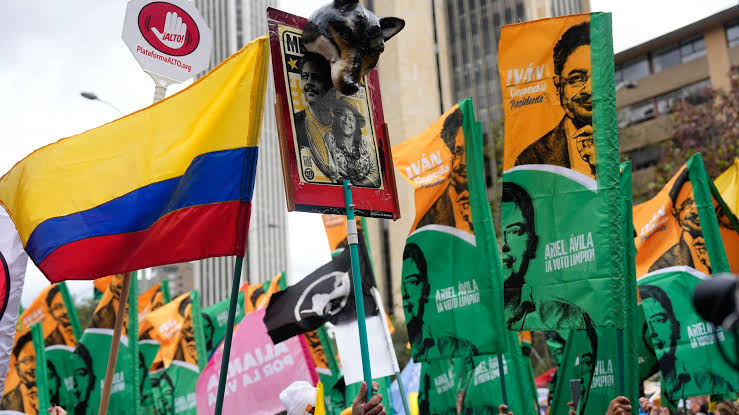
Colombians went to the polls on Sunday in a closely watched presidential runoff that has come to symbolise a broader clash over the country’s political direction, pitting a political outsider promising disruption against a progressive candidate defending institutional reform and social programmes.
The vote follows a tense first round in which no candidate secured the 50% threshold needed for outright victory, forcing a head-to-head contest that has exposed deep divisions over inequality, security, and the pace of change in Latin America’s fourth-largest economy.

AD: Capeesh Restaurant
The runoff reflects a political landscape still shaped by long-standing concerns over violence, organised crime, and uneven development, even as the country has made significant strides since the 2016 peace deal with the Revolutionary Armed Forces of Colombia (FARC).
According to reporting from regional and international media, voter turnout has been closely watched as an indicator of public engagement in a contest where both candidates have framed the election as a turning point for Colombia’s democratic future.
The outsider candidate, a political newcomer who surged unexpectedly in the first round, has built his campaign on anti-establishment rhetoric, promising to overhaul what he describes as a stagnant political elite. His supporters have rallied behind messages of economic disruption, stricter security policies, and sweeping institutional reform. His rise has drawn comparisons with other outsider movements across the region, reflecting voter frustration with traditional parties.

AD: Oysterian Sea Food Restaurant And Bar
His opponent, the progressive candidate, has sought to defend the government’s record on social investment and peace-building efforts while arguing that Colombia must continue strengthening its institutions rather than dismantling them.
Her campaign has emphasised reducing inequality, expanding access to education and healthcare, and protecting the fragile gains of the peace process. Analysts note that her platform appeals strongly to urban voters and younger demographics concerned about social justice and environmental policy
The contest has unfolded against a backdrop of persistent violence and insecurity across Colombia’s rural regions, where armed groups and dissident factions continue to compete for territorial control and profit from drug trafficking routes and illegal economies, a dynamic that has intensified since the 2016 peace agreement according to reporting on the country’s election environment .
In many areas, particularly in the south and along key rural corridors, the state’s presence remains limited, allowing these groups to fill governance gaps and shape everyday life through coercion, extortion, and control of local movement, contributing to widespread voter anxiety ahead of the runoff .
These security conditions have become one of the defining issues of the election, with analysts noting that violence is now more territorially concentrated but still deeply influential in shaping political behaviour, especially in communities affected by displacement and limited institutional access .
Both candidates have responded with sharply contrasting approaches: the outsider candidate advocates a hardline security strategy centred on military escalation and a tougher stance against armed groups, while the progressive candidate supports a combination of continued negotiations, social investment, and strengthening state presence in neglected regions as part of a broader “total peace” framework
Economic concerns have also played a central role in the campaign. Inflation pressures, informal employment, and uneven recovery from global economic shocks have contributed to widespread dissatisfaction. Many voters say they are seeking change not necessarily aligned with ideology, but with tangible improvements in daily life, particularly in employment opportunities and cost-of-living stability.
A divided electorate weighs change against continuity in a high-stakes vote
Divided Electorate Weighs Change Against Continuity In High Stakes Vote
Polling stations opened across Colombia, the atmosphere reflected both anticipation and uncertainty in a deeply polarised election that has drawn significant international attention, with voters turning out across a vast and diverse electorate of more than 41 million citizens amid heightened political tensions .
Election authorities, supported by extensive national and international monitoring missions, deployed large-scale oversight mechanisms to ensure transparency and credibility in the vote, with observers describing the process as closely watched due to concerns over electoral integrity and political polarisation .
Regional and international analysts cited in coverage emphasised that Colombia’s election carries broader significance for democratic stability in Latin America, given the country’s size, institutional weight, and ongoing security challenges linked to armed groups and drug trafficking networks that continue to affect rural governance and public trust.
Against this backdrop, observers have highlighted that Colombia remains one of the most politically influential countries in the Andean region, with its electoral outcomes closely followed for their implications on regional security cooperation, democratic resilience, and institutional stability .
Campaign rhetoric in the final days intensified sharply, with both candidates warning that the country’s future trajectory hinges on the outcome. The outsider has framed the election as a rejection of what he calls entrenched political corruption, while his rival has warned that dismantling institutions could undermine democratic stability and jeopardise social progress achieved in recent years.
Political analysts have described the runoff as a referendum not only on policy but on political identity itself. The divide between continuity and rupture has become the defining feature of the race, reflecting broader global trends in which established parties face growing challenges from insurgent political movements.
International reaction has been closely watched as well, with neighbouring governments and economic partners signalling interest in maintaining stable diplomatic relations regardless of the outcome. Colombia’s role in regional trade, migration management, and security cooperation means that its political direction carries implications beyond its borders.
However, the election is less about geopolitical positioning and more about immediate concerns. In rural municipalities, access to security and basic services dominates conversations, while in urban centres, debates over inequality, employment, and public services have shaped voter preferences.
The progressive candidate’s emphasis on institutional reform and social investment has resonated strongly in cities, while the outsider’s promise of disruption has gained traction among voters disillusioned with traditional politics. Turnout figures will be closely analysed as an early indicator of legitimacy and engagement. Regardless of the outcome, the election is expected to mark a significant moment in Colombia’s ongoing political evolution, underscoring both the resilience of its democratic system and the depth of its internal divisions. The time results are declared, Colombia will have chosen not just a president, but a direction either toward institutional continuity and reform or toward a more radical reordering of its political landscape.

AD: Heritage And Restaurant Lounge Bar