
By Isabelle Wilson-
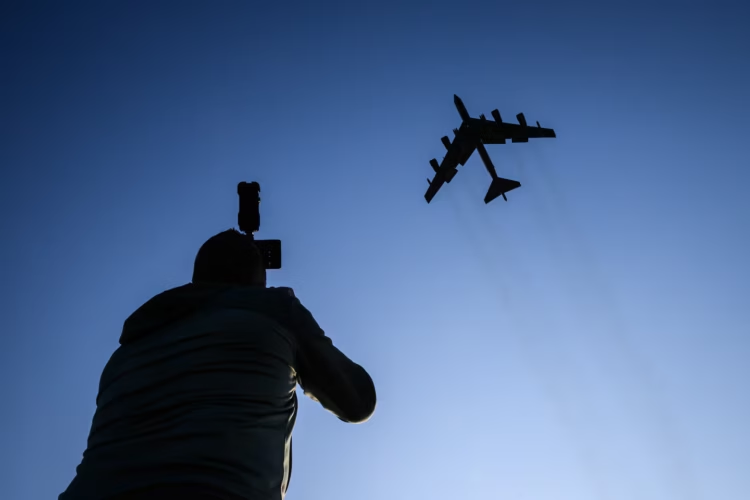
A military test flight involving a Boeing B-52 Stratofortress ended in disaster after the aircraft entered a rapid, uncontrolled descent reportedly approaching nearly a mile per minute before impacting the ground, according to preliminary accounts attributed to defence aviation investigators.
The incident, still under formal review, has triggered a multi-agency inquiry into what caused one of the world’s most enduring strategic bombers to lose stability during a routine evaluation sortie.

AD: Capeesh Restaurant
Officials associated with the U.S. Air Force have not released a full technical summary, but early reconstruction efforts suggest the aircraft transitioned from stable flight into a steep downward trajectory in a matter of minutes. The severity and speed of the descent have raised immediate questions about whether a catastrophic systems failure, structural issue, or cascading cockpit emergency played a role.
Investigators from the National Transportation Safety Board are reportedly assisting in the analysis of flight data and wreckage patterns, although military aviation incidents of this nature are typically led by defence authorities.
The B-52 platform, produced originally by Boeing and continuously modernised over decades of service, remains a cornerstone of long-range strategic bombing capability.

AD: Oysterian Sea Food Restaurant And Bar
Aviation analysts and defence officials note that the Boeing Boeing B-52 Stratofortress, despite entering service in the 1950s, remains a central pillar of U.S. long-range strike capability due to continuous modernisation programs intended to extend its operational life into the 2050s and beyond. According to reports, the aircraft is currently undergoing one of its most significant upgrade cycles in decades, including new engines under the Commercial Engine Replacement Program and extensive avionics, radar, and systems integration work designed to improve reliability and reduce maintenance demands.
However, defence analysts emphasise that the aircraft’s longevity depends heavily on sustained, meticulous upkeep, with each new layer of modernisation adding complexity to the integration of legacy airframes and modern digital systems, increasing potential interdependencies that can be difficult to predict in edge-case or high-stress flight conditions. Incidents involving sudden loss of control are treated with particular seriousness, as investigators increasingly examine not only mechanical or structural issues, but also how system complexity and pilot decision-making interact when aircraft are operating under rapidly changing or degraded conditions .
Rapid Descent During Routine Evaluation
The flight in question was described by defence sources as a routine test sortie intended to evaluate performance parameters following scheduled maintenance and avionics checks.
Such flights are typically conducted under controlled conditions, often with expanded instrumentation to monitor structural loads, engine output, and flight control responsiveness. In this case, however, something during the mission appears to have deviated sharply from expected operational behaviour.
Preliminary flight reconstruction data indicates the Boeing B-52 Stratofortress maintained a stable profile in the initial phase of its test sortie, with no immediate anomalies in altitude or heading before the onset of the emergency sequence. Reports described the mission as a routine test flight tied to ongoing evaluation work at Edwards Air Force Base, part of broader efforts to sustain and modernise the long-serving bomber fleet, with no early indication that weather or external environmental factors played a role in the accident.
Officials have not identified any immediate hazards during takeoff or the early climb phase, and investigators have instead focused on reconstructing flight data to understand the sudden transition into a steep, unrecoverable descent shortly after departure, which remains the central question in the ongoing inquiry.
A descent rate approaching a mile per minute is considered extreme for a heavy bomber of the B-52’s size and configuration. Aviation analysts note that such a trajectory suggests either a near-total loss of lift, a severe flight control malfunction, or an unrecoverable aerodynamic condition.
In normal operational envelopes, the aircraft is designed to maintain stable glide characteristics even under partial system degradation, making the reported rate of descent a critical anomaly. U.S. Air Force investigators, tasked with examining cockpit voice recordings, flight data recorder results, and maintenance logs, are reportedly assessing whether the descent was caused by mechanical failure, sensor inaccuracies, or potential pilot actions in reaction to an onboard emergency.
Although no official conclusions have been released, early indications suggest the crew may have faced multiple simultaneous alerts in the final moments of controlled flight. Experts familiar with long-range bomber operations emphasise that test flights, while carefully planned, often expose aircraft to operational boundaries that routine missions avoid. These profiles are designed to validate safety margins but can reveal vulnerabilities not previously encountered during standard deployments.
In this case, investigators are also examining whether recent maintenance procedures or component replacements could have contributed to unexpected system behaviour.The aircraft’s descent reportedly continued despite attempted recovery inputs, though the effectiveness of those inputs remains under review. Analysts caution that in high-stress aerodynamic failures, control surfaces may lose authority, rendering pilot corrections insufficient.
The question of whether the descent was gradual at first or abruptly initiated is central to determining if the event was recoverable at any stage.
Wreckage distribution patterns, according to early site assessments, are being used to reconstruct the final seconds of flight. A steep, high-energy impact is consistent with a near-vertical or sharply angled descent, reinforcing initial reports of an exceptionally rapid loss of altitude. However, investigators stress that only a full analysis of onboard data will confirm the sequence of events.
Human factors specialists within the U.S. Air Force are examining crew workload in the moments leading up to the crash. Modern military flight operations often require rapid decision-making under conditions of incomplete or conflicting information. If multiple systems failed simultaneously, the cognitive load on the flight crew could have increased beyond manageable limits.
Maintenance history is also under scrutiny. The aircraft had reportedly undergone scheduled servicing prior to the test flight, a standard procedure intended to ensure airworthiness after component wear or system upgrades.
Investigators will be looking closely at whether any recent repairs or replacements introduced unforeseen vulnerabilities. Even minor calibration errors in flight control systems can have amplified consequences at altitude and speed. Aviation safety experts note that older airframes, even those as robust as the B-52, rely heavily on meticulous upkeep to maintain performance reliability.
While the aircraft is structurally sound by design, decades of incremental modernisation can create complex interdependencies between old and new systems. These dependencies are often benign under normal conditions but may become critical under stress.
The role of environmental factors is also being evaluated. Although initial reports suggest stable weather conditions, localised turbulence or wind shear cannot be fully ruled out until full atmospheric modelilng is completed. Investigators typically reconstruct environmental data from both onboard sensors and external meteorological records to determine whether external forces contributed to instability. In parallel, data recovery teams are working to extract and preserve onboard recorders, which are expected to provide the most definitive timeline of events.
These systems capture flight parameters such as altitude, pitch, roll, engine thrust, and control surface position. When synchronised with cockpit audio, they often allow investigators to reconstruct not only what happened, but how the crew responded in real time.
Officials have emphasised that the investigation remains in its early stages, and conclusions about causation would be premature. The U.S. Air Force has indicated that a full safety board will ultimately determine whether procedural changes, technical modifications, or training updates are required to prevent recurrence.
The aviation community is left with a sobering case study in how quickly controlled flight can deteriorate under certain conditions. The reported near-mile-per-minute descent underscores the narrow margins within which even highly sophisticated aircraft operate when multiple systems are pushed beyond expected limits.
Investigators continue their work, the focus remains on reconstructing the final minutes with precision. Whether the cause is ultimately traced to mechanical failure, human factors, or a combination of both, the findings are expected to have implications not only for the B-52 fleet but for broader military aviation safety practices.
What remains clear is that the incident represents a rare and serious deviation from the aircraft’s long operational history. The B-52, which has served across generations of strategic missions, is designed for resilience but like all complex systems, it is not immune to failure when multiple vulnerabilities align at once.

AD: Heritage And Restaurant Lounge Bar