
By Aaron Miller-
Georgia’s Republican legislative leadership has rejected a proposal tied to Governor Brian Kemp’s suggestion of revisiting congressional district boundaries ahead of the 2028 election cycle, setting up an early intraparty divide over one of the most politically sensitive processes in American state governance.
The dispute centres on whether Georgia should begin considering redistricting adjustments outside the standard post-census cycle, a move critics say could reshape political power in a state that has become one of the nation’s most closely watched electoral battlegrounds.

AD: Capeesh Restaurant
Republican leaders in the state legislature have signalled that they do not support opening a new redistricting process at this stage, effectively halting momentum behind any immediate redraw initiative linked to the governor’s broader electoral strategy.
The governor’s office has argued in recent weeks that evolving population patterns, legal developments, and federal court decisions could justify revisiting district lines before the next decade’s formal redistricting window. However, legislative leaders have countered that reopening the process prematurely risks destabilising electoral certainty and inviting prolonged legal challenges.
Georgia’s congressional map has been a recurring point of contention in national politics, particularly after the 2020 census, which led to significant partisan scrutiny of how district boundaries were drawn.The state’s current map has already faced multiple legal challenges, with critics arguing it dilutes minority voting power, while Republican lawmakers maintain that it reflects lawful population-based adjustments.

AD: Oysterian Sea Food Restaurant And Bar
The rejection of an early redistricting effort reflects broader tensions within the Republican Party in Georgia, where elected officials must balance national political pressures with state-level governance priorities. According to reports, GOP legislative leaders have made clear that they view the current district map as settled and not subject to near-term revision absent extraordinary legal or demographic developments.
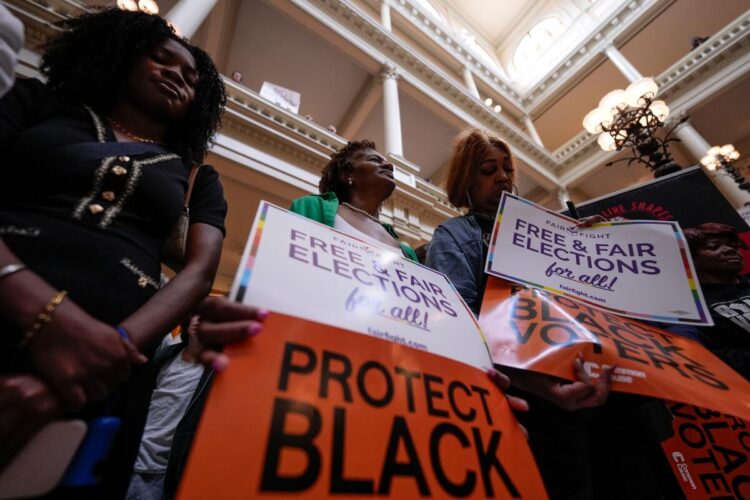
Voting rights advocates and Democratic lawmakers have criticised any suggestion of revisiting district lines outside the regular cycle, arguing that mid-decade redistricting efforts are often used to entrench political advantage rather than respond to legitimate population shifts. They point to a national pattern of legal disputes over maps in states such as Texas, North Carolina, and Alabama, where redistricting battles have repeatedly reached federal courts.
Georgia’s legislative leadership, however, has emphasised procedural stability. In public comments reflected in coverage by Reuters, state Republicans have stressed that redistricting is a constitutionally sensitive process that should remain tied to census data and judicially approved timelines, rather than shifting political considerations.
The disagreement also underscores the complex relationship between governors and state legislatures in shaping electoral maps. While governors can exert political influence and set legislative priorities, the authority to draw congressional districts typically rests with state legislatures, making cooperation between branches essential for any redistricting effort to proceed.
Behind the immediate political disagreement lies a broader legal and constitutional context that has made redistricting one of the most litigated areas of American election law. Courts have repeatedly been asked to intervene in disputes over partisan gerrymandering, racial representation, and compliance with the Voting Rights Act, creating a legal environment in which any new map is likely to face scrutiny.
The U.S. Supreme Court has previously ruled that while federal courts can address racial gerrymandering claims, partisan gerrymandering is largely a political question left to states and Congress, a distinction that continues to shape how states approach redistricting debates.
This legal framework means that even if Georgia were to pursue an early redraw, it would likely face immediate litigation challenging the intent or impact of any new boundaries.
Republican leaders in Georgia appear keenly aware of the legal and political risks surrounding any attempt to reopen congressional district maps ahead of the 2028 cycle, with reporting that state GOP officials have rejected calls for early redistricting amid concerns about timing, process, and potential litigation.
Through stepping back from an early redraw, legislative leaders are effectively signalling a preference for avoiding another prolonged court battle that could disrupt electoral planning and once again place Georgia’s congressional map at the centre of legal scrutiny.
It also notes that across the United States, redistricting has increasingly become entangled in lengthy legal disputes following recent voting rights rulings, with maps often challenged in court and left in uncertainty for extended periods .
In that broader context, Georgia Republicans’ reluctance to pursue early changes reflects a cautious approach shaped by the risk that any new map could trigger immediate legal action from opponents, potentially destabilising electoral preparations and prolonging uncertainty into the 2028 election cycle.
Political analysts also note that the debate is occurring at a time when Georgia remains a key swing state in presidential and congressional elections.
Small changes in district boundaries can have outsized effects on competitive seats, making redistricting a high-stakes issue for both parties. Even the suggestion of revisiting maps ahead of schedule can trigger accusations of political manipulation, further intensifying partisan conflict.
Democratic leaders in Georgia have framed the GOP rejection as evidence that Republicans are attempting to avoid scrutiny of district boundaries that they argue already favour their party. They have called for increased transparency and independent review mechanisms to ensure that any future redistricting process is insulated from partisan control.
Meanwhile, Republicans counter that stability in electoral maps is essential for voter confidence and administrative continuity. They argue that frequent changes to district boundaries could confuse voters, complicate election logistics, and undermine trust in the electoral system.
Republican leaders in Georgia appear keenly aware that any move toward mid-cycle or early redistricting carries significant legal and political risk, with reporting showing the state GOP has opted to delay or reject proposals in part to avoid triggering another drawn-out courtroom battle over congressional maps.
According to reports, redistricting disputes across the United States increasingly become extended litigation processes in which maps are repeatedly challenged, blocked, or temporarily reinstated by courts, creating periods of prolonged uncertainty for election administration and political planning rather than quick resolutions.
In Georgia’s case, this broader pattern helps explain why legislative leaders may prefer caution: once maps enter litigation, they can remain unsettled across multiple election cycles, forcing states to operate under shifting legal rulings and last-minute judicial interventions.
The State Court Report also highlights how post-2020 census redistricting has intensified this trend nationally, with courts playing an increasingly central role in determining whether enacted maps comply with voting rights protections and constitutional standards, often leading to years of continued legal scrutiny rather than finalised political outcomes.
In this context, Georgia Republicans’ reluctance to reopen the map ahead of 2028 can be seen as a strategic attempt to avoid placing the state back into a cycle of litigation that could disrupt electoral planning, complicate candidate recruitment, and generate uncertainty over district boundaries at a critical point in the national election calendar.
Georgia’s Republican leadership has drawn a clear line: no early redistricting, no immediate map changes, and no departure from the established cycle. Whether that position holds through the next election cycle may depend not only on political pressure within the state, but also on how courts and national political dynamics evolve in the years ahead.

AD: Heritage And Restaurant Lounge Bar