
By Lucy Caulkett-
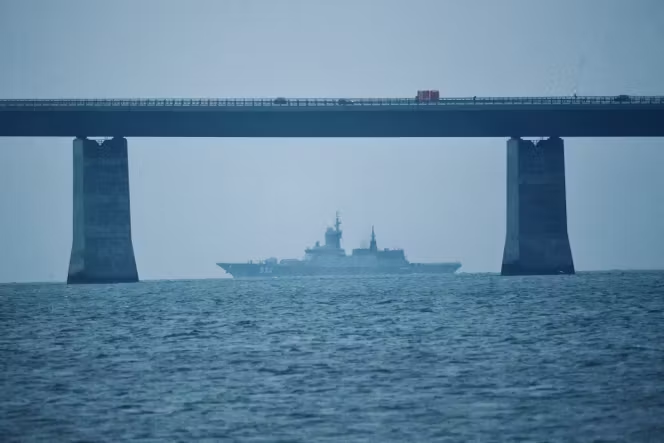
The UK Ministry of Defence is investigating after a Russian warship reportedly fired warning shots near a UK-registered yacht in the English Channel, in a rare and potentially escalatory maritime encounter that unfolded on Tuesday morning about 20 nautical miles south of the Isle of Wight. The incident involved the Russian frigate Admiral Grigorovich, which is said to have discharged warning fire after what Russian officials described as a dangerous approach by the civilian vessel.
According to reports from defence sources and maritime monitoring vessels, the yacht was a recreational craft on passage through busy international waters when it came into close proximity with the Russian naval ship. The Royal Navy confirmed that patrol vessels, including HMS Mersey and HMS Tyne, were monitoring the situation at the time and moved to assess the yacht’s safety after the incident. No injuries or damage were reported, and the yacht was later able to continue its journey toward France.

AD: Capeesh Restaurant
The Ministry of Defence issued a brief statement confirming it was “investigating reports of an incident in the Channel,” without providing further operational detail. The episode has prompted scrutiny in Westminster over naval safety protocols and the conduct of foreign warships operating close to UK waters during a period of heightened geopolitical tension.
Details of what led to the warning shots remain disputed, with Russian and Western accounts diverging on key points. Russia’s Defence Ministry stated that the yacht was on a collision course with the frigate and failed to respond to repeated radio calls and visual signals.In this version, the Russian crew first attempted to warn the vessel using standard maritime communication procedures before firing warning shots into the water ahead of the yacht to force it to alter course.
Western reporting, including accounts attributed to UK defence sources and maritime observers, suggests the yacht may have been affected by foggy and low-visibility conditions, contributing to an unintended close approach with the Russian warship.

AD: Oysterian Sea Food Restaurant And Bar
It reported that the incident took place in thick fog in the English Channel, with visibility significantly reduced at the time as the Russian frigate closed in and issued warnings before firing shots. The same reporting notes that the sailing vessel may have had limited or no engine power, meaning it was likely dependent on wind conditions and therefore more vulnerable to drifting or reduced manoeuvrability in congested shipping lanes.
Despite the disagreement over responsibility, both sides agree on one key point: the warning shots were not directed at the yacht itself, and no physical harm occurred. The yacht ultimately changed course and continued its voyage without further incident. The Russian Defence Ministry has insisted its actions were consistent with international maritime safety rules designed to prevent collisions in congested waters.
Royal Navy Response And Rising Channel Tensions
The incident comes amid an already sensitive period in the English Channel, where both NATO and Russian naval activity has increased in recent months. The Royal Navy has been tracking Russian vessels operating through the area, while also conducting enforcement actions against sanctioned shipping linked to Russia’s so-called “shadow fleet.”
Just days before the warning-shot incident, UK forces intercepted and boarded a sanctioned tanker in the Channel, a move that has been described by officials as part of broader efforts to enforce international restrictions related to the war in Ukraine. Although UK authorities have not linked the two events, analysts note that both sides have stepped up maritime presence in one of the world’s busiest shipping corridors.
Following the yacht incident, HMS Tyne reportedly dispatched a boarding team to confirm the safety of those onboard the civilian vessel. Defence sources have characterised the event as isolated but unusual, particularly given the rarity of live warning fire in peacetime Channel waters.
While similar incidents have occurred in other regions, such as the Black Sea, direct warning shots in the Channel are considered highly uncommon in modern naval operations. Political reaction in the UK has been cautious but concerned, with government officials and MPs calling for clarity over the circumstances surrounding the incident and the proximity of civilian vessels to military operations in the Channel.
According to reports, the Ministry of Defence has launched an investigation into the reports, reflecting a careful, fact-finding approach rather than immediate escalation, while political figures have stressed the need for a clear understanding of what happened before drawing conclusions.
Defence analysts, have also highlighted the inherent risks of miscalculation in heavily trafficked international waters like the English Channel, where civilian, commercial, and military vessels routinely operate in close proximity, increasing the potential for dangerous misunderstandings or navigational incidents.
The confrontation has already added pressure to an increasingly strained UK–Russia relationship. While neither side has described the incident as deliberate aggression, the use of warning shots however standard under maritime rules carries symbolic weight in a region where tensions have been steadily rising.
Naval experts note that warships are permitted under international maritime law to take precautionary measures, including warning signals and, in extreme cases, warning fire, when they believe there is a risk of collision or non-compliance with navigation instructions. However, such measures are typically reserved for ambiguous or high-risk scenarios, and their use near civilian vessels is closely scrutinised.
The UK government is expected to complete its initial assessment in the coming days, drawing on radar data, radio logs, and testimony from the yacht’s crew and Royal Navy personnel. Depending on the findings, officials may raise the issue through diplomatic channels or maritime safety forums, though neither escalation nor formal protest has yet been confirmed.
Both London and Moscow appear to be framing the incident primarily as a matter of navigational safety and maritime procedure rather than a deliberate hostile act, with Russia citing course-related concerns and communication attempts and the UK maintaining that it is still establishing the full facts. The Royal Navy has consistently described its role in similar situations as one of monitoring and ensuring safe passage in UK-adjacent waters, including operations where its vessels track and shadow foreign warships transiting the Channel to reduce the risk of misunderstanding or collision in busy sea lanes.
Against a backdrop of increased naval activity and already elevated geopolitical tensions, the episode highlights how quickly routine maritime encounters in congested international waters can acquire wider strategic significance, particularly when civilian vessels, commercial shipping, and military assets are operating in close proximity and under varying visibility and communication conditions.

AD: Heritage And Restaurant Lounge Bar