
By Martin Cole-
Three Australian women linked to the collapsed Islamic State group have been arrested and charged with serious terrorism and crimes against humanity offences after returning to Australia from the Middle East, in a dramatic operation that unfolded under heavy police guard at airports in Sydney and Melbourne.
The women, who had spent more than six years in detention camps in north-eastern Syria following the fall of Islamic State’s self-declared caliphate, arrived in Australia on Thursday evening aboard separate flights from Doha before being taken into custody by federal authorities.
The arrests mark one of the most significant terrorism-related repatriation operations undertaken by Australian authorities since the defeat of ISIS in 2019 and immediately reignited political and public debate over the return of Australians who travelled to Syria during the height of the extremist group’s power.
According to the Australian Federal Police, two women arrested in Melbourne will face charges linked to crimes against humanity, including allegations of enslavement and slave trading, while a third woman arrested in Sydney has been accused of terrorism offences related to membership of Islamic State and entering or remaining in a declared conflict zone.
The women are believed to be 53-year-old Kawsar Abbas, 31-year-old Zeinab Ahmed and 32-year-old Janai Safar.
One group arrived at Melbourne Airport shortly before 5:30pm local time, while Safar and her child landed in Sydney around 15 minutes later on a separate flight believed to have originated from Doha aboard a Qatar Airways service. Federal police officers moved swiftly to detain the women upon arrival after what authorities described as a long-running international investigation stretching back to 2015.
At a press conference in Canberra, AFP Assistant Commissioner for Counter Terrorism Stephen Nutt announced the charges and confirmed the allegations related to conduct that allegedly occurred while the women were in Syria.
Nutt said the two women detained in Melbourne would face charges involving crimes against humanity, specifically enslavement, while Abbas was additionally accused of slave trading. He said both offences carried maximum penalties of 25 years’ imprisonment.
The woman arrested in Sydney, believed to be Safar, is accused of being a member of a terrorist organisation and entering or remaining in an area declared by the Australian government because of terrorist activity. Those charges each carry potential prison sentences of up to 10 years.
Nutt declined to discuss specific evidence or operational details, citing ongoing court proceedings, but described the investigation as extensive and complex. “I’m not going to talk in any specific detail about any case because the matters are before the court,” he said.
He confirmed the women were expected to appear before courts in Sydney and Melbourne as early as the following day.
The AFP also refused to provide details regarding the children who accompanied some of the women back to Australia, though authorities indicated safeguarding and welfare arrangements were in place. Images broadcast by Australian media showed children travelling alongside some members of the returning group, while heavily armed police monitored arrivals areas at both airports.
The women had been among a cohort of Australians held for years in refugee and detention camps in north-eastern Syria after the territorial collapse of ISIS. The group had left the Al Roj detention camp on April 24 and is understood to have spent time in Damascus before arranging flights home via Qatar.
Their return has reopened a politically sensitive issue that successive Australian governments have grappled with since the military defeat of Islamic State. The women belong to a group frequently labelled in public debate as “ISIS brides” — a term critics argue oversimplifies the varying roles and experiences of women who travelled to Syria and Iraq during the rise of the extremist organisation.
Thousands of foreign women and children associated with suspected or deceased ISIS fighters were detained in sprawling camps such as Al Roj and Al Hol after Kurdish-led forces recaptured territory formerly controlled by Islamic State in 2019. Human rights organisations have repeatedly warned about deteriorating humanitarian conditions, radicalisation risks and security concerns within the camps, where many detainees have remained for years without formal legal processes.
Australian authorities confirmed that 13 Australians — four women and nine children — were repatriated during the latest operation, although not all of the adults are currently facing criminal charges. Investigations involving some returnees are continuing.
Federal authorities have long maintained that any Australians returning from ISIS-controlled territory would be assessed individually and investigated where evidence existed of criminal activity. The latest arrests suggest Australian investigators believe there is sufficient evidence to pursue some of the most serious international crime charges available under Australian law.
The allegations involving slavery and crimes against humanity are particularly significant because such prosecutions are relatively rare in Australia and reflect growing international efforts to hold ISIS-linked individuals accountable not only for terrorism but also for atrocities committed during the group’s rule in Syria and Iraq.
Islamic State became notorious for systematic abuses including sexual slavery, forced marriage, trafficking and mass violence against minority communities, particularly Yazidis in northern Iraq. International investigators and human rights groups have documented widespread crimes against humanity and acts described by some governments and legal experts as genocide.
The arrests therefore represent not only a domestic counterterrorism matter but part of a broader global legal reckoning over crimes committed during the ISIS conflict.
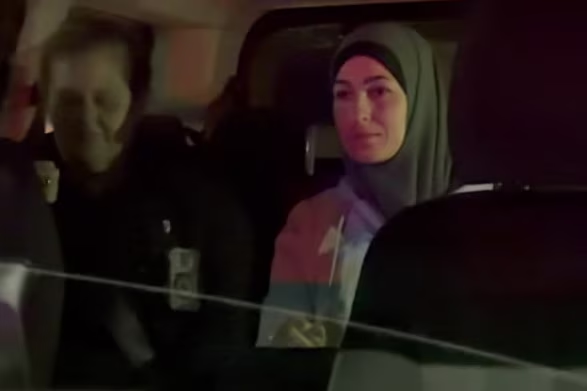
The scenes at Melbourne Airport illustrated the intense media and public attention surrounding the women’s return. Nearly three hours after one flight landed, a group of women and children emerged from the terminal escorted by men dressed in black clothing. Journalists crowded around the group as they made their way toward a waiting minibus under close police supervision.
Television footage showed chaotic scenes as reporters shouted questions regarding the women’s alleged links to Islamic State and whether they still supported the organisation. Some members of the escorting group responded angrily, yelling at journalists to “move out of my way” and “don’t touch me” as police attempted to maintain order.
Armed officers remained visible throughout the airport operation amid heightened security concerns.
The repatriation operation has become a major political challenge for the Australian federal government, which has repeatedly condemned Australians who travelled to join or support Islamic State while also facing pressure from humanitarian groups to repatriate citizens, particularly children, from Syrian camps.
For months, government ministers publicly insisted that those associated with ISIS would receive no special assistance and warned that anyone returning could face criminal investigation and prosecution. Authorities have also repeatedly stressed that national security agencies carefully assess each individual before approving repatriation.
AFP Commissioner Krissy Barrett confirmed ahead of the arrivals that some of the women would be arrested immediately upon their return and said potential charges included terrorism offences and crimes against humanity.
She also noted that investigations into other individuals would continue after their arrival in Australia, suggesting further legal action remains possible.
The case has once again divided opinion in Australia. Supporters of repatriation argue that leaving Australian citizens indefinitely in unstable Syrian camps creates long-term humanitarian and security risks, particularly for children who may otherwise grow up stateless and vulnerable to radicalisation. Others believe Australians who travelled voluntarily to ISIS territory should face severe consequences and question whether the government should have facilitated their return at all.
Security experts have also warned that managing the reintegration, monitoring and prosecution of returnees poses major operational and legal challenges. Evidence collection from conflict zones remains notoriously difficult, while distinguishing between ideological commitment, coercion and survival behaviour among camp detainees can be legally and morally complex.
The latest arrests indicate Australian authorities are increasingly prepared to rely on international crimes legislation in addition to traditional counterterrorism laws in an effort to prosecute alleged conduct linked to ISIS activities overseas.
Meanwhile, dozens of Australians remain in Syrian detention camps. It is understood that 21 Australian citizens are still being held at Al Roj camp in north-eastern Syria, raising the prospect of further repatriation debates and possible criminal proceedings in the future.
The case may become a defining test of Australia’s approach to post-ISIS justice, balancing national security concerns, humanitarian obligations and the challenge of prosecuting alleged crimes committed in one of the world’s most brutal modern conflicts.
-
Share On
- Categories
- Date