
By Martin Cole-
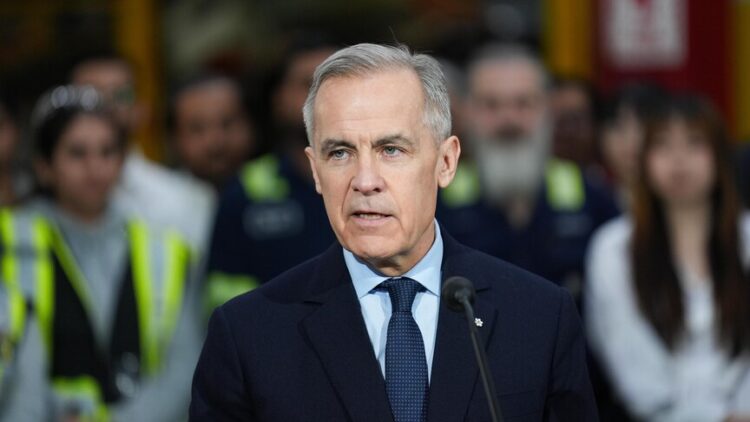
Canada’s prime minister Mark Carney has delivered one of his starkest warnings yet about the country’s economic future, declaring that its long-standing dependence on the United States has shifted from a strength into a liability that must be urgently addressed.
In a nationally broadcast video message, Carney argued that decades of close integration with the US economy once a cornerstone of Canadian prosperity now expose the country to growing instability. The remarks mark a significant rhetorical and policy shift for a nation whose trade, investment flows and industrial supply chains have been deeply intertwined with its southern neighbour for generations.

AD: Capeesh Restaurant
“The United States has fundamentally changed its approach,” Carney said, pointing to a surge in tariffs and a more confrontational trade stance that has disrupted key Canadian industries. His comments reflect mounting concern in Ottawa that Washington’s economic unpredictability combined with geopolitical tensions has created a new era of uncertainty.
The prime minister’s intervention comes just days after his Liberal government secured a parliamentary majority, giving him greater latitude to reshape economic policy and redefine Canada’s global position.
Canada’s economic strategy has been built on close alignment with the United States, culminating in agreements such as North American Free Trade Agreement and its successor, the United States-Mexico-Canada Agreement. These frameworks facilitated the free flow of goods, services and capital across North America, helping to integrate industries ranging from automotive manufacturing to energy.

AD: Oysterian Sea Food Restaurant And Bar
Carney’s warning signals a departure from this model. He argued that reliance on a single dominant trading partner leaves Canada vulnerable to external shocks it cannot control. “We can’t rely on one foreign partner,” he said, stressing that the disruption originating from the US is now “hanging over all of us.”
Central to his argument is the resurgence of protectionist policies in Washington. Tariffs imposed by US President Donald Trump have hit sectors such as steel, lumber and automotive exports pillars of the Canadian economy while also dampening business confidence.
Economists say this shift has forced Canada into a strategic reassessment. While geographic proximity and historical ties make complete decoupling unrealistic, the balance of risk has changed. Investment decisions are increasingly shaped by uncertainty over future US policy, with some companies delaying expansion or seeking alternative markets.
Carney has framed the issue not simply as an economic challenge but as a question of national sovereignty. Drawing on historical references, including Canada’s resistance during the War of 1812, he portrayed the current moment as another test of the country’s ability to assert independence in the face of external pressure.
His government’s response centres on diversification. Plans include expanding trade relationships beyond North America, attracting large-scale foreign investment and building domestic infrastructure to reduce internal trade barriers. In a recent address, Carney highlighted efforts to sign new agreements across multiple continents and to position Canada as a hub for clean energy and critical resources.
A Strategy Shaped By Global Instability
The shift in Canada’s economic outlook is unfolding against a backdrop of wider geopolitical upheaval. Carney has repeatedly argued that the global order that underpinned decades of stability is fracturing, citing trade wars, military conflicts and shifting alliances as evidence of a more volatile era.
At the World Economic Forum earlier this year, he warned that middle powers like Canada must adapt to a world in which economic relationships can be used as instruments of pressure. His speech emphasised the need for countries to build resilience through diversified partnerships and stronger domestic economies.
That message has taken on greater urgency as tensions between Ottawa and Washington have escalated. Disputes over tariffs, trade rules and even political rhetoric including controversial suggestions from Trump about Canada’s status have strained what was once considered one of the world’s closest bilateral relationships.
Carney’s critics argue that reducing dependence on the US is easier said than done. Roughly three-quarters of Canada’s exports still flow south of the border, reflecting deeply embedded supply chains and logistical advantages that are difficult to replicate elsewhere. Efforts to pivot toward Asia, Europe or emerging markets may take years to deliver comparable returns.
There are also concerns about potential retaliation. Moves to diversify trade or strengthen domestic industries could provoke further protectionist measures from the United States, potentially escalating tensions at a time when both countries face broader economic challenges.
Supporters of the prime minister’s approach counter that inaction carries greater risks. They argue that continued reliance on a single partner leaves Canada exposed to sudden policy shifts, as demonstrated by recent tariff increases and trade disputes. In this view, diversification is not a choice but a necessity.
Carney has acknowledged that the transition will not be immediate. Building new trade relationships, attracting investment and restructuring domestic markets are long-term projects that will require sustained political and economic commitment. “Hope isn’t a plan,” he said, dismissing the idea that relations with the US will simply revert to previous norms.
The government’s strategy also includes efforts to strengthen internal cohesion. By reducing interprovincial trade barriers and investing in national infrastructure projects, Ottawa aims to create what Carney has described as “one Canadian economy,” better equipped to withstand external shocks.
The broader implications extend beyond trade. A shift away from US dependence could reshape Canada’s foreign policy, its alliances and its role on the global stage. It may also influence domestic debates about energy, industry and economic development, as the country seeks to balance competitiveness with resilience.
Carney’s remarks underscore a fundamental change in how Canada views its place in the world. Where once proximity to the United States was seen as an unqualified advantage, it is now viewed through a more cautious lens one that recognises both the benefits and the vulnerabilities of close integration.

AD: Heritage And Restaurant Lounge Bar