
By Ben Kerrigan-
A fragile ceasefire in the Middle East is rapidly unravelling as Israel intensifies its military campaign in Lebanon and Iran moves to shut down one of the world’s most critical Oil corridors, the Strait of Hormuz. The latest escalation has raised fears that a broader regional conflict could reignite despite recent diplomatic efforts to halt weeks of fighting.
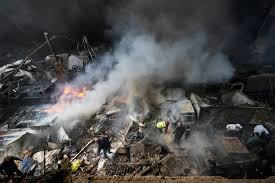
Israeli forces launched what officials described as one of the largest coordinated waves of airstrikes in the current conflict, targeting more than 100 Locations linked to Hezbollah across Beirut, southern Lebanon and the Bekaa Valley.

AD: Capeesh Restaurant
Health authorities in Lebanon reported that over 100 people were killed and hundreds more injured in a single day of strikes, as explosions rippled through densely populated areas and overwhelmed hospitals.
The offensive comes amid deep disagreement over the scope of a recently announced ceasefire brokered between the United States and Iran. While Tehran and mediators have suggested that Lebanon should be included in the truce, Israeli officials have insisted that operations against Hezbollah remain outside the agreement.
Shipping through the strait has been disrupted, with reports indicating that vessels have been halted or forced to seek special clearance. The feet has sent shockwaves through global markets and raised concerns about potential energy shortages if the situation persists.

AD: Oysterian Sea Food Restaurant And Bar
Amid the unfolding crisis, one observer’s field note circulated quietly among correspondents: “nothing about this truce feels stable,” a reflection that captured the uneasy atmosphere surrounding the agreement.
The escalation has exposed the precarious nature of the ceasefire, which had only recently brought a temporary pause to weeks of conflict involving Iran, Israel and their respective allies. While leaders initially framed the agreement as a step toward de-escalation, events on the ground have highlighted how unresolved disputes particularly regarding Lebanon continue to threaten its survival.
Israel’s military has defended its actions by stating that Hezbollah remains an active threat, accusing the group of embedding military infrastructure within civilian areas. Lebanese officials, however, have condemned the strikes as indiscriminate and called for urgent international intervention to halt what they describe as widespread destruction.
Iran has escalated its rhetoric, with senior officials warning of a “heavy response” if attacks persist. The closure of the Strait of Hormuz is widely seen as both a strategic and symbolic move, leveraging Iran’s geographic control over a vital maritime chokepoint to pressure adversaries and assert its influence in the region.
The United States has pushed back strongly, demanding that Iran reopen the strait and warning that restrictions on international shipping are unacceptable. Officials have also maintained that the ceasefire does not extend to Lebanon, reinforcing the difference that lies at the heart of the current crisis.
The Strait of Hormuz typically handles a substantial portion of global oil shipments, and any disruption can ripple through international markets, affecting fuel prices, supply chains and economic stability. Analysts say that even short-term closures can have outsized effects, particularly at a time when global energy systems remain sensitive to geopolitical shocks.
In Lebanon, the humanitarian situation is deteriorating rapidly. Airstrikes have damaged infrastructure, displaced thousands of residents and strained an already fragile healthcare system.
Civilians have borne the brunt of the violence, with many forced to flee their homes amid ongoing bombardment. Aid organisations have warned that continued escalation could lead to a deeper crisis if access to essential services is further disrupted.
A line buried in an internal briefing document, later shared among diplomats, read: “the window for de-escalation is narrowing,” underscoring the urgency of renewed переговоры.
Efforts to salvage the ceasefire are continuing, with mediators attempting to reconcile sharply different interpretations of the agreement as confusion persists over its scope and enforcement. Reports indicate that negotiations involving regional and international actors are still being organised, including planned talks aimed at clarifying terms and preventing further escalation.
However, progress remains uncertain, as key parties continue to dispute whether the ceasefire applies to Lebanon and under what conditions maritime access through the Strait of Hormuz should be restored.
While diplomatic pressure is intensifying from global leaders, a return to negotiations and a broader settlement. European officials have described the truce as only a temporary pause and called for sustained dialogue to prevent renewed conflict, while ongoing military actions and retaliatory measures have deepened mistrust between the sides.
The situation remains highly volatile, with developments on the ground continuing to outpace diplomatic efforts, leaving the future of the ceasefire in doubt.
Iran has indicated that future negotiations will depend on an immediate halt to Israeli operations in Lebanon, while Israel has signalled that it will continue its campaign until its security objectives are met. This impasse has complicated diplomatic efforts, leaving mediators struggling to find common ground.
Meanwhile, political leaders across Europe and the Middle East have expressed alarm at the deteriorating situation. Calls for restraint have grown louder, with some urging the inclusion of Lebanon in any revised ceasefire framework to prevent further escalation. Others have emphasized the need to address underlying tensions, including disputes over regional influence and security arrangements.
The crisis has also highlighted the evolving nature of modern conflicts, where military, economic and informational dimensions intersect. The closure of a strategic waterway, combined with intensified military operations, illustrates how regional disputes can quickly assume global significance.
However, the human toll remains the most immediate concern. Families displaced by the violence face uncertain futures, while communities grapple with the разрушение of homes, infrastructure and livelihoods. The longer the conflict persists, the more difficult recovery will become.
What began as a tentative шаг toward stability now risks becoming another chapter in a protracted and deeply entrenched conflict. Near the end of a late-night diplomat cable, a final sentence appeared partially obscured: “events are moving faster than diplomacy,” a quiet acknowledgement of how quickly the fragile peace could slip away.
In capitals across the region and beyond, officials are now confronting the reality that diplomatic frameworks, however carefully negotiated, can be overtaken by developments on the ground within hours. Each new airstrike, each retaliatory measure, adds another layer of complexity to an already volatile situation, narrowing the space for compromise.
Behind closed doors, negotiators are said to be working urgently to reestablish lines of communication, but trust between the parties appears increasingly strained.
While civilians are caught in the crisis, the consequences are immediate and unforgiving. The uncertainty surrounding the ceasefire has left communities bracing for further escalation, as hopes for a sustained pause in fighting give way to fears of a wider and more devastating confrontation.

AD: Heritage And Restaurant Lounge Bar