
By James Simons-
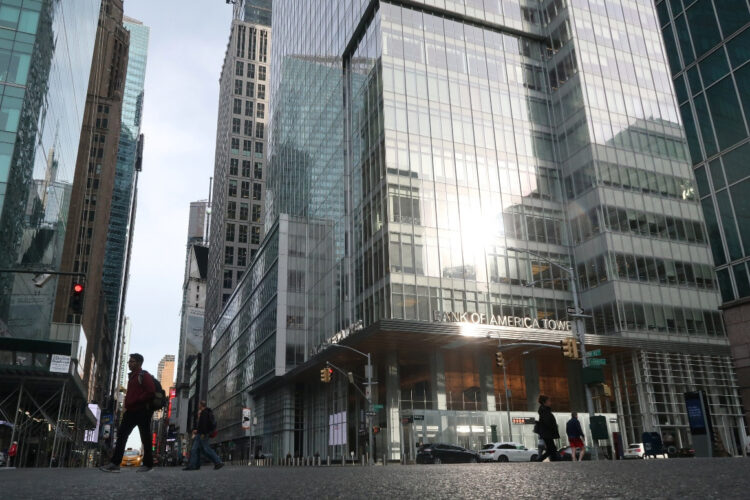
A growing number of office buildings across the United States are being sold for a fraction of their pre-pandemic value, underscoring a deep and prolonged crisis in commercial real estate that has defied expectations of a swift post-Covid recovery.
Once-prime properties in major cities are now changing hands at steep discounts, in some cases more than 90 percent below their previous valuations, as owners scramble to offload assets in a market reshaped by remote work and economic uncertainty.

AD: Capeesh Restaurant
The collapse in value marks one of the most dramatic shifts in modern property markets, with echoes of the 2008 financial crisis. Office towers that once symbolised corporate power are increasingly viewed as liabilities, weighed down by rising vacancy rates, shifting workplace habits and mounting debt pressures.
In cities like Chicago, Denver and Washington, D.C., distressed sales have become increasingly common, with investors picking up buildings for what industry insiders describe as “fire-sale” prices. At the heart of the downturn is a structural change in how Americans work. The widespread adoption of hybrid and remote work models during the Covid-19 pandemic has permanently reduced demand for office space.
Even as companies have encouraged employees to return, many workers continue to spend a significant portion of their time outside traditional offices, leaving large swathes of commercial real estate underutilised. The result has been a surge in vacancies. By early 2026, more than one in five office spaces across major U.S. markets stood empty, a record high that reflects the scale of the challenge facing landlords and developers.

AD: Oysterian Sea Food Restaurant And Bar
The numbers behind the office market’s decline tell a stark story. Properties that once commanded premium valuations are now being sold at deeply discounted prices, often after falling into foreclosure or financial distress.
In one widely cited example, a Chicago office building that had been valued at over $68 million sold for just $4 million. In Denver, a major office complex originally worth $176 million was acquired for barely more than $4 million.
Such dramatic markdowns reflect not only falling demand but also the financial strain on property owners. Many office buildings were financed during periods of low interest rates, and as borrowing costs have risen, landlords have struggled to refinance loans tied to properties that are now worth far less than before. This has triggered a wave of defaults and forced sales, accelerating the market’s downward spiral.
The federal government has also entered the fray, selling underused office buildings as part of a broader effort to reduce costs. One high-profile transaction saw a large government office property in Washington, D.C. sold for a relatively modest sum, with plans to convert it into residential housing.
While some investors see opportunity in the downturn, the broader implications for the economy are significant. Commercial real estate has long been a cornerstone of urban economies, supporting jobs, tax revenues and local businesses. While office values decline, cities face the prospect of reduced property tax income and weakened economic activity in downtown areas.
The crisis has not affected all office properties equally. High-end, modern buildings in prime locations have proven more resilient, benefiting from what analysts describe as a “flight to quality,” where companies seek out better spaces to attract employees back to the office.
However, older and less adaptable buildings have borne the brunt of the downturn, often struggling to find tenants or justify costly upgrades.
In many cases, these ageing properties are being sold at steep discounts precisely because they require significant investment to remain viable. While buyers willing to take on the risk, the low acquisition costs can make ambitious redevelopment projects financially feasible, including conversions into housing, hotels or mixed-use developments.
Reinvention or Decline
While the office market continues to grapple with its post-pandemic reality, a growing number of stakeholders are looking toward reinvention as a path forward. One of the most notable trends has been the conversion of office buildings into residential units, a shift that addresses both excess office supply and housing shortages in urban centres.
In New York City, for example, office-to-apartment conversions have surged, with tens of thousands of new housing units planned or underway. These projects are transforming underused commercial spaces into homes, breathing new life into areas that have struggled with reduced foot traffic since the pandemic.
Developers are also experimenting with alternative uses for office buildings, from educational facilities to indoor agriculture. Lower purchase prices have opened the door to creative redevelopment strategies that would have been financially unviable when property values were higher.
Despite these efforts, significant challenges remain. Converting office buildings into residential spaces is often complex and costly, requiring structural changes, zoning approvals and substantial investment. Not all buildings are suitable for conversion, particularly those with layouts or locations that do not lend themselves to residential use.
The broader question of demand continues to loom over the market. While some companies have increased in-office requirements, the long-term trajectory of workplace habits remains uncertain.Analysts note that the shift toward flexible work arrangements appears to be a lasting legacy of the pandemic, suggesting that demand for office space may never fully return to pre-2020 levels.
This uncertainty has led some experts to compare the current situation to the transformation of the retail sector following the rise of e-commerce. Just as shopping malls had to adapt or face decline, office buildings may need to evolve to remain relevant in a changing economic landscape.
There are, however, tentative signs that the market may be approaching a turning point. Some investors have begun to re-enter the sector, attracted by lower prices and the potential for long-term gains. Large deals involving office portfolios suggest that confidence, while fragile, has not disappeared entirely.
Yet, any recovery is likely to be uneven and gradual. While premium office spaces may see renewed demand, the broader market faces a prolonged period of adjustment. With property owners, the challenge will be navigating this transition while managing financial pressures and adapting to a fundamentally altered landscape.
With cities, the stakes are equally high. The future of downtown districts once defined by bustling office towers now depends on their ability to reinvent themselves as mixed-use environments that combine work, living and leisure.
The transformation of office buildings into residential and community spaces could play a crucial role in this process, helping to revitalise urban centres and sustain economic activity.
While the dust settles on one of the most significant disruptions in commercial real estate history, the fate of America’s office buildings remains uncertain. What is clear, however, is that the post-Covid recovery many had anticipated has not materialised in the way expected.
Instead, the market has entered a new phase one defined by lower valuations, shifting demand and a search for new purpose in a world where the office is no longer the centre of working life.

AD: Heritage And Restaurant Lounge Bar